PART 3
The wagon bells sounded again, faint but unmistakable beneath the winter wind.
Daniel Mercer lifted his head.
For a moment, he wondered whether exhaustion had finally begun playing tricks on him. He had spent the night fighting a blizzard, pulling cattle through deep snow, and watching the roof of his barn collapse.
Now he sat beside Clara Bennett, staring at the remains of a building his father had raised forty years earlier.
But the bells came again.
Clara stood.
“Someone's coming.”
Daniel rose slowly and followed her into the yard.
Through the thinning snowfall appeared two wagons pulled by exhausted horses. Nathan Price, the supply contractor who had betrayed their agreement, rode beside the first wagon with his hat pulled low.
Caleb Turner emerged from the bunkhouse.
“Well, I'll be damned.”
Nathan climbed down, looking as though he hadn't slept in days.
“Mr. Mercer.”
Daniel said nothing.
Nathan glanced toward the ruined barn.
“I heard the storm caught you badly.”
“You heard correctly.”
The contractor swallowed.
“I couldn't recover everything I sold. But I brought flour, beans, salt pork, and some grain. Enough to get you through another few weeks.”
Daniel looked at the wagons.
“Why?”
Nathan removed his hat.
“Because I knew what I'd done.”
He looked toward the farmhouse, where smoke rose from the chimney.
“I made money on that shipment. Then I heard the roads were closing and remembered you had men depending on it.”
Caleb folded his arms.
“Feeling guilty doesn't bring back the cattle.”
“No,” Nathan admitted. “It doesn't.”
He reached into his coat and produced a folded paper.
“I've written down everything I owe. I'll work off the difference if you'll allow it.”
Daniel studied him.
The old Daniel might have sent the man away.
The man who had once ordered Samuel through a storm because a shipment mattered more than caution would have called forgiveness weakness.
But the blizzard had taught him something he wished he had understood years earlier.
A man could make a terrible mistake and still be given the chance to do better.
“Start unloading,” Daniel said.
Nathan looked up.
“You mean that?”
“You'll work until the debt is settled. Caleb will keep the accounts.”
Caleb grunted.
“And I'll be watching every sack.”
For the first time that morning, Clara smiled.
Ellie slept for nearly sixteen hours.
Clara sat beside her bed through most of them, changing the warm cloths around her daughter's hands and checking her breathing.
The little girl had suffered from the cold, but by the following afternoon her cheeks had regained their color.
When she finally opened her eyes, Clara leaned forward.
“Hello, sweetheart.”
Ellie blinked.
“Did the calf live?”
Clara closed her eyes briefly.
Of course that would be her first question.
“Yes,” she whispered. “The calf lived.”
Ellie smiled.
“Good.”
Clara brushed the hair from her forehead.
“But you frightened me terribly.”
“I know.”
“Why did you go outside alone?”
Ellie looked toward the window.
“Caleb said the little calf might not survive. And I thought…”
Her voice faded.
“What did you think?”
Ellie's eyes filled with tears.
“I thought if I saved him, maybe nobody else would have to be sad.”
Clara's heart twisted.
She gathered her daughter into her arms.
“Oh, my darling girl.”
For fourteen months, Clara had tried to protect Ellie from every reminder of her father's death. She had hidden her tears, swallowed her fears, and smiled when there was nothing left to smile about.
But children noticed more than adults believed.
“You are not responsible for keeping everyone happy,” Clara whispered. “And you must never risk your life because you're afraid someone will be sad.”
Ellie buried her face against her mother's shoulder.
“Are you still sad about Papa?”
Clara held her tighter.
“Sometimes. I think I always will be, a little.”
“Even here?”
“Even here.”
Ellie was quiet.
Then she asked, “Can you be sad about Papa and happy with Mr. Mercer?”
Clara's breath caught.
She had no answer ready.
But she knew the truth.
“Yes,” she whispered. “I believe I can.”
The weeks that followed were difficult.
The blizzard had taken thirty-seven cattle, damaged the south fencing, and destroyed half the barn.
Daniel spent long hours repairing what could be saved. Caleb organized the men into work crews. Nathan Price hauled lumber and feed until his hands were raw.
And Clara kept the ranch alive from the kitchen.
She reduced waste, stretched every sack of flour, and negotiated small exchanges with neighboring families when the roads briefly opened.
She also made certain nobody went to bed hungry.
One evening, Daniel entered the kitchen to find Clara kneading bread.
Her sleeves were rolled to her elbows. Flour dusted her apron, and a loose strand of dark hair had escaped its pins.
She looked tired.
Beautifully, stubbornly tired.
“Clara.”
She glanced up.
“Yes?”
“You've been working since before sunrise.”
“So have you.”
“I can stop.”
“Then perhaps you should.”
He smiled.
She returned her attention to the dough.
Daniel remained in the doorway.
“What?” she asked.
“Nothing.”
“Daniel Mercer, you've been standing there for nearly a minute.”
He stepped closer.
“I was wondering whether anyone has told you how much you've changed this place.”
Clara gave a small laugh.
“The men have mentioned the biscuits.”
“I'm not talking about biscuits.”
She looked up.
Daniel rested his hands on the table.
“Before you came, this house was somewhere I slept. I ate because I had to. I worked because there was nothing else to do.”
Clara's expression softened.
“And now?”
“Now I find myself looking forward to supper.”
She smiled.
“Because of the gravy?”
“Because you're here.”
Her hands stopped moving.
For a moment, the kitchen seemed very quiet.
Daniel wanted to reach across the table.
He wanted to tell her that he had begun measuring his days by the sound of her footsteps, that Ellie's laughter had become the sweetest sound in the world, and that he dreaded the coming spring because she had promised to stay only until then.
Instead, he said, “You deserve more than what I can offer right now.”
Clara lowered her eyes.
“Perhaps you should let me decide what I deserve.”
He looked at her.
Then Ellie burst into the kitchen carrying a wooden horse Caleb had carved.
“Mama! Look what Mr. Turner made!”
The moment passed.
But neither adult forgot it.
By February, Clara had begun noticing something else.
Daniel never sat in the wooden chair beside the stove.
The chair had belonged to Samuel.
Its cracked seat had been repaired with careful wooden braces, but Daniel continued avoiding it.
One evening, Clara found him standing beside the chair with a small tin box in his hands.
“Samuel kept his letters in here,” he said.
Clara approached quietly.
“Would you like me to leave?”
“No.”
He opened the box.
Inside were a few photographs, a pocketknife, and a folded letter.
Daniel held the letter for a long time.
“He wrote this before his last journey.”
Clara waited.
“I never opened it.”
“Why?”
“Because I knew what it would say.”
She looked at him gently.
“Do you?”
Daniel's jaw tightened.
“I sent him through that pass. The weather was turning, and he warned me. But the shipment had to reach town.”
He swallowed.
“I told him he could manage it.”
Clara rested a hand on the table.
“Daniel…”
“He trusted me.”
His voice broke.
“And I buried him because of it.”
For a long moment, Clara said nothing.
Then she moved closer.
“You made a decision you regret. But you have been punishing yourself for two years without knowing what Samuel wanted you to remember.”
Daniel looked down at the letter.
His fingers trembled as he unfolded it.
The handwriting was hurried but familiar.
Samuel had written about the ranch, the horses, and the plans he hoped to make when spring arrived.
Near the end was a sentence that made Daniel close his eyes.
Don't spend your whole life working so hard that you forget to live it.
Daniel read it twice.
Then he sat down in Samuel's chair.
Clara knelt beside him.
He covered his face with one hand.
And for the first time since his brother's funeral, Daniel allowed himself to cry.
Clara did not tell him to be strong.
She did not tell him that everything happened for a reason.
She simply stayed beside him until the tears passed.
When he finally looked at her, his voice was barely audible.
“Why are you so kind to me?”
Clara smiled sadly.
“Because I know what it feels like to believe you should have done more for someone you loved.”
He reached for her hand.
This time, neither pulled away.
March brought a few warmer afternoons, but the nights remained bitter.
Ellie began attending lessons with the children of neighboring ranchers whenever the roads were passable.
Caleb taught her how to identify animal tracks.
Nathan Price repaired the damaged storage shed before finally clearing his debt.
And Daniel began sitting at the kitchen table every evening.
Sometimes he helped Ellie with arithmetic.
Sometimes he listened while Clara read aloud.
Sometimes he simply sat beside them, content to be included.
One night, Ellie fell asleep with her head resting on Daniel's arm.
Clara looked up from her sewing.
“You can put her to bed.”
Daniel glanced at the sleeping child.
“I don't want to wake her.”
“She sleeps like a stone.”
He smiled.
“She's grown fond of this place.”
“She has.”
“And you?”
Clara's needle stopped.
“I've grown fond of it too.”
Daniel looked toward the fire.
“Spring will be here soon.”
“Yes.”
“You'll have enough wages saved to make another start.”
Clara folded her sewing.
“That's true.”
He nodded slowly.
She waited for him to say more.
But he remained silent.
Finally, she asked, “Is there something you want to tell me, Daniel?”
He looked at her.
There were a hundred things.
He wanted to ask her to stay.
He wanted to tell her that her full, warm presence had made his house feel alive again, that he loved the strength in her hands and the tenderness in her voice, that every part of her seemed more beautiful to him the longer he knew her.
But he remembered the humiliation she had endured in town.
He remembered how fiercely she protected her independence.
And he feared that asking her to stay would make her feel obligated.
So he said only, “Whatever you decide, I'll make certain you're paid everything you're owed.”
Clara's expression changed.
“Of course.”
She gathered her sewing.
“Good night, Daniel.”
He watched her leave.
And understood, too late, that silence could wound as deeply as careless words.
April arrived with thawing streams and the first green grass along the creek.
The Mercer ranch had survived.
Its herd was smaller, its savings nearly gone, and the repaired barn looked different from the one Daniel remembered.
But the men were healthy.
The cattle that remained were strong.
And the house was filled with laughter.
Clara considered that a victory.
Daniel was still learning to see it that way.
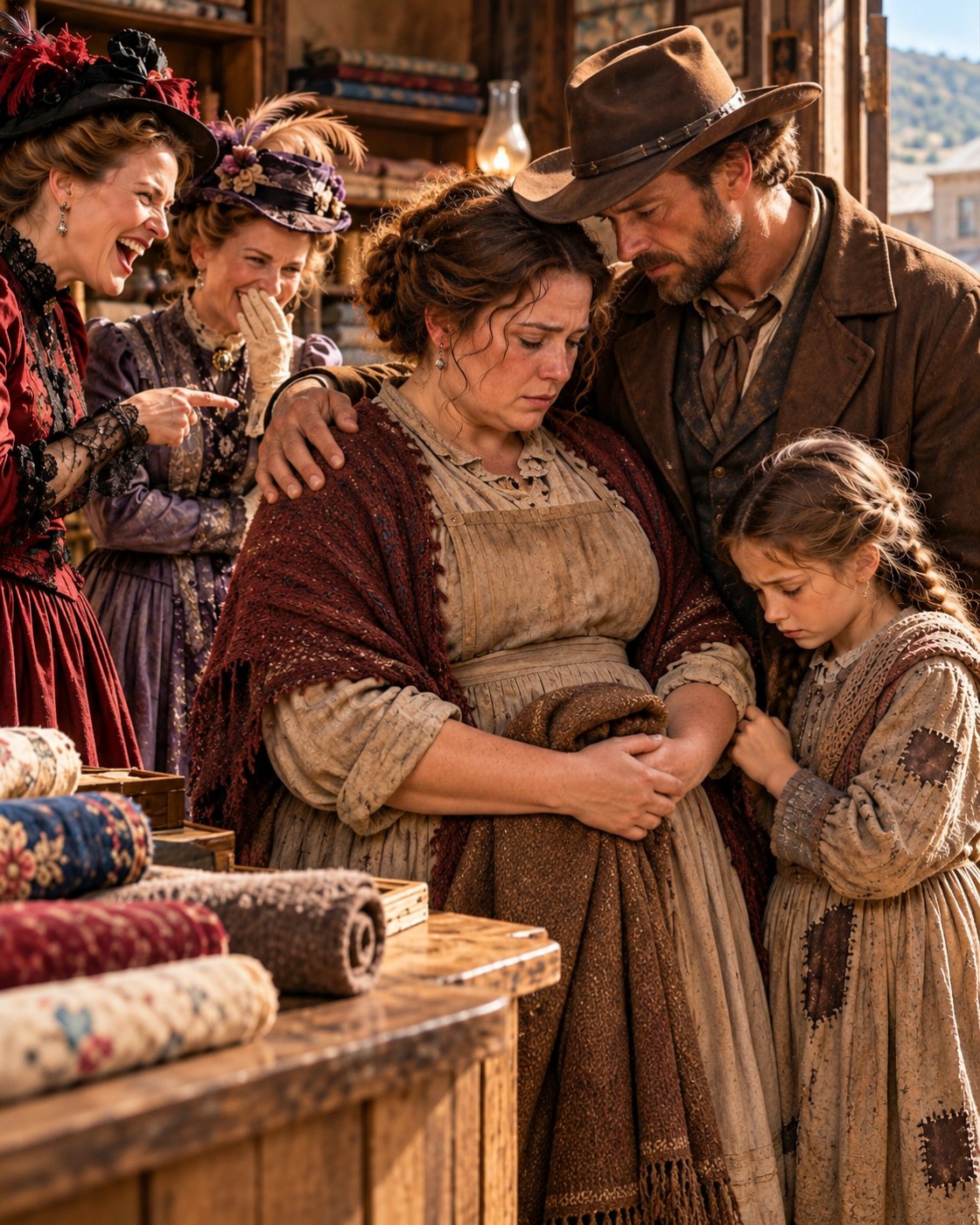
One afternoon, Mrs. Whitcomb arrived from town carrying a roll of dark blue wool.
Clara met her on the porch.
“Mrs. Bennett,” the shopkeeper began awkwardly, “I heard what happened during the winter.”
Clara waited.
“I heard you kept the men fed. And that your little girl nearly froze.”
“Yes, ma'am.”
Mrs. Whitcomb looked down at the fabric.
“I wasn't kind to you when you came into my store.”
“No,” Clara answered. “You weren't.”
The older woman flushed.
“I thought perhaps your daughter could use a new coat.”
Clara examined the wool.
It was beautiful.
Thick, warm, and precisely the shade Ellie loved.
“How much?”
Mrs. Whitcomb hesitated.
“I meant it as a gift.”
Clara smiled politely.
“I appreciate the thought. But I'd rather buy it.”
The shopkeeper studied her.
Then she nodded.
She named a fair price.
Clara paid with money she had earned.
There was no grand embrace.
Only an apology accepted without requiring Clara to surrender her dignity.
That evening, she began sewing.
She lined Ellie's new coat with pieces of an old wool jacket that had belonged to her father.
When Ellie discovered the familiar cloth, she touched it gently.
“Papa's jacket.”
Clara nodded.
“Part of it.”
“Doesn't cutting it make you sad?”
“A little.”
“Then why did you?”
Clara kissed her forehead.
“Because your father would have wanted it to keep you warm.”
Ellie slipped into the coat and spun around the kitchen.
Daniel watched from the doorway.
And something inside him finally became clear.
Love did not require the past to disappear.
Sometimes love meant allowing what remained to become something new.
A week later, Clara placed her completed accounts on Daniel's desk.
He looked up.
“What's this?”
“My final winter inventory.”
Daniel's chest tightened.
“Final?”
“The roads are open again.”
He set down his pen.
“I see.”
Clara stood very still.
She had spent the entire morning wondering whether he would ask her to stay.
Instead, he opened a drawer and removed a document.
“I've prepared an offer.”
She took it.
The paper outlined permanent employment managing the ranch kitchen and supplies, with higher wages, purchasing authority, and a private room for herself and Ellie.
Clara read it carefully.
Then she looked up.
“You're offering me a permanent position?”
“Yes.”
“And if I refuse?”
“I'll pay everything I owe you and help you find another place.”
She studied his face.
“Is that all you want to say?”
Daniel stood.
“No.”
The word came out more firmly than he expected.
He walked around the desk.
“I want you to stay, Clara.”
Her breath caught.
“Because the ranch needs a cook?”
“No.”
“Because Ellie needs a home?”
“That's part of it. But no.”
He stopped in front of her.
“I want you here because I love you.”
Clara stared at him.
Daniel took a slow breath.
“I love the way you speak your mind. I love the way you make every man in this house feel worth feeding. I love that you never mistake kindness for weakness.”
His voice softened.
“And I love the way you look at Ellie as though she's the finest thing God ever made.”
Tears filled Clara's eyes.
“Daniel…”
“I know I have little to offer you right now. The ranch is struggling, and I can't promise an easy future.”
She shook her head.
“I never asked for easy.”
“I know.”
He reached for her hand.
“I can promise honesty. I can promise that your work will be respected. And I can promise I'll never make you feel you have to earn your place at my table.”
Clara looked down at their joined hands.
For fourteen months, she had lived as though every kindness came with a price.
Every roof could be taken away.
Every meal could become a debt.
Every person who offered help might someday remind her how little she possessed.
But Daniel was offering something different.
A choice.
And he was leaving that choice entirely in her hands.
“I've been afraid,” she whispered.
“So have I.”
“I don't look like the women men usually dream about marrying.”
Daniel's expression softened.
“Clara, when I look at you, I see the woman who brought warmth back into my house. I see strength, beauty, and a heart large enough to make room for people who've forgotten how to hope.”
He gently touched her cheek.
“And I have never wanted anyone more.”
Clara began to cry.
Daniel drew back slightly.
“Have I said something wrong?”
She laughed through her tears.
“No, you foolish man.”
“Then what?”
She stepped closer.
“I love you too.”
For a moment, he simply stared.
Then he smiled.
It was a smile Clara had never seen before, open and unguarded, as though some locked door inside him had finally swung wide.
He bent toward her.
She rose to meet him.
Their first kiss was gentle, uncertain, and full of all the things neither had dared say during the long winter.
When they finally separated, Daniel rested his forehead against hers.
“Will you stay?”
Clara smiled.
“Yes.”
He kissed her again.
“But,” she added, “I intend to keep managing those accounts.”
Daniel laughed.
“I wouldn't dare take them away from you.”
They did not marry immediately.
Clara wanted Ellie to have time to understand what was changing.
Daniel agreed.
One evening, they sat with the little girl at the kitchen table.
“Ellie,” Clara began, “Mr. Mercer and I have something to tell you.”
Ellie looked between them.
“Are we leaving?”
Clara's heart tightened.
“No, sweetheart.”
“Then what?”
Daniel reached across the table.
“Your mother and I care for each other very much.”
Ellie considered this.
“Like married people?”
Clara smiled.
“Something like that.”
The child looked at Daniel.
“Are you going to marry Mama?”
“If she'll have me.”
Ellie turned to her mother.
“Will you?”
Clara laughed.
“I think I might.”
Ellie sat quietly for a moment.
Then she asked the question that mattered most.
“Will we still talk about Papa?”
Daniel's smile softened.
“Whenever you want.”
“And can I keep his jacket?”
“Of course.”
“And will you still help me with arithmetic?”
Daniel pretended to consider.
“Even the difficult sums.”
Ellie grinned.
“Then I think it's a very good idea.”
She climbed into his lap and wrapped her arms around his neck.
Daniel held her carefully.
And Clara watched the two people she loved most in the world discover that they had room in their hearts for one another.
They married in June.
The ceremony took place beneath the cottonwood trees near the farmhouse.
Clara wore a simple cream-colored dress that she had sewn herself, shaped to flatter her full figure and finished with delicate lace at the sleeves.
Ellie carried wildflowers.
Caleb stood beside Daniel, looking uncomfortable in a clean shirt.
Nathan Price attended with his wife and brought a basket of preserves.
Even Mrs. Whitcomb came, carrying a small wrapped parcel.
Inside was a pair of warm gloves for Ellie.
The ceremony was quiet.
There were no grand speeches.
Only two people who had survived grief, poverty, and a terrible winter, promising to face whatever came next together.
When Daniel slipped the ring onto Clara's finger, his hands trembled.
She smiled.
“Are you nervous?”
“Terrified.”
“Of marrying me?”
“Of being this happy.”
Clara squeezed his hand.
“Then we'll learn together.”
He kissed her while the ranch hands cheered and Ellie threw her flowers into the air.
That evening, after the guests had gone, Clara found Daniel standing beside Samuel's old chair.
He had moved it back to the kitchen table.
“There's room for another chair,” she said.
Daniel smiled.
“I know.”
She slipped her arm around his waist.
“Do you miss him?”
“Every day.”
“So do I,” she whispered, thinking of her first husband.
Daniel kissed the top of her head.
“I think they'd be glad we're happy.”
Clara looked toward the doorway.
Ellie's new blue coat hung beside Daniel's heavy ranch coat and Clara's brown wool cloak.
Three coats.
Three people.
One home.
Years later, when Ellie was grown, she would remember that first Wyoming winter more clearly than any other.
She would remember the snow piled against the windows.
The frightened calf in the barn.
Her mother's strong arms lifting her from the cold.
And Daniel Mercer standing in the doorway, holding a lantern, refusing to leave anyone behind.
She would also remember the little things.
Fresh biscuits at sunrise.
Caleb complaining about washing dishes.
Daniel helping with arithmetic.
And the sound of her mother laughing again.
The Mercer ranch never became the richest in Wyoming.
There were lean years and good years, calves born healthy and crops ruined by weather.
But no ranch hand was ever turned away hungry when there was food to share.
No child was made to feel ashamed for needing warmth.
And no one in that house was ever required to prove they deserved a place at the table.
Every winter, when the first snow began falling, Daniel would bring in extra firewood and make certain the kitchen stove burned brightly.
Clara would check the pantry, close her ledger, and put another loaf of bread into the oven.
And Ellie, even after she was grown, would return home whenever she could.
One December evening, many years after the blizzard, Daniel found Clara standing beside the kitchen window.
Snow drifted across the pasture.
He approached quietly and wrapped his arms around her.
“Cold, Mrs. Mercer?”
She leaned back against him.
“Not anymore.”
He kissed her cheek.
“Do you remember the day you came looking for work?”
“Of course.”
“You told me you wanted wages, a room, and nothing more.”
Clara smiled.
“I was a very practical woman.”
“You still are.”
“And you were a terribly lonely man.”
“I was.”
She turned in his arms.
“Are you still lonely, Daniel?”
He looked toward the table, where three generations of their family would gather for Christmas supper the following day.
Then he looked at his wife.
“No,” he whispered. “Not for a single day since you decided to stay.”
Clara kissed him.
Outside, the Wyoming wind swept across the darkening fields.
Inside, the fire burned steadily.
And on the hook beside the kitchen door hung an old blue wool coat, carefully preserved long after Ellie had outgrown it.
A reminder of the winter when a widow arrived with twelve dollars, a hungry child, and no certainty of tomorrow.
She had asked only for work until spring.
But she had found something neither money nor promises could buy.
A man who respected her strength.
A family that chose to remain.
And a home where her daughter would never again have to apologize for needing warmth.