A Silent Mountain Man Rode Into Town for Supplies — He Rode Back Up the Mountain With a Widow the Whole Town Had Left to Be Broken
Part 3
He drew back and slammed his whole body into the door one last time. It burst open. Netta had been right on the other side. She’d heard him. She grabbed the front of his coat before the wind could tear the door from her hands, hauled him through by pure strength, then threw herself against the door until the latch clicked. The sudden silence was like a blow. Wick stood dripping in the middle of the floor, ice in his beard, unable to feel anything below his wrists. She didn’t ask how he was. She shoved a stool by the stove, sat him on it, and clawed at his frozen coat laces. They wouldn’t give. She grabbed his own skinning knife, cut them, and had the coat off in a minute flat. Then she took his hands in hers.
Her skin was shockingly warm. She rubbed hard, not gently, forcing blood back into his fingers in fierce circles. It burned like fire coming back. He didn’t make a sound. She pressed a cup of warm water into his hands and went straight back to her mending. For an hour, neither spoke. Wick flexed his fingers slowly. No black at the tips. Close. But close didn’t count. He watched her by the firelight, red hair loose around her face, frowning at her needle. “You’ve done that before,” he said, his voice rough. “Worked someone’s hands back.” “My husband,” she said quietly. “Three times, his last winter. The cold always went into him too fast.” “How long ago?” “Fourteen months.” She bit off the thread. “He was a good man. He just wasn’t built for what he took on.”
Wick didn’t ask more. A person’s losses were theirs to carry. He knew that weight himself. “Storm’ll break by morning,” he said. “Get some sleep,” she said. “You look like you nearly died.” He nearly had. And to his surprise, the thought bothered him more than it ever had before.
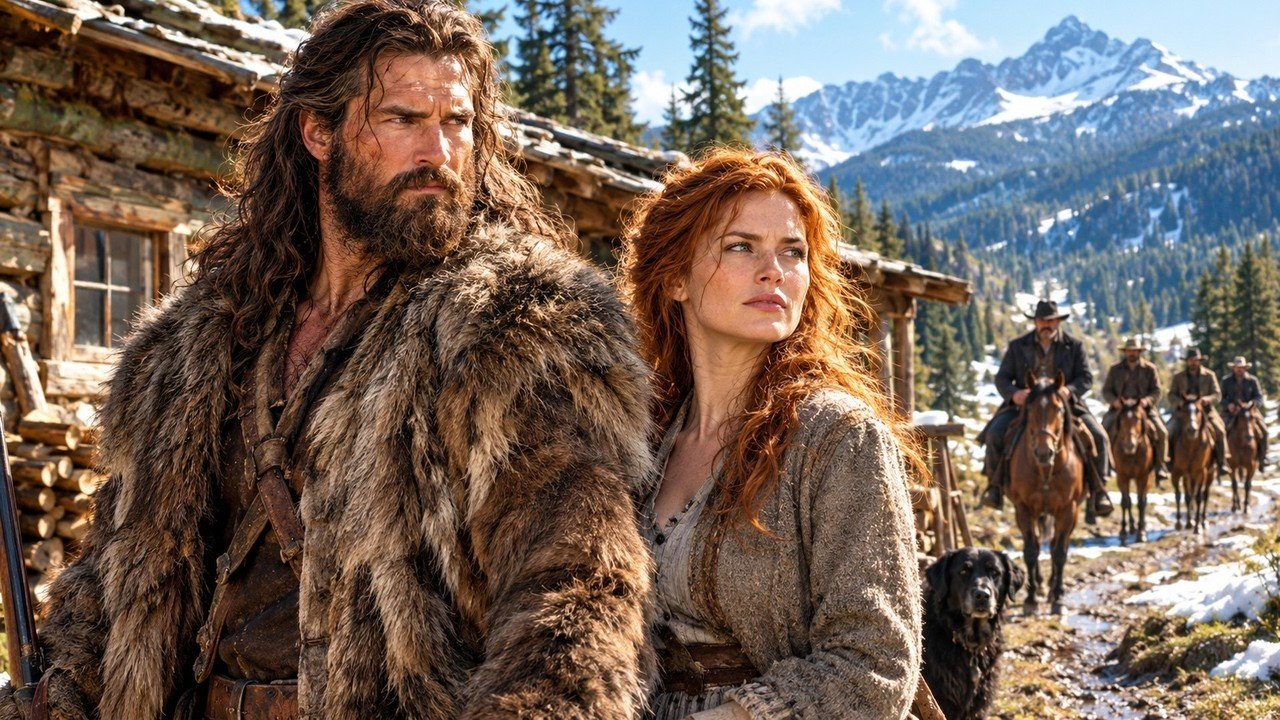
The weeks fell into rhythm. Wood and water and cold. Running the trap lines in the brutal December light, coming home with numb feet to find the cabin warm and supper already on. He never asked her. She simply did what needed doing, the same as he did. One January afternoon, he came back early and heard her voice outside, calm and flat. A huge, starving black dog had her backed against the woodpile, circling low and silent. Wick grabbed the Winchester. “Wait,” Netta said. She crouched, set down her hatchet, and held out an empty hand. For two long minutes, the dog circled. Then its head dropped, and it crept forward and pressed its nose to her palm. She walked it straight into the cabin. “He’ll eat supplies we can’t spare,” Wick said. “I’ll train him to run small game,” she said, already checking him for wounds. “It’s that, or let him starve under our floor.” Our floor, Wick noted. He said nothing. She named the dog Flint. He turned out to have a nose for rabbit warrens that saved Wick hours every trap run. Wick never admitted she’d been right. But he stopped shutting the door on the dog.
February brought the cold that old mountain men speak of with a kind of fear. They’d begun sharing the sleeping platform on the worst nights. Body heat needed no discussion. One night, Wick woke to find Netta sitting up, watching him. “You said a name,” she said softly. “Twice. Sarah.” He was quiet a long time. The wind moaned outside. “My wife,” he finally said. “She didn’t make it through our second winter up here. A fever. I was out on the trap line three days. When I came back…” He stopped. There was no use finishing. “I didn’t come back up the mountain for two years. When I did, I never planned to leave again.” Eleven years ago, he’d dug her grave with his bare hands in frozen ground.
“You came back because it was her place too,” Netta said quietly. “Not just yours.” He’d never thought of it that way. It was true in a way that shook him. “That first winter after my husband died,” she said, pulling up the fur, “I kept waking at three in the morning, expecting to hear him breathing. There’s no good way through it. There’s just the other side of it.” They lay back down, not touching, but neither moved away. Wick stared at the ceiling he knew by heart and listened to her breathe. He thought Sarah would have liked her. He thought Sarah would have been glad someone had survived those storms. And for the first time in eleven years, the cabin didn’t feel like a grave anymore.
When March came and the snow began pulling back, Wick grew restless. He checked the Winchester every morning. He slept lighter. “The deputy,” Netta said one evening, not looking up from a harness. “He’ll come in spring.” “Yes.” “Not alone.” “No.” Wick went to the supply crate and pulled out an oilcloth bundle. Inside was a heavy black Remington Army revolver. “I’ve only ever used a shotgun,” Netta said. “Then we start there.” He stood behind her and reached around to correct her grip, his hands over hers, aligning her wrists so the recoil wouldn’t crack them sideways. Her hair smelled of woodsmoke and pine. “Pick a spot. Put all your attention on it. The trigger comes last.” He watched the moment her focus changed. “Whatever you just thought about,” he said quietly. “Keep that.”
The next morning, she fired twelve rounds at a pine stump. The first four pulled left. Her wrist broke on the fifth. By the tenth, eleventh, and twelfth, she was hitting dead center every time. Her shoulder was bruised purple for a week. She never mentioned it once.
The deputy came on a Wednesday in late April, with three hired men. Enough to feel confident. Not enough to be careful. Wick was at the woodpile when the blue jays went silent. He set down his maul without hurrying, took the Winchester, and walked into the middle of the clearing. The deputy reined in twenty yards out in a proper riding coat. “She owes taxes on a legal seizure,” he announced, in a rehearsed voice. “The county has authority here.” “The county stops at the snowline,” Wick said. “There are four of us.” “There are,” Wick agreed. Then the cabin door opened. He’d told her not to come out. He understood why she had.
Netta Rourke stepped into the morning light in his spare wool shirt belted with rope, red hair blowing loose in the cold wind, the heavy Remington held in both hands, muzzle down. The deputy sized her up the way men like him always did. A woman alone. A gun too big for her. Easy to frighten. He was wrong on every count. One hired man edged his horse sideways for a clear shot at Wick’s flank. Wick’s rifle came up before the horse finished the step. The man froze. “I’ll say this once,” Wick said. “Ride down the mountain. That debt was paid in silver at Dolby’s store. I have the receipt. You’ve come up here with hired guns on a claim that doesn’t exist. I’ll defend this land and the people on it.” The deputy looked at Netta. She met his eyes without blinking and raised the Remington in both hands. She’d never fired at a man. Everyone in that clearing could see she knew that she could.
The deputy did the kind of arithmetic men do when it’s their own life on the line. He turned his horse. His three men followed. None of them looked back. Wick held the rifle level until the hoofbeats faded into the rush of snowmelt and birdsong. Then he lowered it, walked back to the woodpile, and picked up his maul. There was still half a cord to split before sundown. Netta lowered the revolver in the doorway, and something crossed her face that wasn’t quite a smile, but lived close to one. She walked out and started rolling pine rounds to his chopping block. They worked side by side in silence until the light was gone, two people who’d learned every rhythm of each other down to the smallest detail.
That night, over coffee at the plank table, Flint asleep by the stove, Netta said, “He’ll file paperwork. They’ll take the farm.” She shrugged. “Twelve acres of hard clay and disappointment. I don’t especially miss it.” They looked at each other across the table. The long silence had nothing uncomfortable in it at all. That alone was a kind of miracle, between two strangers who’d first met on opposite sides of a curtain in a general store. “Spring up here is short,” Wick finally said. “I know,” Netta said. “I’ve been here for it.” He turned his cup in his huge hands. He was not a man made for speeches.
“I’m not asking you to stay because it’s practical,” Wick said slowly. “I’m asking because this cabin is different with you in it. Because I sleep through the night again. Because I stopped thinking of this place as somewhere I was just waiting for something to end.” He paused. “I know what I am. I’m not easy company.” Netta looked at him across the table. The cut above her eye from Dolby’s store had long since healed. Her hands around the tin cup were callused and stained from five months of mountain work. They were the hands of a woman who had decided, clearly and without illusions, exactly what she was willing to fight for.
“I came up this mountain with one carpetbag and a worn-out mule,” she said. “I’ve been robbed by the county, nearly frozen twice, and had a hired gun pointed at me.” She set down her cup. “I’m not staying because it’s easy. I’m staying because it’s mine.” She met his eyes. “And because you’re mine, if you’re willing.” Outside, a late wind moved through the spruce like a running river. Flint sighed and went back to sleep. Wick Callaway set down his cup, reached across the table, and laid his rough hand over hers. He didn’t say a word. He was never a man to say a thing when it could be more honestly done.
They sat like that until the fire burned low. Two people who had survived the worst the mountain could throw at them, and come out the other side still holding the line, still holding each other. The wind ran clean and cold across Garnet Peak, while the world far below went on with its ordinary business, never knowing what had been built up there, in the thin, pitiless, perfect air.
(Note: This story is entirely fictional and was created with the help of AI for entertainment purposes. Any resemblance to real people or events is purely coincidental.)