PART 3
Otis Whitcomb's voice trembled as he stood before the school directors.
The twelve-year-old boy held the county notice in both hands, struggling to keep the paper steady.
His father, a broad-shouldered rancher who had spent years declaring that his son would never amount to much, stared at him from across the room.
"Otis," he said sharply, "sit down."
But Otis didn't move.
Instead, he looked at Ada Pell.
She stood beside Sheriff Ben Caldwell, pale from her recent illness, one hand resting against the back of a wooden chair.
Ada gave him the smallest encouraging nod.
Otis swallowed.
Then he began to read.
"By order of the county court, the children of Mrs. Ada Pell, widow, shall be removed to the children's home in Portland..."
His voice grew steadier with every word.
The room fell completely silent.
Outside, horses stamped their hooves beside the waiting county wagon.
Molly stood between her younger brothers, clutching Finn's hand so tightly that his fingers had turned white.
Mrs. Crowther watched from the doorway, the official papers tucked beneath her arm.
Otis finished the notice.
Then he looked directly at his father.
"Miss Ada taught me those words."
Mr. Whitcomb's expression hardened.
"Who told you to speak?"
"Nobody, Pa."
"Then why are you standing there?"
Otis glanced toward Ada.
"Because you said I was too stupid to learn. You said if I couldn't read by fourteen, I never would."
The boy's voice cracked.
"Miss Ada said you were wrong."
A few men shifted uncomfortably in their seats.
Mr. Whitcomb opened his mouth, but Otis continued.
"She didn't laugh when I got the letters backward. She didn't call me useless. She just showed me again."
He held up the notice.
"Three weeks ago, I couldn't read any of this. Today I can."
Then he looked around the room.
"If you send her away, who's going to teach the rest of us?"
Nobody answered.
Ben Caldwell had witnessed many things during his twenty years wearing a sheriff's badge.
He had seen men confess to crimes they hadn't committed. He had watched respectable citizens become cowards when courage was required. He had learned that people often listened more carefully to money than to truth.
But he had rarely seen a child change an entire room with a single question.
Mr. Whitcomb slowly stood.
For a moment, Ben feared he would drag Otis outside.
Instead, the rancher approached his son.
"Read me that first sentence again."
Otis looked frightened.
"Pa?"
"Go on."
The boy lifted the paper.
He read the sentence carefully.
Then he read the next.
Mr. Whitcomb listened without interrupting.
When Otis finished, his father looked toward Ada.
"You taught him that?"
"Yes, sir."
"How?"
"One letter at a time."
The rancher lowered his head.
For years, he had believed his son lacked intelligence. He had mistaken difficulty for laziness and embarrassment for stubbornness.
Now, in front of half the town, he was being forced to recognize how wrong he had been.
Mr. Whitcomb returned to his chair.
Then he raised his hand.
"I vote yes."
Ben felt his breath catch.
One vote had changed.
But they still needed another.
The school board chairman cleared his throat.
"The proposal before us is to reopen the district school and employ Mrs. Ada Pell at thirty dollars a month."
He looked toward the remaining directors.
"Those in favor?"
Two hands rose.
Then Mr. Whitcomb raised his.
The chairman counted.
Three votes.
They needed four.
Ben looked toward the final director, an elderly farmer named Samuel Price.
Samuel had refused to commit the night before.
He was a deeply religious man who believed every important decision required prayer.
Ben had visited his home after midnight.
Samuel had listened politely, then told him to return in the morning.
Now the old farmer sat silently, his hands folded.
Ben approached him.
"Mr. Price?"
Samuel looked toward the window.
Outside, Molly was standing beside the county wagon.
Her father's oversized coat hung almost to her knees.
Finn leaned against her shoulder, while their middle brother, Daniel, watched the horses with frightened eyes.
Samuel's expression softened.
"I prayed last night, Sheriff."
Ben waited.
"And?"
The old man sighed.
"I asked the Lord whether we could afford another schoolteacher."
He paused.
"Then I remembered my own grandchildren."
Samuel looked toward Ada.
"My eldest granddaughter read an entire chapter of the Bible to me last Sunday. I was so proud I could barely speak."
His eyes filled.
"Then I asked myself what would happen if she had never been given the chance to learn."
He slowly raised his hand.
"I vote yes."
For a moment, nobody moved.
Then the chairman struck his gavel.
"The motion carries."
Ada covered her mouth.
Ben closed his eyes.
The school district had hired its first teacher in two years.
And that teacher was Ada Pell.
But Mrs. Crowther was still standing in the doorway.
"The court order remains in effect," she said firmly.
The room quieted.
"The county approved the removal because Mrs. Pell had no reliable income and the children were living in unsafe conditions."
Ben turned toward her.
"She has employment now."
"Employment doesn't repair a broken door or put food on the table today."
Ada's shoulders sank.
For one terrible moment, she believed they had come too late.
Mrs. Crowther continued.
"The petition was filed because those children were in danger. I will not apologize for trying to protect them."
Ben stepped forward.
"Nobody is asking you to apologize for caring about children."
"Then you understand my position."
"I understand it perfectly."
He pointed toward the school directors.
"But circumstances have changed. Ada has a position, a salary, and the support of this district. The schoolhouse has a stove, a roof, and rooms that can be used until her cabin is repaired."
Mrs. Crowther hesitated.
Ben continued.
"And if the court needs a statement confirming that those children will be properly housed, fed, and cared for, I'll sign it myself."
The chairman stood.
"The district will provide temporary quarters adjoining the schoolhouse."
Mr. Whitcomb cleared his throat.
"I've got spare lumber. I'll repair the widow's cabin door."
Samuel Price nodded.
"My wife can send bedding."
Another man offered firewood.
Mrs. Engle, the baker, appeared at the back of the room.
"And I'll see that those children have bread every morning."
Ada began crying.
For weeks, she had asked for work and been refused.
Now the same town that had turned her away was offering something she had nearly stopped believing existed.
A chance.
Mrs. Crowther looked around the room.
Then she slowly removed the county petition from her folder.
"I filed this because I believed the children had nowhere safe to stay."
She looked at Ada.
"If the school directors are prepared to guarantee these arrangements, I will withdraw my petition and notify the court immediately."
Ben released a breath he hadn't realized he was holding.
Ada gripped the chair.
Outside, Molly saw the adults moving toward the door.
She immediately stepped in front of her brothers.
"You can't take them!"
Mrs. Crowther stopped.
For the first time, her expression softened completely.
"No, Molly."
The little girl blinked.
"What?"
"You're staying with your mother."
Molly stared at her.
Then she ran.
She threw herself into Ada's arms so hard that the widow nearly lost her balance.
Finn followed.
Daniel wrapped both arms around his mother's waist.
Ada knelt despite her weakness and held all three children against her.
"We're staying, Mama?" Molly whispered.
Ada kissed her hair.
"Yes, sweetheart."
"All of us?"
"All of us."
Molly began crying.
But this time, they were tears of relief.
The schoolhouse had stood silent for nearly two years.
Its windows were dusty, its desks were covered in cobwebs, and the old bell above the entrance had not rung in so long that many children had forgotten what it sounded like.
Ben stood outside looking up at it.
Ada approached with Molly beside her.
"What's wrong?" she asked.
Ben didn't answer immediately.
His gaze remained fixed on the bell.
Finally, he spoke.
"Annie used to ring that bell."
Ada looked at him.
"Your daughter?"
He nodded.
"Every morning during her last winter. The teacher let her ring it because she was always the first child here."
His voice grew quiet.
"After she died, I couldn't bear hearing it."
Ada said nothing.
Ben looked toward the empty schoolyard.
"For three years, I've walked past this place without looking up."
He swallowed.
"Every time I heard a child laugh, I thought about her."
Ada reached for his hand.
Ben looked down at their joined fingers.
"I kept thinking that if I had done something differently, she might still be alive."
"Ben."
"I was her father. I was supposed to protect her."
Ada stepped closer.
"You loved her."
"That wasn't enough."
"No," she whispered. "Sometimes love cannot stop what happens."
He looked at her.
"But it doesn't mean your love failed."
Ben's eyes filled.
For years, he had carried Annie's death as though it were a debt he could never repay.
He had stopped visiting friends. He had avoided families with young children. He had kept Annie's room untouched and her boots beside his door.
He had convinced himself that loving anyone again would somehow mean leaving his daughter behind.
But standing beside Ada, he began to understand something.
Annie's memory did not need to remain locked inside his grief.
It could become part of the kindness he offered someone else.
Molly tugged his sleeve.
"Sheriff?"
Ben looked down.
"Yes, sweetheart?"
"Can I ring the bell?"
He stared at her.
For a moment, he couldn't speak.
Then he smiled through his tears.
"Yes, Molly."
He lifted her onto the wooden platform beneath the bell rope.
She wrapped both hands around it.
"Like this?"
"That's right."
"Will it be loud?"
"Very loud."
Molly grinned.
"Good."
She pulled.
The bell rang across the schoolyard.
Its clear sound rolled over the rooftops, through the streets, and toward the distant hills.
Children cheered.
Mrs. Engle laughed.
Even Mr. Whitcomb smiled.
Ben stood perfectly still.
Then, unexpectedly, he began to laugh.
Not a polite smile.
Not a quiet chuckle.
A real laugh.
The kind he hadn't heard from himself in years.
Molly stared at him.
"Sheriff! You laughed!"
Ben wiped his eyes.
"I guess I did."
She pulled the rope again.
The bell rang louder.
And for the first time since Annie died, Ben heard that sound without feeling as though his heart were breaking.
The following weeks changed everything.
Ada moved into the small rooms beside the schoolhouse while the townspeople repaired her cabin.
Mrs. Engle brought fresh bread each morning.
Samuel Price's wife donated blankets.
Mr. Whitcomb sent lumber and helped repair the broken stove pipe.
The children returned to school.
Molly quickly became one of Ada's most enthusiastic pupils.
Finn preferred counting to spelling, while Daniel loved geography and spent hours studying the old maps hanging on the classroom wall.
Otis Whitcomb arrived early every morning.
He had become determined to prove that his father had been wrong about him.
Ada never treated him differently from the other children.
She simply gave him more time when he needed it.
One afternoon, Mr. Whitcomb appeared at the classroom door.
He stood watching as Otis read aloud from a book.
When the lesson ended, the rancher approached his son.
"That was good reading."
Otis looked surprised.
"Thank you, Pa."
His father hesitated.
Then he placed a hand on the boy's shoulder.
"I was wrong about you."
Otis stared at him.
The words seemed to mean more than any gift his father could have offered.
Ada watched quietly from her desk.
She had spent years believing that teaching was something she had lost forever.
Now she understood that it had always been part of who she was.
Ben continued visiting the schoolhouse.
At first, he claimed he was checking the repairs.
Then he said he needed to speak with the directors.
Later, he stopped inventing excuses.
He simply came.
Sometimes he brought apples.
Sometimes he carried firewood.
Sometimes he sat at the back of the classroom while Ada finished her lessons.
The children adored him.
Molly especially.
She had begun following him around town whenever Ada allowed it.
She asked endless questions about horses, lawmen, and the county jail.
Ben answered every one.
One afternoon, she discovered that he had written a notice containing several spelling mistakes.
She marched into his office holding the paper.
"Sheriff, robbery has two B's."
Ben looked up.
"Does it?"
"Yes."
"Well, that's inconvenient."
"And information doesn't have an S-H in it."
Ben sighed dramatically.
"The county pays me to catch outlaws, Molly. Spelling costs extra."
She burst into laughter.
Ben laughed with her.
Ada, standing in the doorway, smiled.
She had begun noticing how different he looked when the children were around.
The sadness never completely disappeared from his eyes.
But it no longer controlled every expression.
And sometimes, when he looked at Molly, Ada saw something that made her heart ache.
He wasn't trying to replace Annie.
He was remembering how to be a father.
One evening, Ben arrived at Ada's cabin carrying a small notebook.
She had returned home after the repairs were completed, and the children were sleeping.
Ada invited him inside.
"What's that?" she asked.
Ben placed the notebook on the table.
"Your account."
Ada smiled.
"My account?"
"You said you'd repay everything I spent."
She opened it.
The first page listed the bread, milk, salt pork, firewood, and doctor's visit.
At the bottom was the total.
$3.40.
Ada laughed softly.
"You kept track?"
"Of course."
She reached into her pocket and removed a small envelope.
Inside were the first coins she had saved from her teaching salary.
She counted them carefully and placed them on the table.
"Three dollars and forty cents."
Ben stared at the money.
"Ada, you don't have to—"
"I know."
She pushed the coins toward him.
"But I promised."
Ben looked at her for a long moment.
Then he took out his pencil.
He crossed out the balance.
"Paid in full."
Ada smiled.
"Thank you, Sheriff."
But Ben didn't close the notebook.
Instead, he turned to a fresh page.
"There's another matter."
Ada raised an eyebrow.
"What matter?"
"A new agreement."
She folded her arms.
"Should I be worried?"
"Possibly."
He began writing.
Ada leaned forward.
"Ben, what are you doing?"
"Preparing terms."
He turned the notebook toward her.
On the page, in his uneven handwriting, he had written:
Balance to be paid in suppers.
One supper every evening.
Duration: forty years.
Ada stared at the words.
Then she looked at him.
"You spelled forty with a U."
Ben sighed.
"I knew you'd notice."
She laughed.
But when she looked into his eyes, her laughter faded.
"Ben..."
He reached across the table and gently took her hand.
"I'm not asking you to marry me because you're poor."
Ada remained silent.
"I'm not asking because you need someone to protect your children."
His voice softened.
"And I'm not asking because I think you owe me anything."
She felt tears gathering.
"Then why are you asking?"
Ben looked toward the small bedroom where Molly and her brothers were sleeping.
Then he looked back at Ada.
"Because somewhere between that stolen loaf of bread and the sound of the school bell, I started wanting to come home to you."
Ada covered her mouth.
Ben continued.
"I spent three years believing my life was finished. I thought there was nothing left for me except my badge and the memories I couldn't put away."
He swallowed.
"Then Molly stole my bread."
Ada laughed through her tears.
"And I followed her home."
He smiled.
"I thought I was going to help a hungry family. Instead, I found people who reminded me what it feels like to be alive."
Ada reached for his other hand.
"Ben, I was afraid of loving you."
"I know."
"I thought if I depended on you, I'd lose myself."
"You won't."
"How can you be sure?"
He looked at her.
"Because I don't want a woman who needs me to tell her who she is."
He smiled.
"I want the woman who stood in front of a county court and fought for her children. The woman who taught a boy to read when his own father had given up on him."
Ada began crying.
"And the woman who corrected my spelling."
She laughed again.
Ben leaned closer.
"I'm not asking to save you, Ada."
His voice trembled.
"I'm asking you to let me stay."
For a long moment, Ada couldn't speak.
Then she whispered:
"I think I'd like that."
Ben smiled.
"Is that a yes?"
Ada nodded.
"Yes."
He kissed her gently.
And outside, the school bell began ringing.
Both of them turned toward the window.
Molly stood in the schoolyard, pulling the rope with all her strength.
Finn and Daniel were laughing beside her.
Ben shook his head.
"That girl is going to wear the bell out."
Ada smiled.
"She has a good reason."
Ben looked at her.
"What reason?"
Ada rested her head against his shoulder.
"She finally has something worth celebrating."
They married the following spring.
The ceremony was small, held inside the schoolhouse with the children seated in the front row.
Mrs. Engle brought a wedding cake.
Mr. Whitcomb provided flowers from his ranch.
Samuel Price read a blessing.
Mrs. Crowther arrived carrying a carefully wrapped package.
Inside was a new classroom broom.
Ada smiled.
"Another broom?"
Mrs. Crowther looked embarrassed.
"The first one wore out."
Then she took Ada's hand.
"Teach them well."
Ada squeezed her fingers.
"I will."
Ben wore his best coat.
Molly insisted on carrying the rings.
Finn nearly dropped his flowers.
Daniel asked whether married people had to kiss in front of everyone.
Ben replied that the law required it.
Ada laughed so hard that she nearly forgot her vows.
When the ceremony ended, Molly ran toward Ben.
"Can I call you Pa now?"
Ben knelt before her.
His eyes filled.
"You can call me whatever you like, sweetheart."
Molly threw her arms around his neck.
"Pa!"
Ben held her tightly.
For a moment, he closed his eyes.
He thought about Annie.
He thought about the little boots beside his door.
He thought about the years when he had believed he would never hear a child call him father again.
Then he kissed Molly's forehead.
"Yes, sweetheart."
She pulled away.
"Can I ring the bell?"
Ben laughed.
"Go ahead."
Molly ran outside.
The bell rang across the town.
Ada stood beside her new husband, watching the children race through the schoolyard.
Ben took her hand.
"Do you think she'll ever stop ringing that thing?"
Ada smiled.
"Not today."
He looked toward the bell.
"Good."
That summer, Ben finally moved Annie's boots from beside his front door.
He didn't throw them away.
He cleaned them carefully and placed them in a wooden chest alongside her favorite books, ribbons, and small drawings.
Ada helped him.
They sat together on the floor, looking through the things Annie had left behind.
Ben told stories about his daughter.
How she had loved horses.
How she had once tried to teach a chicken to follow commands.
How she had insisted on ringing the school bell every morning, even when snow covered the steps.
Ada listened.
She never told him to stop grieving.
She never asked him to forget.
When Ben finished, she placed her hand over his.
"She sounds wonderful."
Ben smiled through his tears.
"She was."
Then he closed the chest.
For the first time, he didn't feel that putting Annie's things away meant losing her.
He understood that she would always belong to him.
And that loving Ada and her children did not make his love for Annie any smaller.
It simply gave his heart more room.
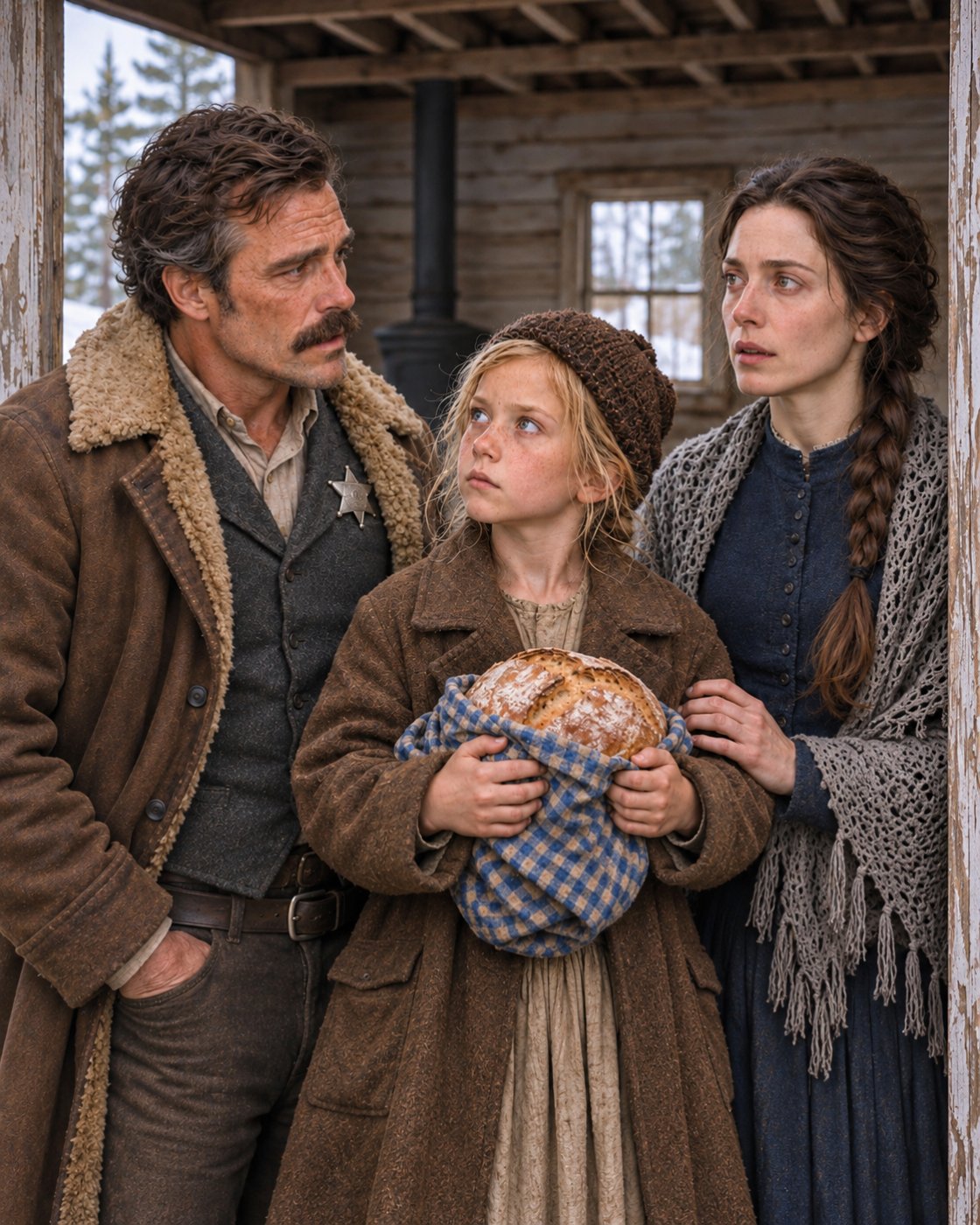
Years later, people in the little Oregon town still told the story of how Sheriff Ben Caldwell had followed a hungry child home after she stole a loaf of bread.
Some remembered the widow who nearly lost her children.
Others remembered the schoolteacher who taught Otis Whitcomb to read.
Many remembered the day the old school bell rang again after years of silence.
But Molly remembered something different.
She remembered standing inside Mrs. Engle's bakery, terrified that the sheriff would arrest her.
She remembered the weight of the stolen bread beneath her coat.
And she remembered the man who looked into her frightened eyes and chose kindness.
When Molly grew older, she became a teacher herself.
On her first morning in the classroom, she stood beneath the same bell her little hands had once struggled to ring.
Ben, now older and grayer, watched from the schoolyard beside Ada.
Molly smiled down at them.
Then she pulled the rope.
The bell rang across the town.
Ben looked at Ada.
"Still ringing it."
Ada laughed.
"Some things never change."
He squeezed her hand.
"And some things change everything."
The sound of the bell carried over the rooftops, across the fields, and toward the distant hills.
It was the sound of a town that had learned compassion.
The sound of children being given a chance.
And the sound of a lonely sheriff discovering that a broken heart could learn to love again.
Because sometimes the greatest love stories don't begin with flowers, promises, or grand declarations.
Sometimes they begin with a frightened little girl stealing bread.
And a man who chooses to follow her home.