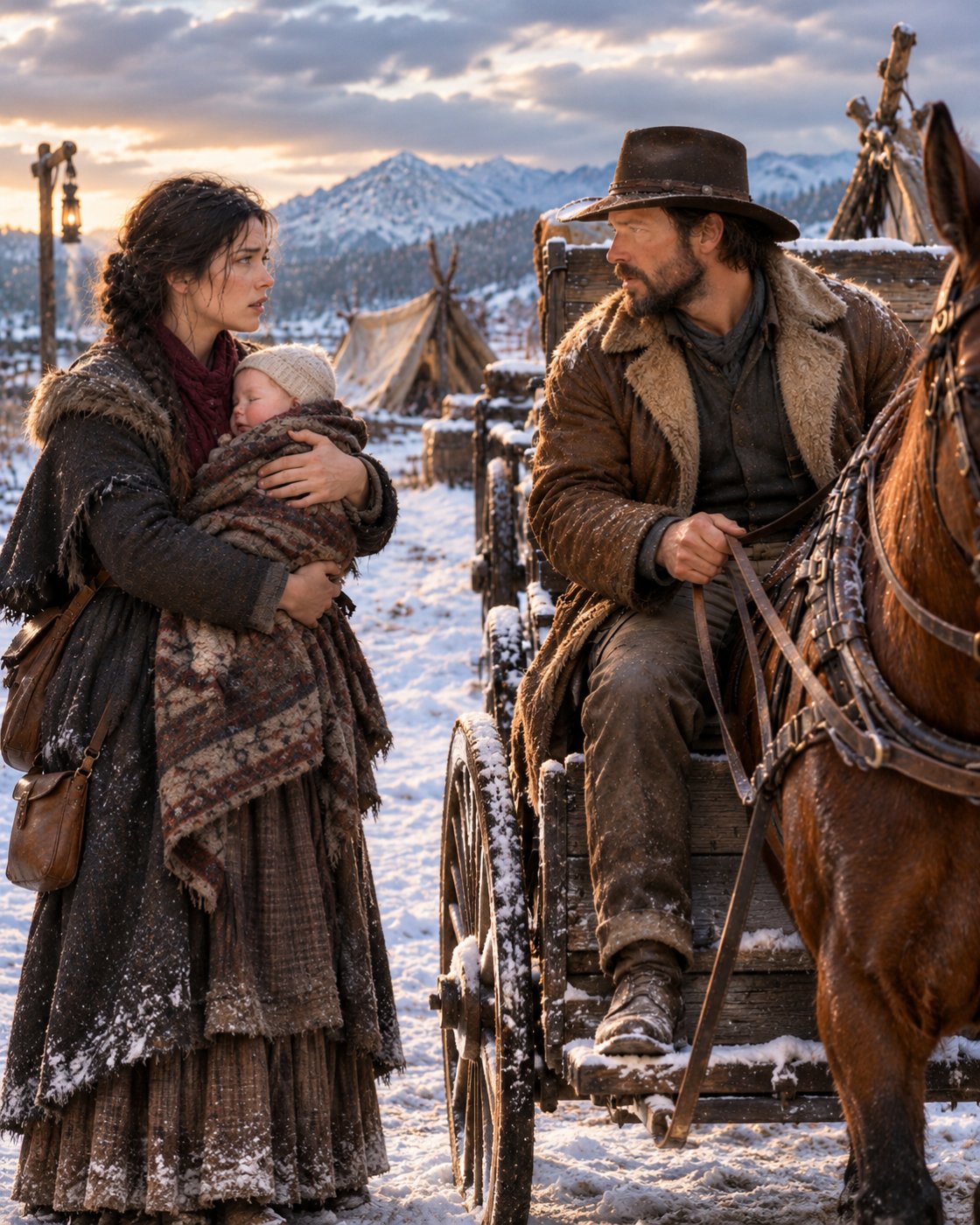
A Widowed Cowboy Stopped for a Mother and Baby in the Storm… She Asked, “Can We Sleep in Your Barn?”
PART 1
“Please, mister, don't take us back to town. If they find my baby, they'll take her away from me.”
The young mother stood trembling beside a flooded Montana road, clutching a tiny bundle beneath her soaked shawl. Rain streamed down her face, her lips had turned blue, and the infant in her arms was barely making a sound.
Eli Mercer pulled his wagon to a stop.
He was a thirty-nine-year-old widowed cowboy who had buried his wife and newborn son three years earlier. Since then, he'd lived alone on a cattle ranch outside Miles City, speaking more often to his horses than to another human being.
“Ma'am, you'll freeze out here,” he said. “Town's six miles back. I'll take you.”
“No!” Her voice cracked. “Please. Anywhere but town.”
Eli looked at the baby.
“How old is she?”
“Three months.”
“And you're walking through a storm with her?”
The woman lowered her eyes.
“I didn't have a choice.”
Eli removed his coat and held it out.
“My father taught me one thing. You never ride past someone who needs help.”
She hesitated before asking the question that would change both their lives.
“Do you have a barn, mister? Could we sleep there tonight? I'll work for it. I can cook, wash clothes, anything.”
Eli stared at her.
Then he shook his head.
“No, ma'am.”
Her face collapsed.
But he continued.
“You'll sleep in the house. I'll take the barn.”
Her name was Lydia Pride. Her daughter was Josie.
That evening, Eli gave them dry blankets and a warm meal. He didn't ask why she'd been wandering the road or why she flinched whenever a horse passed the window.
He simply placed a wooden bar across the bedroom door.
“Lock it from the inside,” he told her.
“Even against you?”
“Especially against a stranger.”
For the first time in days, Lydia slept without her boots on.
But shortly after midnight, Josie developed a terrible fever.
Lydia rushed into the kitchen, crying.
“Eli! She's burning up!”
The nearest doctor was ten miles away, and the river crossing had flooded.
Eli stayed awake beside the stove, helping Lydia keep the baby comfortable and offering small amounts of milk while they watched for signs she was worsening.
By dawn, Josie's fever had eased.
Lydia wept with relief.
“You saved her.”
Eli looked at the sleeping child.
“No, ma'am. We got through the night together.”
Over the following days, Lydia began keeping Eli's ranch accounts. Within a week, she discovered a dishonest supplier had been charging him for sacks of feed never delivered.
Eli was astonished.
“You found what I've been missing for six months.”
Lydia smiled for the first time.
“Numbers don't frighten me, Mr. Mercer.”
He offered her wages and a permanent room.
But that evening, while they sat beside the stove, Lydia finally revealed why she'd fled Missouri.
Her husband had died of fever. His wealthy brother, Virgil Pride, had claimed she owed him $160 for funeral expenses.
Then he'd petitioned the court to take custody of Josie.
“Why would he want your daughter?” Eli asked.
Lydia's hands shook.
“Because Daniel left her eighty acres beside the railroad. The company offered eight hundred dollars for it.”
Eli slowly set down his coffee.
“And if Virgil becomes her guardian…”
“He can sell everything.”
Before Eli could answer, someone knocked on the door.
Three hard blows.
Then a man's voice called from the porch.
“Lydia Pride! I know you're in there. I've got a court order, and I've come for my niece.”
Lydia went white.
Because the man outside wasn't alone.
Two armed riders stood behind him, and one carried a folded paper bearing an official seal.
Had Virgil already convinced a judge to take Josie away? And could Eli protect a mother and child when the law itself appeared to be on their pursuer's side?
What would you do if a frightened mother begged you to hide her baby from a man carrying a court order?
Discover what Eli does when Virgil demands the child in PART 2, in the first comment. 👇
PART 2
Because the man outside wasn't alone.
Two armed riders stood behind him, and one carried a folded paper bearing an official seal.
Eli stepped onto the porch, closing the door behind him. “Evening, gentlemen.” The tallest rider dismounted. “Virgil Pride. I've come for my brother's child.” He unfolded the paper. “A Missouri court appointed me temporary guardian. The mother fled before the hearing.” Eli read the document beneath the lantern. It named Virgil as guardian, but nowhere did it authorize him to seize the child in Montana. “You'll need to speak to a judge here,” Eli said. Virgil smiled coldly. “You think a lonely rancher can stand between me and my own blood?” Eli folded the paper and returned it. “I think you can come back with the proper authority.”
Virgil's smile vanished. “She's living under your roof, isn't she? A widow and a strange man. I'll make certain the court hears about that.” Behind the door, Lydia held Josie so tightly the baby began to cry. Eli didn't move. “You can tell the court whatever you please. But you won't take a child from this house tonight.” The two hired riders exchanged uneasy looks. Neither wanted to fight a rancher over a disputed court order. Virgil finally climbed back into the saddle. “Monday morning,” he warned. “I'll have that baby.”
At dawn, Eli drove Lydia and Josie to Judge Amos Fletcher's office in Miles City. Lydia told the judge everything: Daniel's death, the funeral bill, the railroad land, and the hearing she'd fled. Fletcher examined Virgil's papers. “This order doesn't automatically give him authority to remove a child from Montana,” he explained. “Your daughter stays with you while we review the matter. I'll hear his petition Monday.” Lydia nearly collapsed with relief. But the judge warned that Virgil would likely use her living arrangements against her.
Back at the ranch, Eli quietly moved his bedding into the barn. Lydia found him carrying blankets across the yard. “You shouldn't have to sleep out here because of me.” Eli looked at her. “I've slept in worse places.” She reached for his hand. “Why are you doing so much for us?” For a long moment, he said nothing. Then he admitted, “My wife Martha died after giving birth. Our little boy, Samuel, lived only two days. I've spent three years coming home to an empty house. Now I hear Josie laughing in the kitchen, and I don't want the silence back.”
Lydia's eyes filled. She stepped closer, but Eli gently released her hand. “I won't ask you for anything while you're afraid of losing your daughter.” That night, Lydia found an old wooden cradle in the storage room, carefully covered with a quilt. She understood then how much grief Eli had carried alone.
Monday morning, the courthouse was packed. Virgil accused Lydia of abandoning her responsibilities and living improperly with a stranger. But when Judge Fletcher asked about the $160 debt, Lydia produced the undertaker's original receipt. The funeral had cost eighteen dollars. She'd earned that exact amount keeping Eli's books and had repaid Virgil in front of witnesses. The judge studied the receipt, then asked Virgil a question that silenced the room.
“Mr. Pride, if your brother's funeral cost eighteen dollars, why did you swear under oath that his widow owed you one hundred and sixty?”
Virgil opened his mouth.
No answer came.
Then Judge Fletcher unfolded a second document, newly delivered from Missouri.
“There's something else,” he said. “The railroad company has provided a copy of a land purchase agreement signed three days after Daniel Pride's death.”
Lydia stared.
“I never signed any agreement.”
The judge looked directly at Virgil.
“That's precisely the problem. Someone signed your daughter's land away before anyone had been appointed her guardian.”
Had Virgil forged the sale of Josie's inheritance before stealing custody of her? And could Lydia prove the deception before the railroad took possession of the land?
If you were Lydia, would you trust Eli enough to build a new life—or would fear of losing everything keep you running?
Comment “MOTHER” for PART 3, where the courtroom revelation changes Josie's future, and Eli must finally reveal what he wants from the woman who brought life back into his home.
PART 3
“That's precisely the problem. Someone signed your daughter's land away before anyone had been appointed her guardian.”
The words hung in the Montana courtroom like a thunderclap.
Lydia Pride sat frozen beside Eli Mercer, her hands clasped so tightly that her fingernails pressed into her palms. Across the aisle, Virgil Pride stared at Judge Amos Fletcher with an expression that changed from arrogance to disbelief.
The judge held up the railroad agreement.
“This document purports to transfer eighty acres of land in Lafayette County, Missouri, from the estate of Daniel Pride to the Western Continental Railroad Company.”
Lydia rose.
“Your Honor, Daniel left that land to our daughter. He told me himself. It was the only thing he owned outright.”
Fletcher nodded.
“And according to the probate records, the land was intended for Josephine Pride, his surviving child.”
He looked at Virgil.
“Yet this agreement bears your signature, Mr. Pride, claiming authority to sell the property on behalf of the estate.”
Virgil cleared his throat.
“My brother owed debts. The land had to be sold to satisfy them.”
“Debts totaling one hundred and sixty dollars?”
“Among others.”
“Can you produce documentation?”
Virgil shifted in his chair.
“Not at present.”
The judge's expression hardened.
“Then I suggest you stop making claims you cannot support.”
A murmur passed through the room.
Lydia felt Eli's hand settle gently over hers.
She looked at him.
He said nothing.
He didn't need to.
For the first time since Daniel's death, someone was standing beside her while she fought for her daughter's future.
Judge Fletcher turned back to the document.
“The railroad's attorney has already questioned the validity of this agreement. That's why a copy was sent here when the company learned a custody dispute had crossed territorial lines.”
Virgil's face reddened.
“This is Missouri business, Your Honor.”
“Then Missouri courts will determine the validity of the land transfer,” Fletcher replied. “But the matter before me today is whether this child should be removed from her mother's care.”
He turned toward Lydia.
“Mrs. Pride, have you neglected your daughter?”
“No, sir.”
“Have you abandoned her?”
“Never.”
“Have you provided food, shelter, and care?”
“Yes, sir.”
The judge glanced toward Eli.
“Mr. Mercer, how long has Mrs. Pride worked on your ranch?”
“Nearly three weeks.”
“And you pay her wages?”
“One dollar a day, Your Honor.”
“Does she perform the work?”
Eli almost smiled.
“She discovered a supplier had cheated me out of twenty-one dollars. I'd say she's earned every penny.”
A few people chuckled.
Even Judge Fletcher's mouth twitched.
“And where do you sleep, Mr. Mercer?”
“In the barn.”
“Why?”
Eli looked toward Lydia.
“Because she's a widow traveling alone with a child. I wanted her to feel safe.”
The courtroom fell quiet.
Fletcher studied him for a moment.
Then he nodded.
“Thank you.”
Virgil rose abruptly.
“Your Honor, this woman fled her home! She crossed state lines without informing her family!”
Lydia stood.
“I fled because you threatened to take my baby.”
Virgil pointed toward her.
“She was hysterical after my brother's death. She couldn't manage the farm. She couldn't manage her finances.”
Lydia's face flushed.
“Daniel and I kept those accounts together for five years.”
“You were a housewife!”
“I was his partner.”
Her voice rang across the courtroom.
The judge raised his hand.
“Mrs. Pride, continue.”
Lydia turned toward him.
“When Daniel died, I was grieving. Josie was three weeks old. I had no money and no one to help me.”
She swallowed.
“Virgil paid eighteen dollars for the coffin. A week later, he told me I owed him one hundred and sixty.”
Her eyes filled.
“When I refused to sign over the land, he went to court and said I was unfit to raise my daughter.”
She looked at Virgil.
“You didn't want Josie because you loved her.”
Her voice trembled.
“You wanted her land.”
Virgil opened his mouth.
But Lydia continued.
“And when I wouldn't give it to you, you tried to take the only person I had left.”
Silence filled the room.
Judge Fletcher examined the undertaker's receipt.
Then he turned toward Virgil.
“Mr. Pride, did Mrs. Pride repay the eighteen dollars?”
Virgil hesitated.
“Yes.”
“And did you accept the money?”
“Yes.”
“Then the documented funeral expense has been repaid.”
The judge placed the receipt on the desk.
“As for the remaining alleged debt, you have presented no reliable evidence.”
Virgil's face darkened.
“Your Honor—”
“Sit down.”
The judge looked toward Lydia.
“Mrs. Pride, I find no evidence that you're unfit to care for your daughter.”
Lydia stopped breathing.
“The petition to remove Josephine Pride from your custody is denied.”
For a moment, she couldn't understand the words.
Then Eli squeezed her hand.
“Lydia,” he whispered.
She turned toward him.
His eyes were shining.
“You did it.”
Lydia covered her mouth.
Tears spilled down her cheeks.
The judge continued.
“This court will notify the Missouri authorities of the evidence presented today and request review of the guardianship proceedings and the disputed land transfer.”
He looked directly at Virgil.
“And I strongly advise you not to attempt to remove this child without lawful authority.”
Virgil rose so quickly his chair scraped across the floor.
“This isn't finished.”
Judge Fletcher's voice remained calm.
“No, Mr. Pride. I suspect it isn't.”
He struck his gavel.
“Court adjourned.”
Outside the courthouse, Lydia stood on the wooden steps beneath the bright Montana sunshine.
For the first time in months, she wasn't afraid of footsteps behind her.
Josie slept peacefully in her arms.
Eli stood beside her, holding the baby's little blanket.
Lydia looked at him.
“I don't know how to thank you.”
He shook his head.
“You don't have to.”
“But you gave us a home. You stood beside me in court. You—”
“Lydia.”
She stopped.
Eli looked at the child.
“You did the hardest part.”
“What do you mean?”
“You walked away from everything you knew because you believed your daughter deserved better.”
He met her eyes.
“You kept going when you were frightened. You worked when you were exhausted. You stood in front of a judge and told the truth.”
Lydia's throat tightened.
“I only did what any mother would do.”
Eli smiled.
“Maybe. But that doesn't make it any less brave.”
She looked down at Josie.
Then back at him.
“Will you take us home?”
Eli's expression softened.
“Of course.”
And when he helped her into the wagon, Lydia realized something she'd been afraid to admit.
She no longer thought of Eli's ranch as a temporary shelter.
She thought of it as home.
The weeks that followed were peaceful.
Lydia continued keeping the ranch accounts.
Eli began teaching her how to handle the horses and repair small tools around the property.
Josie grew stronger every day.
And the old farmhouse slowly changed.
Fresh curtains appeared in the kitchen.
A small patch of flowers bloomed beside the porch.
The shelves filled with jars of preserved peaches and blackberry jam.
Eli began coming inside for supper instead of eating alone in the barn.
At first, they spoke mostly about the day's work.
Then about childhood memories.
Then about the people they'd lost.
One evening, Lydia found him standing in the doorway of the small bedroom at the end of the hall.
He was holding a folded quilt.
She approached quietly.
“Eli?”
He didn't turn.
“This was Martha's.”
Lydia stepped closer.
The quilt was pale blue, stitched with tiny white stars.
“She made it for our son,” Eli said.
His voice was rough.
“Samuel.”
Lydia felt her heart ache.
Eli sat on the edge of the bed.
“He was born too early. Lived two days.”
He looked down at the quilt.
“Martha held him the whole time.”
Lydia sat beside him.
“I'm so sorry.”
Eli nodded.
“She took a fever a week later.”
He swallowed.
“And then she was gone too.”
For a long moment, neither spoke.
The silence wasn't uncomfortable.
It was simply heavy with grief.
Finally, Eli whispered, “I never thought I'd hear a baby laugh in this house again.”
Lydia reached for his hand.
“Josie loves you.”
He smiled sadly.
“I know.”
“She looks for you every morning.”
Eli looked toward the hallway, where the baby was sleeping.
Then he turned back to Lydia.
“Would you let her sleep in Samuel's cradle?”
Lydia's eyes filled.
“Are you sure?”
He nodded.
“I think Martha would like that.”
That night, Eli carried the old wooden cradle into Lydia's room.
He'd built it with his father before Samuel was born.
The wood was smooth from years of careful sanding, and small carved stars decorated the sides.
Lydia lined it with Martha's quilt.
Then she gently placed Josie inside.
The baby stirred, opened her eyes, and looked up at Eli.
He smiled.
“Hello, little one.”
Josie reached toward him.
He offered his finger.
She wrapped her tiny hand around it.
And Eli began crying.
Not loudly.
Not dramatically.
Just quiet tears slipping down the face of a man who had spent three years believing his heart was finished.
Lydia stood beside him.
She didn't try to stop his tears.
She simply rested her hand on his shoulder.
And for the first time since Martha's death, Eli allowed himself to grieve without being alone.
One afternoon, Opal Greer arrived with a blackberry pie.
She found Lydia hanging laundry and Eli repairing a wagon wheel near the barn.
Opal watched them for a moment.
Then she smiled knowingly.
“Well, isn't this something.”
Lydia looked up.
“Good afternoon, Opal.”
The older woman stepped down from her buggy.
“Afternoon, dear.”
She glanced toward Eli.
“Mercer, you've got flour on your sleeve.”
Eli looked down.
“Have I?”
Opal laughed.
“You've been helping in the kitchen again.”
Lydia blushed.
“He was trying to make biscuits.”
“Trying?”
Eli grinned.
“They came out fine.”
Lydia shook her head.
“They could've shod a horse.”
Opal burst into laughter.
“Well, I'd say this house has changed.”
Eli looked toward Lydia.
“Yes, ma'am.”
His voice softened.
“It has.”
That evening, after Opal left, Eli found Lydia sitting on the porch.
The sunset painted the prairie in shades of amber and rose.
Josie slept inside.
Eli sat beside her.
For a while, neither spoke.
Then he cleared his throat.
“Lydia?”
“Yes?”
“Can I ask you something?”
She smiled.
“You've been asking permission for weeks.”
He looked at her seriously.
“I don't want you to feel that you owe me anything.”
Her smile faded.
“I know.”
“Not because I gave you shelter. Not because I helped with the court.”
She turned toward him.
“Eli, what are you trying to say?”
He took a breath.
“I want you to stay.”
Lydia looked at him.
“I'm already staying.”
He shook his head.
“Not as my bookkeeper.”
Her heart began pounding.
“Then as what?”
Eli looked down at his hands.
For a man who could handle frightened horses and difficult cattle, he suddenly seemed unsure of himself.
“As someone I care about.”
Lydia's eyes filled.
He continued.
“I don't know how to say this properly. I've spent three years avoiding anything that reminded me of what I lost.”
He looked at her.
“Then you came walking out of a storm with that baby in your arms, and suddenly I wanted to come home again.”
Lydia covered her mouth.
“Eli…”
He reached for her hand.
“I love you, Lydia.”
The words were quiet.
But they changed everything.
Lydia began crying.
“I love you too.”
Eli stared at her.
“You do?”
She laughed through her tears.
“Yes, you stubborn man.”
He smiled.
Then he leaned closer.
“May I kiss you?”
Lydia nodded.
And beneath the fading Montana sky, Eli Mercer kissed the woman who had brought life back into his lonely home.
Their wedding was held the following spring.
Judge Fletcher attended.
Opal Greer brought two pies and insisted on arranging the flowers herself.
The ranch hands decorated the porch with ribbons.
And Josie, now a happy toddler, wore a little white dress Lydia had sewn by hand.
Eli stood beneath the cottonwood tree in his best suit.
Lydia approached carrying a small bouquet of wildflowers.
When she reached him, he took her hands.
“You look beautiful.”
She smiled.
“You look nervous.”
“I am.”
“Why?”
He laughed softly.
“Because I never thought I'd get another chance at this.”
Lydia squeezed his fingers.
“Neither did I.”
The minister began the ceremony.
When he asked Eli whether he would take Lydia as his wife, Eli answered without hesitation.
“I do.”
Then he looked at Josie.
“And I promise to love her as my own.”
Lydia's eyes filled.
When the minister asked her the same question, she smiled through her tears.
“I do. With all my heart.”
The guests applauded as Eli kissed his bride.
And for the first time in years, the Mercer ranch felt completely alive.
Months later, Lydia received a letter from Missouri.
The circuit court had reviewed the evidence against Virgil Pride.
The temporary guardianship order had been set aside, and the disputed railroad sale had been declared invalid.
Josie's inheritance remained protected.
Lydia read the letter twice.
Then she folded it carefully and placed it inside the family Bible.
Eli watched from the doorway.
“Good news?”
She smiled.
“The best.”
He stepped closer.
“Want to tell me?”
She held out the letter.
He read it.
Then he looked at her.
“You're free.”
Lydia shook her head.
“No.”
Eli frowned.
She smiled.
“We're free.”
Years passed.
The ranch prospered.
Josie grew into a bright, determined young girl who loved horses and books.
Eli taught her to ride.
Lydia taught her to keep accounts.
And when a baby boy arrived one summer morning, they named him Samuel Mercer.
Eli held his son with tears in his eyes.
Lydia watched him.
“Are you happy?”
He nodded.
“More than I ever thought possible.”
She smiled.
“Good.”
He looked down at the sleeping baby.
Then toward Josie, who stood beside the cradle.
“Come here, sweetheart.”
Josie climbed onto his knee.
Eli wrapped one arm around her and held Samuel with the other.
Lydia sat beside them.
And together, they watched the afternoon sunlight spill across the floor.
One evening, many years later, Eli stood on the porch watching the sun disappear behind the Montana hills.
Lydia joined him with two cups of coffee.
She handed him one.
“Do you remember the day we met?”
Eli smiled.
“Hard to forget.”
“I asked if we could sleep in your barn.”
“You did.”
“And you said no.”
He laughed.
“Then I offered you the house.”
Lydia leaned against his shoulder.
“You didn't even know my name.”
“No.”
“You didn't know why I was running.”
“No.”
“You didn't know whether I was telling the truth.”
Eli looked at her.
“I knew you were cold. And I knew your baby needed shelter.”
Lydia smiled.
“That was enough?”
He nodded.
“That was enough.”
She rested her head against his shoulder.
“And now?”
Eli looked toward the house, where their children were laughing over supper.
“Now I've got everything I ever wanted.”
Lydia squeezed his hand.
“So do I.”
And as the last light faded over the prairie, Eli Mercer understood something he'd spent years trying to learn.
Sometimes love doesn't arrive with grand promises.
Sometimes it comes walking out of a storm, carrying a frightened baby and asking for nothing more than a place to sleep.
And sometimes the bravest thing a lonely heart can do is open the door.
Would you have stopped for Lydia and Josie that stormy night, knowing they might bring danger to your home? And do you believe Eli was right to trust a stranger before knowing her story?