PART 3
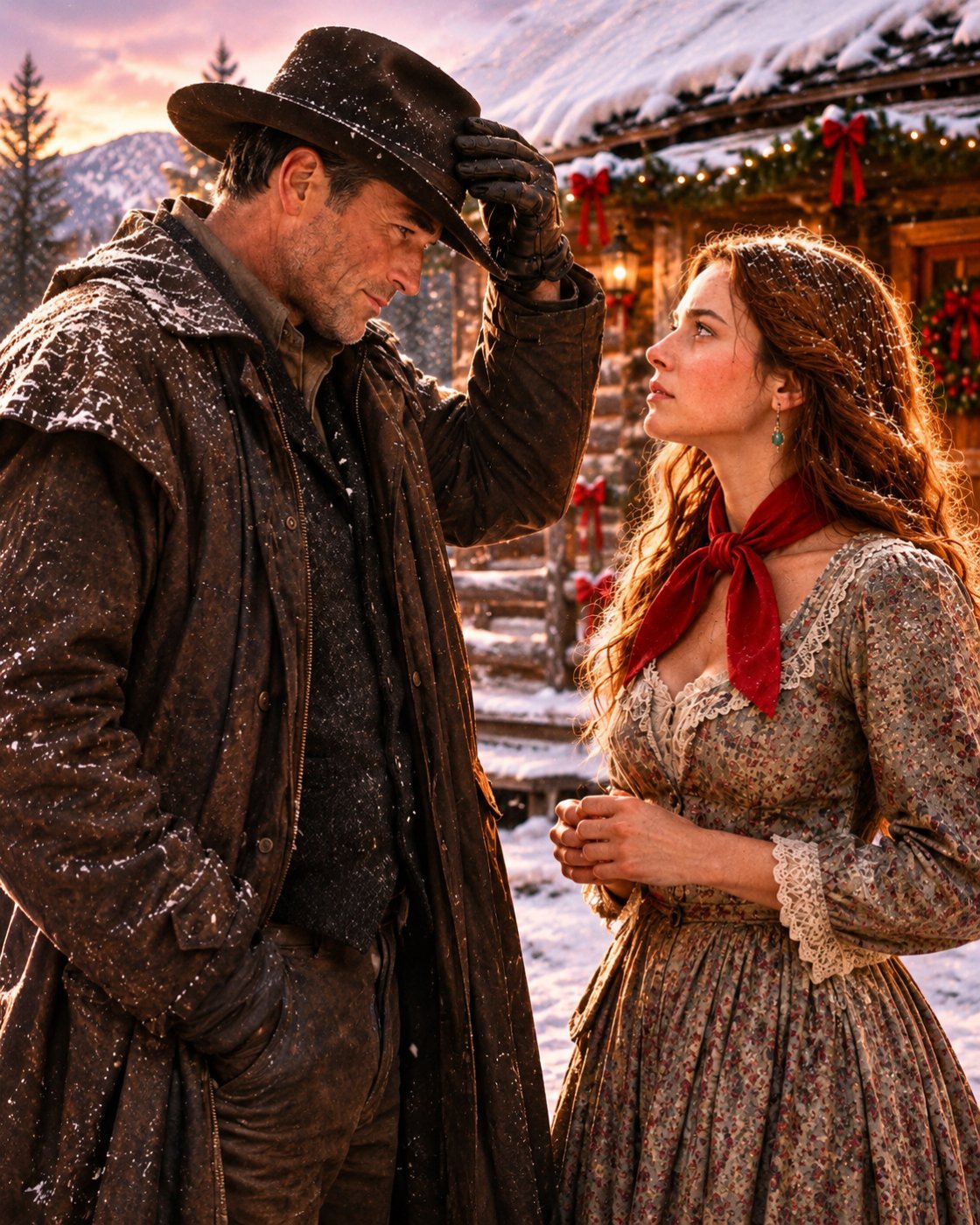
In case you missed it: Five days before Christmas, 1886, a drifter named Wade Corbett asked young widow Josie Harlow for work at her mountain stage station.
She'd invented a husband, "Percival," in twenty-two letters to keep her grieving father alive.
When a telegram said Papa was coming for Christmas, she begged Wade to play the part.
For two days, she trained him in lemon tea, bows, and Latin.
Then her father arrived.
At supper, he mentioned a widow on Lawrence Street in Denver who'd kept a lamp in her window for five years, waiting for her son.
Wade carried an unmailed letter in his coat, addressed to Lawrence Street.
"Percival?"
The judge was looking down the long table at him over his spectacles.
"Are you unwell, my boy? You've gone white as a sheet".
Wade set his fork down on the edge of his plate.
It made no sound at all.
His hand dropped under the table and pressed flat against the front of his coat, against the place where the oilcloth packet lay over his heart.
Josie saw it.
She didn't understand it.
But she saw it.
"The altitude, sir," Wade said hoarsely.
"Forgive me.
It catches up with a man sometimes.
Weak lungs".
"Ah.
Yes.
Josephine wrote me about your lungs".
The judge nodded sympathetically.
"Philadelphia air will do that.
All that coal smoke".
He went back to his venison.
"Well, as I was saying.
I'd hoped you'd meet her one day, Josephine.
Mrs. Corbett.
You'd like her very much.
She has a daughter, too, about twenty.
A sweet girl.
Sings in the choir at Trinity".
Under the table, Wade's hand closed into a fist against his coat.
"What's the son's name?" Josie asked.
She didn't know why she asked it.
Something in Wade's face made her ask.
"Oh, she never says it," said the judge.
"Not out loud.
I've had Sunday dinner at that table for four years, and I've never heard her say his name once.
As if it would hurt too much".
He shook his head.
"But the girl let it slip once.
Wade, I think it was.
Or Walt.
Something like that".
At the end of the table, Wade Corbett stood up.
"Excuse me," he said.
"I need some air".
He went out the front door into the snow without his coat.
The judge looked after him.
Then he looked at his daughter.
"Is he always like that, Josephine? After venison?"
"Mountain air," said Josie faintly.
"It takes some people strangely".
"Evidently," said the judge.
Wade came back in a quarter of an hour later, with snow melting in his hair and his face composed.
He sat back down at the foot of the table.
He drank his lemon tea without a word of complaint.
He answered the judge's questions about the weather and the stage road and the price of hay.
If Josie hadn't been watching him so closely, she would have thought nothing had happened at all.
But she was watching him.
And she saw that his hand never left the front of his coat for the rest of the meal.
After the plum pudding, the judge pushed back his chair and turned toward the corner of the room.
"And now," he said, rubbing his hands together, "the thing I've waited for since September".
Josie's hand closed around her napkin.
"Josephine has written me so much about your playing, Percival," said the judge.
"Letter number four.
'Percival played Silent Night at the church social, and the minister wept.
' I've read it so many times the page is coming apart".
He beamed.
"Please.
For an old man, on Christmas.
Play me Silent Night".
Wade rose.
He walked to the pump organ in the corner like a man walking to the gallows.
He lifted the folded quilt off it.
He sat down on the little stool.
He set his big boots on the pedals and his big scarred hands on the keys.
Josie closed her eyes.
He pumped.
The bellows filled with a long, asthmatic wheeze.
Then he played.
It was not music.
It was a disaster in four parts.
The first note went on far too long.
The second was the wrong one entirely.
The third seemed to belong to a different song, possibly in a different country.
Somewhere in the middle of the first verse, a stop jammed, and the organ let out a long, rising howl like a stepped-on hound.
Out in the kitchen, Judge the gray cat, who had come back in from the snow only an hour before, rose from his place by the stove.
He gave the organ one long look of pure contempt and fled out through his little door into the night.
Wade kept going.
He played all three verses.
He played them red to the ears, with sweat standing out on his forehead, pumping the pedals with grim determination.
Every single note was wrong.
He never once stopped.
When he finally lifted his hands from the keys, the silence in the room was very large.
Josie opened her eyes.
Her father was sitting very still in his chair at the head of the table, staring at the organ.
Then his shoulders began to shake.
He laughed.
He laughed until he had to take his spectacles off and wipe his eyes with his napkin.
He laughed until he was gasping for breath, holding his side.
And then Josie was laughing too, helplessly, with her face in her hands, and Wade sat on the organ stool with his ears scarlet and didn't know where to look.
"Oh, dear heavens," the judge gasped at last.
"Oh, my dear boy.
I once heard a blacksmith drop an anvil on a church bell.
It had more melody than that".
"I may be a little out of practice, sir," said Wade.
The judge put his spectacles back on.
He looked at Wade for a long time.
When he spoke again, he wasn't laughing anymore.
"A man who'll make a perfect fool of himself in front of his wife's father," he said quietly, "just to make her happy.
That's a good man".
He looked at his daughter.
"That's the only kind of man I ever wanted for you, Josephine".
Josie looked across the room at Wade.
He didn't look away.
The next morning was Christmas Eve.
It brought trouble.
The down stage was due through at midday, with Abel Kinney on the box.
It carried the Christmas mail and a load of supplies for the valley towns below.
Josie had the relief team harnessed and waiting by eleven.
But the night's thaw had frozen hard again before dawn.
The steep grade below the station, the last mile before the bend, had turned to glass.
They heard it before they saw it.
A shout.
Then the scream of a horse.
Then the grinding, slithering sound of iron wheels skidding on ice.
The stage had come over the top of the grade too fast.
The wheel brake couldn't hold on the glazed road.
The two lead horses lost their footing at the first bend.
They went wild, rearing and plunging in the traces, dragging the whole team sideways.
And the coach, with Abel fighting the reins on the box, began to slide toward the edge of the road, where the mountain dropped away three hundred feet into the gorge.
Wade was off the porch before anyone could stop him.
Josie screamed his name.
He didn't hear her.
He didn't shout at the horses.
He didn't run at them.
He walked straight into the middle of that tangle of plunging, screaming animals, talking low and steady the whole way.
It was the same few words, over and over, the way his father had taught him on a Kansas wheat farm when he was eight years old.
Easy now.
Easy.
Nobody's going to hurt you.
Easy now.
He caught the near leader by the cheek strap.
The horse reared and nearly lifted him off his feet.
He hung on.
Then he pulled off his own coat with his free hand and threw it over the horse's head, over its eyes.
A blinded horse will stand still, if it can't see the thing that's frightening it.
Every horseman in the West knew it.
The leader shuddered, and blew, and went still.
The off leader felt it and steadied.
"Chain!" Wade shouted up at the box.
"Abel! Rough-lock the back wheels!"
Abel Kinney dragged the heavy brake chain out from under the box and threw it down.
Wade caught it one-handed.
Still holding the blinded leader, still talking softly, he wrapped the chain around the rim of the rear wheel and through the spokes.
Locked like that, the wheel would slide on the ice like a sled runner instead of rolling.
He did the other side.
Then, step by slow step, he walked the whole team down the frozen grade.
He went in front, holding the leader's head under his coat, talking the whole way.
The coach slid behind them on its locked wheels, grinding and scraping, but straight.
It came down to the flat ground below the bend and stopped.
Abel Kinney sat on the box breathing hard, gray-faced under his buffalo coat.
"Mister," he said.
"I've driven this pass eleven years.
I never in my life saw a team handled like that".
Wade stood in the snow in his shirtsleeves, steam rising off his shoulders.
He was shaking a little, now that it was over.
Slowly, he turned around.
Up on the porch of Harlow Station stood Josie, with both hands pressed over her mouth.
And beside her, leaning on his silver-headed cane, stood the judge.
Percival Ashby of Philadelphia was terrified of horses.
Every one of the twenty-two letters said so.
Letter number seven said he had once fainted dead away at the sight of a mule.
The judge didn't say anything.
He came down the porch steps very slowly, one at a time, leaning on his cane.
He walked across the yard through the snow to where Wade's coat lay in a heap.
It had slid off the horse's head when the team stopped.
The old man bent, with some difficulty, and picked it up.
Something slid out of the inner pocket and fell into the snow at his feet.
A small packet, wrapped in oilcloth.
The judge picked it up.
The oilcloth had come loose in the struggle.
He saw the envelope inside.
He saw the faded ink of the address, in a young man's careful hand.
Mrs. Ruth Corbett.
Lawrence Street.
Denver, Colorado.
For a long moment, the old man stood absolutely still in the snow, holding it.
Then he folded the oilcloth closed again over the envelope, very carefully.
He put the packet back inside the coat, in the inner pocket, exactly where it had been.
He walked across the yard to Wade and held out the coat.
"You'll catch your death," was all he said.
Wade took the coat.