PART 3
The blizzard swallowed them within a quarter mile.
Jedediah left the trail almost at once.
A trail was a line on the snow that any fool could follow, and the men behind them were not fools.
He turned the roan straight into the spruce, where the trees grew so close that their branches knit together overhead and the snow came down through them in slow, heavy clumps.
The drifts were already knee-deep on the horse.
In the open places between the trees, the wind came screaming down off the peaks so hard that Jedediah could not see his own hand on the reins.
He rode by memory.
Five years of winters had taught him every ravine on this side of the range, every hidden bench and switchback, every place where the snow lay soft over a drop that would break a horse's legs.
Clara sat in front of him with Josephine bundled against her chest under a fold of his coat.
His arms were around both of them, holding the reins.
At first she held herself stiff, leaning forward, as far from him as the saddle allowed.
She did not know him.
An hour ago he had shot two men in front of her.
But the cold was a stronger argument than pride.
After the first mile, her back came against his chest.
After the second, her head tipped back against his shoulder.
"Are you warm enough?" he asked near her ear.
"No," Clara said.
Then, after a moment: "But I'm warmer than I was".
The baby was quiet.
Every few minutes, Clara lifted the fold of fur and looked down at her, as if she needed to make sure the child was still there, still real, still breathing.
Each time, Jedediah felt her whole body let go a little.
They climbed for two hours.
The air thinned until each breath burned.
The roan's sides heaved under them.
Once, crossing a steep slope of loose shale buried under new snow, the horse's back hooves slid out from under it, and for one terrible second they hung tilted over a drop into white nothing.
Jedediah threw his weight forward and spoke low to the animal, and it scrambled and found its footing and went on.
Clara did not scream.
She only tightened her arms around Josephine and closed her eyes.
As the last gray light drained out of the sky, they broke through a thicket of stunted pines and came out on a rocky shelf high on the mountain.
Built straight into the cliff face at the back of the shelf was a cabin.
It was low and heavy, made of unpeeled logs as thick as a man's waist.
The roof pitched steeply to shed the snow.
The windows were narrow slits barred with iron.
A lean-to shed for the horse was built against one side, and a stone chimney rose out of the rock itself.
It did not look like a home.
It looked like a fort.
Jedediah lifted Clara down and set her on her feet.
Her legs nearly gave way.
He caught her elbow and held it until she was steady, then opened the heavy door and guided her inside.
"Stand right there," he said.
"Don't move till I've got light".
He led the roan into the lean-to, stripped the saddle, threw a blanket over its steaming back, and filled its feed box with oats.
He rubbed the horse's neck for a moment and spoke to it.
Then he went in and barred the door behind him.
The cabin was black and freezing, but it was dry.
Jedediah moved through the dark without a misstep.
A match scraped.
A kerosene lamp bloomed yellow on a heavy plank table.
Clara looked around.
She had expected a hermit's den, all filth and bones.
Instead, the room was neat as a ship's cabin.
Cast-iron skillets hung on pegs along one wall in order of size.
Shelves held rows of jars, dried meat wrapped in cloth, sacks of flour and beans.
A rifle rack stood by the door.
A bear-fur rug lay before an enormous stone fireplace that filled nearly the whole back wall, where the cliff rock itself made the chimney.
Everything had a place.
Everything was in it.
"Sit by the hearth," Jedediah said.
He knelt and built a fire with quick, sure hands.
Shavings, then kindling, then split pine, then a log of oak.
Within minutes, the flames were roaring up the stone chimney, and heat began to push back the bitter cold.
Clara sank into a heavy rocking chair by the fire.
She unwrapped Josephine from the layers of wool, and the baby blinked at the firelight and began to fuss.
"She's hungry," Clara said.
"She hasn't eaten since yesterday morning except what you gave her.
I don't have anything for her.
My milk's been drying up since.
.
".
She stopped.
"Since Josiah".
Jedediah was already at the shelves.
He came back with a dented tin of condensed milk.
He warmed a little snow in a pot, mixed in the milk, and tested it on the inside of his wrist.
Then, while Clara watched, he took a small, clean leather pouch from a drawer, cut a tiny hole in one corner with the tip of his knife, and pushed a short length of hollow reed through the hole.
"My boy wouldn't take a cup either," he said quietly, filling the pouch.
"His mother was sick.
This was the only way".
He handed it to her.
Josephine latched onto the reed and drank so greedily that milk ran down her chin.
Clara laughed, a cracked, startled sound, and then she was crying, and then she was laughing again, rocking the baby and wiping her own face with the back of her wrist.
Jedediah turned away to the fire to give her privacy.
He put a kettle of snow on the hook to melt.
Then he started a stew in the big iron pot: dried elk, a handful of beans, two shriveled potatoes, an onion, salt.
The smell filled the room.
When Josephine had drunk her fill, she fell asleep against Clara's shoulder with her mouth open and one fist curled against her mother's neck.
Clara looked across the cabin at the man by the fire.
He was enormous in the small room, with his shaggy dark beard and his broad shoulders and his big scarred hands.
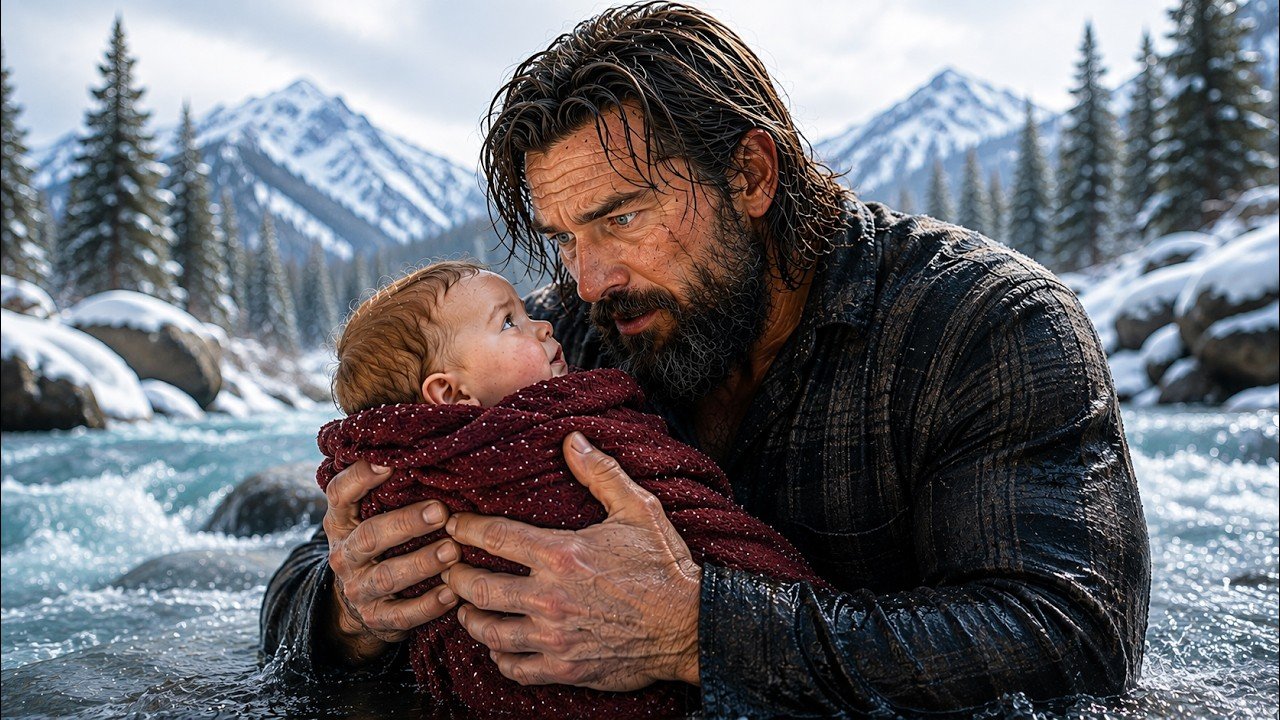
And he had held her daughter against his bare skin all night in the snow to keep her alive.
"You saved my daughter," Clara said softly.
"You went into Dead Man's Creek in the middle of winter.
Everybody in the valley knows what that creek does.
You could have died.
Why did you do it?"
Jedediah was quiet for so long that she thought he wasn't going to answer.
He set down the spoon.
He stared into the fire, and the light moved in his blue eyes.
"Five years ago," he said, "I had a farm in Missouri.
A wife named Mary.
A boy named Thomas.
He was two".
He stopped.
His jaw worked under the beard.
"The cholera came through our county in the summer.
It went through like a scythe through wheat.
I watched them both go in four days.
I sat by the bed.
I couldn't fight it.
Couldn't shoot it.
Couldn't do one thing".
The fire popped.
Josephine sighed in her sleep.
"I buried them under the walnut tree behind the house," he said.
"Then I sold the farm for whatever the first man offered, and I bought a horse and a rifle and rode west till the land ran out.
I came up here so I'd never have to watch anybody die again".
He turned his head and looked at her.
Beneath all that beard and fur, his face was naked with grief.
"I'd already turned my horse away," he said.
"I want you to know that.
I'm not a hero, Mrs. Jenkins.
I saw them throw her in, and I turned my horse for the timber.
Then the wind came up the canyon, and I heard her say it".
His voice cracked.
"Thomas used to say it just like that.
Mama.
Every morning when he woke up.
I couldn't sit on that ridge and listen to another one say it for the last time".
Clara's eyes filled.
She stood, holding the sleeping baby, and crossed the room.
She put her free hand on his thick forearm and left it there.
"You turned back," she said.
"That's the only part that matters".
He looked down at her hand.
"Jedediah McCall," he said, as if he had only just remembered he had a name.
"Clara," she said.
"Clara Jenkins.
And this is Josephine.
And I owe you a debt I can never repay as long as I live".
They ate the stew at the plank table.
Clara had not known how hungry she was until the first spoonful, and then she could not stop.
Jedediah filled her bowl twice without being asked.
Afterward, while the fire burned down and the wind howled against the iron bars of the windows, she told him.
She had married Josiah Jenkins three years ago in the valley town of Hope Springs.
He was a quiet man with big ideas and a laugh that made strangers smile.
He had a small claim in the hills west of the valley, and for two years he had dug in it every day and found nothing but rock and more rock.
Then, last spring, he had broken into a vein of silver as wide as a man's hand.
"He came home white as a sheet," Clara said.
"He sat at our table and couldn't talk.
When he finally could, the first thing he said was, 'Clara, we're going to build a school.
'" She smiled, and her eyes were wet.
"Hope Springs never had one.
The children learned their letters from whoever had time.
Josiah only went three winters himself.
He said if God had put that silver in his hill, it wasn't so he could buy a fine carriage".
"And Amos?"
Clara's face hardened.
"Josiah's half brother.
Same mother, different fathers.
Amos took his father's name, Gentry, and his father's ways.
He's been swindling homesteaders out of their land up and down that valley for ten years.
Buying up mortgages, calling them in early.
Rustling.
Everybody knew it and nobody could prove it".
She looked down at Josephine.
"Josiah always gave him another chance.
He said family is family.
He said Amos had a hard father and a hard life, and one day he'd come round".
"And he didn't".
"Three weeks ago, Josiah rode out to the claim and never came back".
Her voice went flat and careful, the way people speak when they have told a thing so many times in their own head that the words have worn smooth.
"They found him at the bottom of the shaft.
The sheriff said he slipped on the ladder.
But Josiah went up and down that ladder a hundred times a week for two years.
He didn't slip".
She looked up at Jedediah.
"Two days after the funeral, Amos came to the house with a paper.
He said Josiah had sold him the claim before he died.
He said here was the deed, all signed and sealed.
I told him it was a lie and to get off my porch.
That night, somebody burned our barn".
She swallowed.
"I loaded the wagon the next morning.
I was going to my sister in Helena.
I was going to take that deed to a lawyer there, where nobody had heard of Amos Gentry or Judge Caldwell.
I had Josephine on the seat beside me".
Her voice broke.
"They caught me at the creek".
Jedediah was silent for a long moment.
"You understand why he needs you dead," he said at last.
"Because I'm Josiah's widow".
"Because you're Josiah's heir.
You and the baby.
If the claim was never sold, it passes to you.
And if you're both gone, nobody's left to say the deed is false".