PART 3
In case you missed it: In December of 1886, wealthy rancher and banker Wyatt Callahan rode alone into the Montana mountains to see a homestead his bank was about to take.
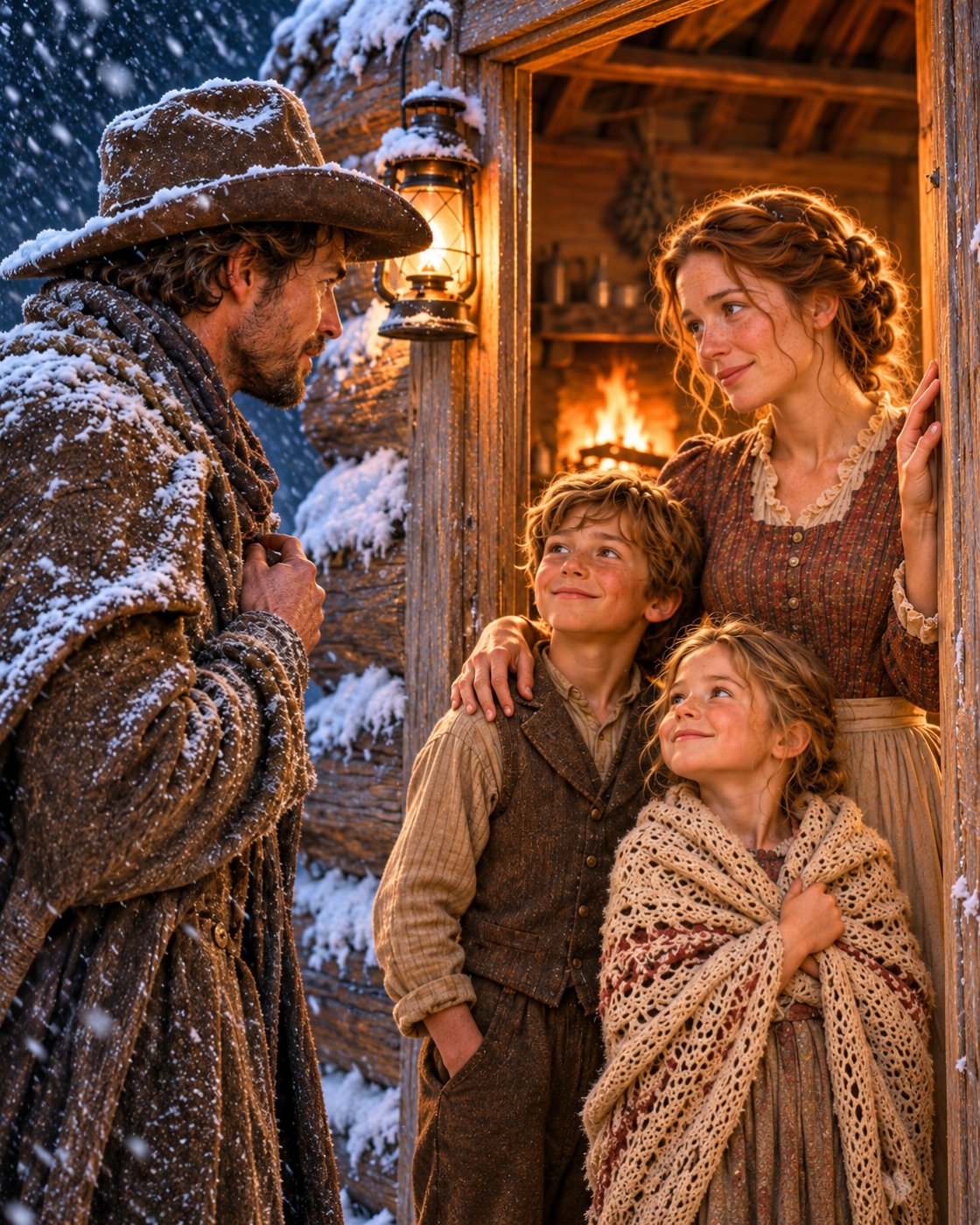
A blizzard caught him, and a lamp in a window led him to the cabin of the very widow he'd come to foreclose on, Clara Hale, and her children, Sam and Rosie.
Snowed in, he let them believe he was just a poor cowboy named Wyatt.
Then, on the fourth morning, he found the foreclosure letter, with his own signature at the bottom.
Wyatt stood in that little kitchen with the letter in his hand, and for a long moment, he couldn't make his mouth work.
Clara took it from him gently, the way you'd take a sharp knife from a child.
She folded it along its old creases and slid it back behind the coffee tin.
"Don't look like that," she said.
"You look like somebody kicked your dog".
"Clara, it's the day after Christmas".
"I can read, Wyatt".
She turned to the stove and began to stir the oatmeal, which was mostly water.
"I've known since October.
I wrote to the bank twice.
Asked if they'd take a payment in the spring, after I sold the calf.
Nobody wrote back".
She shrugged one thin shoulder.
"I don't suppose the man who owns that bank has ever read a letter from anybody like me in his life".
Wyatt thought of the stack of correspondence Silas Crane brought him every Friday.
He thought of how he'd tell Silas, "Handle it," without looking up.
He thought of the wastebasket by his desk.
"No," he said hoarsely.
"I don't suppose he has".
"So I'll tell the children after Christmas.
We'll go down to Miles Crossing.
I can take in washing.
I can cook.
Mrs. Ostrander says the hotel needs a girl in the kitchen".
She tapped the spoon on the rim of the pot.
"It isn't the end of the world.
It's just the end of this part of it".
"This is Tom's house," Wyatt said.
"He built every log of it".
Her hand went still on the spoon.
"Yes," she said, after a moment.
"He did".
Then the door banged open, and Rosie came in with snow up to her knees and Henrietta under one arm, shouting that Buttercup had given half a bucket, and the moment was gone.
But it didn't leave Wyatt.
It sat in his chest all day like a stone.
He split wood until his palms blistered through his gloves.
He went up the ladder and nailed down two more boards on the roof, though there wasn't much left to fix.
Every time he came back inside, his eyes went to the coffee tin.
He could tell her.
He could say it plainly right now.
I'm Wyatt Callahan.
I own the bank.
I'll tear up the paper.
And then what? He imagined her face.
The way she'd look at him.
Every bowl of soup she'd given him, every blanket, every kind word, all of it would curdle in the remembering.
She'd think he had come up the mountain to look over her property like a buyer at an auction.
Which was exactly what he had done.
And she would never, ever take his charity.
He knew that about her already.
A woman who'd give her last bowl of soup to a stranger and then lie about it so he'd eat it would not take a gift from the man who'd tried to take her house.
She'd go to Miles Crossing and wash other people's sheets before she let him feel generous.
So that night, lying on the pallet by the fire, Wyatt did a thing he hadn't done since he was sixteen years old.
He prayed for help with something money couldn't fix.
He'd come west in 1862 with a borrowed rifle and a pair of boots with holes in them.
His father had died owing money to every merchant in Independence, Missouri, and Wyatt had watched the bank men carry the furniture out of their rented rooms one piece at a time, while his mother sat on the step and cried.
He'd sworn that day that nobody would ever carry anything out of his house again.
So he worked.
He drove cattle up from Texas for thirty dollars a month.
He saved every cent.
He bought ten head, then a hundred, then a thousand.
He bought land, then the water on the land, then the bank that held the notes on everybody else's land.
He built the stone house on the hill above Miles Crossing, and he filled it with furniture so heavy no bank man could ever carry it out.
Somewhere along the way, he had become the man on the other end of the furniture.
He'd never married.
There'd been a girl in Denver once, but she'd looked at his ledger more than she'd looked at him, and he'd seen it, and that was the end of that.
After her, it had just been easier to keep to the ledger himself.
"Lord," he whispered into the dark, while the fire popped and Rosie snored softly behind the blanket curtain, "I don't know how to fix this without breaking it.
Show me how".
The answer, when it came, came in the shape of a saddlebag.
The next evening, Wyatt went out to the barn and came back stomping snow, with both of his saddlebags over his shoulder.
He set them on the table, unbuckled them, and began to lay things out, one by one.
Two tins of peaches.
A sack of coffee, real coffee, not the parched barley Clara had been boiling.
A paper cone of white sugar.
A slab of smoked bacon wrapped in cheesecloth.
A bag of dried apples.
A tin of crackers.
A little jar of honey.
And at the very bottom, a tin of oysters packed in Baltimore.
The truth was simpler than any miracle.
Mrs. Abernathy, his housekeeper of fifteen years, had never once in her life let Wyatt Callahan ride out of the yard without enough food for a cavalry company.
He'd always grumbled at it.
He had never once eaten it.
Most of it usually came home again and went into the pantry, where it sat until it was given to the hands.
Rosie stared at the peaches with her mouth open.
"Peaches," she whispered.
"Mama, look.
Real peaches.
Just like at the store".
Clara was looking at the oysters.
"Wyatt," she said slowly.
"Where on earth did all this come from?"
"My saddlebags, ma'am".
He didn't meet her eyes.
"A cowboy never travels without supplies".
"Oysters?"
"It's a long ride from anywhere up here".
"You've been here five days and you never said a word".
"I forgot they were there".
That part, at least, was very nearly true.
"The cold must've got to my head".
Clara looked at him for a long moment.
Something moved behind her eyes, a question she decided not to ask.
Then she picked up a tin of peaches and turned it in the lamplight, as if it were a jewel.
"Tom bought me a tin of these once," she said softly.
"For our first anniversary.
Rode all the way to Miles Crossing for it".
She set it down carefully.
"We'll save them.
For Christmas".
That night, they had bacon with their beans, and real coffee with sugar in it.
Sam ate three helpings and didn't apologize for any of them.
Rosie fell asleep at the table with honey on her chin.
It was the first of many fibs Wyatt Callahan would tell that week.
Years later, he liked to say they were the only fibs he'd ever told that he never once regretted.
Henrietta got her new eye the next day.
Rosie had been explaining Henrietta's tragedy to Wyatt all week, in pieces, the way small children do.
The doll had been made by her grandmother back in Ohio and sent out west in a crate when Rosie was born.
She had two black shoe buttons for eyes.
Then last summer, Henrietta had fallen in the creek, and when Sam fished her out, one of her eyes was gone forever.
"She says it doesn't hurt anymore," Rosie told him gravely.
"But she can only see half of everything".
Wyatt considered this.
Then he reached into his coat, which was hanging by the fire, and took out his pocketknife.
Very carefully, he cut off one of the brass buttons from the cuff.
It was a good coat.
Plain wool, but good, the kind of coat a man buys in Chicago.
And the buttons were real brass, stamped with a little star.
"Do you think Henrietta would like a fancy brass one?" he asked.
Rosie's mouth fell open.
Clara brought her sewing box.
Wyatt held Henrietta still while Rosie supervised and Clara stitched the brass button onto the doll's face, right where the missing eye had been.
When she bit the thread off, Henrietta had one black eye and one shining gold one.
"She looks like a pirate," said Sam.
"She looks like a queen," said Rosie, and hugged the doll so hard her pirate eye nearly came off again.
Clara put her sewing things away.
Then she picked up Wyatt's coat to hang it back on its peg, and stopped.
Her fingers found the other brass buttons, rubbed the fine-woven wool, and touched the silk lining at the collar.
She didn't say anything.
She just hung the coat up very straight, and smoothed its shoulders with both hands.
But Wyatt saw her face, and he knew she had added it to some private account she was keeping.
On the sixth day, the storm took a breath.
The wind dropped.
The clouds thinned to a white haze.
Through the haze, for the first time in nearly a week, came the pale ghost of the sun.
And the children decided, all at once and with great force, that a Christmas without a tree was no Christmas at all.
"Papa always cut one," said Sam.
"Every year.
Even the year we didn't have any money".
"We still don't have any money," said Rosie cheerfully.
So they bundled up, all four of them.
Wyatt carried the axe.
Sam carried a coil of rope.
Clara carried a lantern, in case the weather turned.
Rosie carried Henrietta, so Henrietta could help choose.
They waded up the slope behind the cabin into the pines, the snow up to Wyatt's thighs and nearly to Rosie's armpits.
Wyatt ended up carrying Rosie on his shoulders, which she declared was the best way to choose a tree, because you could see the tops.
They looked at a dozen trees.
Sam wanted a tall one.
Clara wanted one they could get through the door.
Rosie wanted every single one, until she suddenly didn't.
"That one," she said, pointing.
"Mr. Wyatt, that one.
That one's perfect".
It was a little spruce, about five feet tall, growing out of a crack in a boulder.
It leaned hard to the left.
Half its branches were thin where the wind had whipped them.
"That one's a little bit crooked, Miss Rosie," Wyatt said carefully.
"So is Henrietta," said Rosie.
"And she's perfect too".
Wyatt looked up at her.
She looked back down at him, with her chin set exactly like her mother's.
He cut the crooked tree.
They dragged it home in triumph.
Sam built a stand from two crossed boards.
Clara strung dried rosehips and a string of popcorn from the last of the corn.
Rosie cut stars out of the paper the crackers had come wrapped in.
Sam carved a little wooden star for the top, with his father's old whittling knife, and Wyatt helped him smooth the edges.
When it was finished, they stood back together and looked at it in the firelight.
It still leaned to the left.
The popcorn was lumpy.
One of the paper stars was upside down.
"Oh," breathed Rosie.
"It's the most beautiful Christmas tree we've ever had".
Wyatt thought of the trees at the stone house.
Every year, Mrs. Abernathy had the hands haul in a fourteen-foot fir and trim it with glass ornaments shipped from Germany.
Every year, it stood in the front parlor, lit with a hundred candles, and nobody saw it but Wyatt and the help.
"I've had trees taller than this whole cabin," he said quietly.
"Not one of them ever looked like this".
Clara looked at him sideways over Rosie's head.
She didn't ask how a poor cowboy came to have trees taller than a cabin.
She only smiled, a little sadly, and looked back at the tree.
But mountain storms are never finished when they say they are.
That night, the wind came back harder and meaner than before.
It came down off the peaks screaming.
It tore at the roof boards Wyatt had nailed.
It hurled snow against the window until the glass rattled in its frame, and the lamp flame bent sideways in the draft.
Out in the barn, Buttercup began to bawl.
She bawled for an hour.
It was a high, frightened sound, and it went right through the walls.
Sam sat up on his pallet, listening.
"Something's wrong with her," he said.
"She doesn't cry like that".
"She's frightened of the wind, Sam," Clara said.
"Lie down".
"What if the barn door's blown open? She'll freeze.
She's all we've got.
If we lose Buttercup, Rosie doesn't have any milk".