PART 3
The kitchen door slammed against the wall so hard that the little evergreen branch above the window shook.
Abner stood in the doorway, his white hair wild beneath his wool cap, his breath coming in clouds.
“Somebody's been in the office,” he gasped. “The Army papers are gone.”
Elias Brandt was on his feet before the old cook finished speaking.
“What papers?”
“The delivery certificate. The contract. Everything you kept in that brown leather folder.”
Clementine rose from her chair.
“Did you see who took them?”
Abner nodded toward the dark yard.
“Caught sight of a rider leaving through the south gate. Heading toward Whitcomb's place.”
Elias reached for his coat.
“Dutch Kessler.”
“You don't know that,” Clementine said.
“I know who has a reason to stop those horses reaching Fort Keogh.”
“And if you ride after him alone, he may have a reason to stop you reaching home.”
Elias turned.
There was something in Clementine's expression that made him hesitate.
She was not frightened of the man who had stolen their papers. She was frightened of what her husband might do in anger.
He had spent two winters learning how to endure grief by himself. He had become so accustomed to handling trouble alone that asking for help seemed almost unnatural.
But Clementine had not come all the way from Kentucky to watch another man destroy himself over pride.
“Get your rifle,” she said. “But leave it in the scabbard unless you need it. I'll saddle Daisy.”
“No.”
She folded her arms.
“Elias.”
“It's dark. The snow's getting worse.”
“Which is precisely why you shouldn't go alone.”
He stared at her.
Three weeks earlier, he would have ordered her to remain inside.
Now he knew such an order would accomplish nothing except make her angry.
And he was beginning to discover that an angry Clementine Brandt was a formidable thing.
“All right,” he said at last. “But we stay together.”
She reached for her coat.
“That sounds like something a husband ought to say.”
Despite everything, Elias almost smiled.
Outside, the ranch lay beneath a moonless sky.
Snow swept across the yard in pale, restless sheets. The horses shifted uneasily inside the barn, and the wind rattled the loose boards along the western wall.
Clementine saddled Daisy, a sturdy bay mare she had trained during her first week at the ranch.
Elias mounted his gray gelding.
Before they left, Abner caught Clementine's sleeve.
“Miss Clem?”
She looked down at him.
“Yes?”
“Don't let him do anything foolish.”
She glanced at Elias.
“I'll do my best.”
Abner lowered his voice.
“And don't do anything foolish yourself.”
Clementine smiled.
“I make no promises.”
They rode south through the darkness.
For nearly a mile, the only sounds were the horses' hooves breaking through crusted snow and the wind moving across the frozen grass.
Then Clementine raised her hand.
Elias stopped.
“What is it?”
She pointed toward a shallow depression beside the trail.
“Fresh tracks.”
He dismounted and examined them.
One horse.
Moving quickly.
The tracks continued toward the old timber bridge crossing Willow Creek.
Clementine leaned forward.
“Look at the right hind print.”
Elias studied it.
The horseshoe had a distinctive broken edge.
He recognized it.
“Dutch's sorrel.”
Clementine nodded.
“Then we know who took the papers.”
Elias rose.
“And where he's going.”
They followed the tracks until a faint light appeared beyond a stand of cottonwoods.
An abandoned line shack stood near the creek.
Smoke drifted from its chimney.
Elias dismounted quietly.
Clementine followed.
Through the frosted window, they saw a man sitting beside a small stove.
Dutch Kessler.
The former horse trainer held a bottle in one hand and a folded document in the other.
Elias reached for the door.
Clementine caught his wrist.
“Wait.”
He looked at her.
She pointed toward the horse tied beneath the lean-to.
The sorrel's reins were hanging loose.
Its ears were pinned backward.
And someone had left a heavy sack resting against the animal's injured shoulder.
Clementine whispered, “He's been riding that horse hard.”
“Clem, we're here for the papers.”
“I know.”
She looked toward the window again.
“But a man who treats his horse that badly may not be thinking clearly.”
Elias studied her for a moment.
Then he stepped to the door and knocked.
Inside, the chair scraped against the floor.
“Who's there?”
“Brandt.”
Silence.
Then a curse.
“Go away.”
“Open the door, Dutch.”
“I've got a gun.”
“So have I. I'd rather neither of us use one.”
Another silence followed.
Finally, the door opened a few inches.
Dutch stood behind it, his face pale and his eyes bloodshot.
Elias pushed the door wider.
“I want my papers.”
Dutch laughed bitterly.
“Your papers won't save you.”
Clementine stepped into the doorway.
“Perhaps not. But stealing them won't save you either.”
Dutch looked at her.
“The bride.”
“My name is Clementine.”
He snorted.
“Whitcomb said you'd be trouble.”
Elias went still.
“So Whitcomb sent you.”
Dutch looked away.
Clementine spoke before Elias could move.
“How much did he pay you?”
Dutch's jaw tightened.
“Enough.”
“For the papers?”
“For everything.”
The room fell silent.
Elias stared.
“The fence?”
Dutch said nothing.
“The missing gelding?”
Still nothing.
Clementine took a step closer.
“And the black stallion?”
Dutch's expression changed.
She saw it immediately.
“You hurt Ember deliberately.”
“He was already mean.”
“You made him afraid.”
Dutch slammed the bottle onto the table.
“That horse nearly broke my ribs!”
“After you drove your spurs into him.”
Dutch's eyes widened.
Clementine continued quietly.
“I found the scars.”
For a moment, he looked genuinely ashamed.
Then he turned toward Elias.
“Whitcomb promised me a hundred dollars if the Army contract failed. Said you'd lose the ranch anyway. Said there was no sense in going down with you.”
Elias's hands curled into fists.
“Men trusted you with those horses.”
Dutch looked down.
“I know.”
“And you drove them into a storm.”
“I didn't mean for any to die.”
“But one is missing,” Clementine said.
Dutch swallowed.
“I didn't take the gelding.”
“Then where is he?”
“I don't know.”
Elias stepped forward.
“Give me the papers.”
Dutch hesitated.
Then he lifted the leather folder from beneath his coat.
Elias took it.
The documents were damp but intact.
He checked the contract.
The delivery date remained unchanged.
Noon on Christmas Eve.
Less than thirty-six hours away.
Dutch looked toward the stove.
“Whitcomb won't stop because you found me.”
Elias closed the folder.
“Then perhaps it's time somebody stopped him.”
Clementine looked at Dutch.
“You'll come with us.”
He laughed.
“To do what? Confess?”
“Yes.”
He shook his head.
“Whitcomb will ruin me.”
Clementine studied him.
“You've already done a fair amount of that yourself.”
Dutch looked away.
She softened her voice.
“But you can decide whether you're going to make it worse.”
For a long moment, the only sound was the stove ticking.
Then Dutch reached for his coat.
“All right.”
Outside, Clementine went to the sorrel and carefully removed the heavy sack from its shoulder.
Dutch watched her.
“You don't have to bother with him.”
She loosened the girth.
“Somebody does.”
The former trainer lowered his eyes.
And Elias, standing beside his wife in the bitter Montana cold, understood that Clementine possessed a kind of courage he had rarely encountered.
She could confront a dishonest man without becoming cruel herself.
He wondered whether he would ever deserve her.
They reached the ranch shortly before dawn.
Abner was waiting with coffee, fresh biscuits, and an expression of profound irritation.
“Three fools,” he announced when he saw Dutch.
Elias frowned.
“Three?”
“You two for riding out in this weather, and him for thinking he could outrun a woman who knows horses.”
Clementine laughed.
Dutch did not.
Elias locked the recovered papers in a metal strongbox and sent one of his ranch hands to fetch the county deputy.
Dutch agreed to remain until the lawman arrived.
There was no time for a lengthy investigation.
The Army contract mattered first.
Clementine stood in the barn counting the animals.
Nineteen.
She counted again.
Still nineteen.
The missing gelding had not returned.
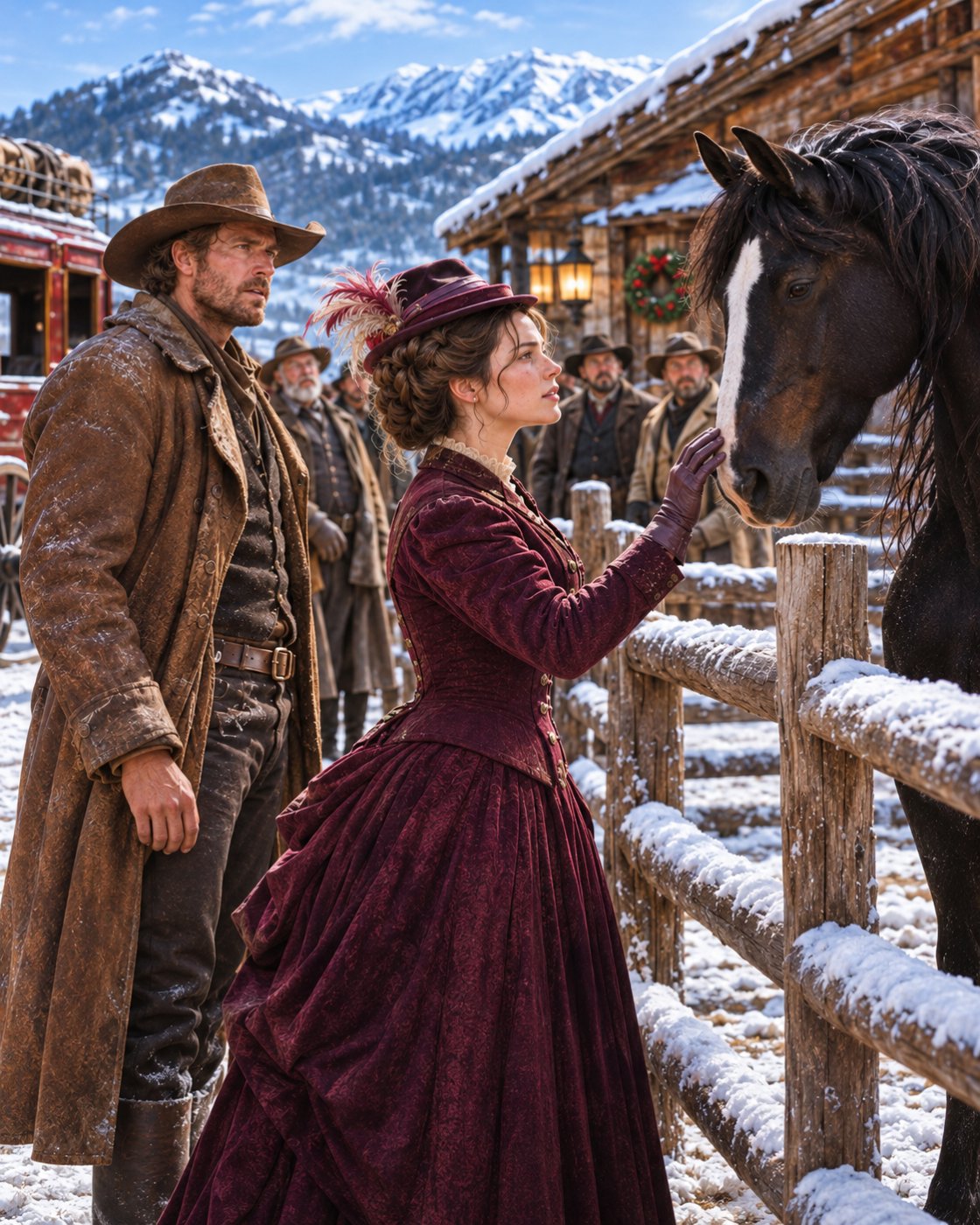
Ember stood in the far stall, his black coat shining beneath the lantern light.
He lifted his head when she approached.
“Hello, handsome.”
The stallion breathed softly against her palm.
She scratched the white star between his eyes.
Behind her, Elias entered the barn.
“The deputy should arrive before noon.”
Clementine nodded.
“And the horses?”
“Abner's getting the wagon ready. We'll leave before first light tomorrow.”
She turned.
“That's not enough time.”
“It's all we've got.”
He looked toward Ember.
For a moment, neither spoke.
Then Elias said, “I meant what I told you.”
“About what?”
“Whatever happens to the ranch, I want you to stay.”
Clementine lowered her eyes.
She had been thinking about those words all night.
In Kentucky, her uncle had treated her future as a transaction.
A wealthy older man wanted a wife.
Her family needed money.
Therefore Clementine was expected to marry him.
No one had asked what she wanted.
Then Elias had advertised for a bride who could cook.
He had needed someone to keep his household running while he fought to save the ranch.
She had answered because she needed somewhere to go.
Their marriage had begun with two people making practical promises.
But something had changed.
She had begun listening for his footsteps in the evening.
She knew how he liked his coffee.
She knew that he rubbed the bridge of his nose when worried and went silent when grief overtook him.
She knew he always checked the barn doors twice before bed.
And she knew that when he laughed, truly laughed, he looked younger than his thirty-nine years.
“Elias,” she said softly, “do you ever wish I'd been the woman you expected?”
He looked puzzled.
“What woman?”
“The one who could cook.”
He smiled faintly.
“Abner wishes that every morning.”
She laughed.
Then grew serious.
“I know you didn't ask for someone who would turn your entire ranch upside down.”
Elias stepped closer.
“No.”
Her heart sank.
Then he continued.
“I asked for someone who wouldn't fear winter.”
He looked around the barn.
“And I got a woman who rides into snowstorms, argues with horse thieves, and teaches frightened animals to trust people again.”
Clementine swallowed.
“That's rather more than I advertised for.”
His smile faded into something tender.
“And I wouldn't trade it.”
She looked at him.
“Not even for a good cook?”
“Especially not for a good cook.”
They laughed quietly.
Then Elias reached for her hand.
Clementine let him take it.
His fingers were rough and warm.
For a moment, the world seemed to grow still around them.
But before either could speak, Ember struck the stall door with one enormous hoof.
Clementine turned.
The stallion tossed his head.
Elias sighed.
“I believe your horse disapproves of being ignored.”
Clementine smiled.
“He's impatient.”
“So am I.”
She looked back at him.
His expression made her heart beat faster.
But Elias simply squeezed her hand and stepped away.
They still had a ranch to save.
And neither of them knew whether Christmas morning would find them living in the same house.
By afternoon, the deputy had taken Dutch's statement.
The former trainer admitted cutting the fence, scattering the horses, and stealing the Army papers.
He also admitted accepting money from Silas Whitcomb.
The deputy warned Elias that proving Whitcomb's involvement would require more than Dutch's word.
Whitcomb was wealthy.
He had friends in business.
And he knew how to make trouble disappear beneath layers of paperwork.
Elias understood.
He had spent years watching the man acquire land from ranchers who could no longer pay their debts.
Whitcomb offered loans when banks refused.
Then he waited.
Sometimes the weather ruined a harvest.
Sometimes cattle prices fell.
Sometimes a family suffered illness or death.
And when the rancher could not pay, Whitcomb appeared with a deed ready to sign.
The Brandt Spring was the one piece of land he had never managed to obtain.
It supplied water to Elias's eastern pasture and remained reliable even during the driest summers.
Without it, Whitcomb's neighboring property was worth considerably less.
With it, he could control grazing rights across the valley.
Elias knew all of this.
But knowing why a man wanted to destroy him was different from proving how he had tried.
That evening, the deputy departed with Dutch.
Before climbing into the wagon, Dutch turned toward Clementine.
“Mrs. Brandt?”
She looked up.
“Yes?”
He hesitated.
“That black horse.”
“Ember.”
Dutch swallowed.
“I didn't know what I was doing with him.”
Clementine studied his face.
“Then learn.”
He nodded.
“I reckon I should.”
She stepped closer.
“Not every horse needs to be conquered.”
Dutch looked toward the barn.
“Maybe not.”
Then the deputy urged the team forward.
Clementine watched them disappear down the road.
Elias came to stand beside her.
“You think he'll change?”
She considered.
“I don't know.”
He nodded.
“Neither do I.”
She looked at him.
“But I think it's worth leaving room for the possibility.”
Elias smiled faintly.
“You always do.”
Clementine shrugged.
“Someone has to.”
That night, the ranch house glowed with candlelight.
Abner had prepared a supper of beef stew, potatoes, and bread.
Clementine had attempted a pie.
The result sat in the middle of the table looking rather like a collapsed wagon wheel.
Abner examined it.
“Miss Clem, did you remember the sugar?”
She looked horrified.
“Was there supposed to be sugar?”
Elias began laughing.
Clementine glared at him.
“You said you wanted pie.”
“I did.”
“And I made one.”
“Certainly.”
Abner cut a cautious slice.
The crust cracked beneath his knife.
He tasted it.
His face remained perfectly serious.
“Well,” he said, “it'll keep the mice away.”
Elias laughed so hard he had to put down his spoon.
Clementine tried to look offended.
Then she began laughing too.
For several minutes, the three of them sat around the table laughing over the dreadful pie.