PART 3
In case you missed it: Twelve years ago, Silas Boone and Adeline Mercer were to be married on December 23rd.
Adeline had gone to Denver so a wealthy relative, Margaret Whitmore, would pay her sick father's hospital bills.
Then each received a letter in the other's handwriting ending the engagement.
Silas stood alone at the altar, and neither ever learned the truth.
Now Adeline had come home for Christmas, and they discovered both letters were forgeries.
The postmaster remembered Silas's late father collecting Silas's mail that winter.
Then Walter found a suitcase in the attic holding all eleven of Adeline's letters, still sealed.
Nobody in the kitchen said anything.
The storm was rising outside.
The wind had found the gap under the back door and was whistling through it, thin and high.
Snow ticked against the window over the sink.
On the stove, the coffeepot Walter had put on an hour ago had boiled down to a black crust, and nobody had noticed.
Silas stood at the kitchen table and looked down into his father's open suitcase.
Eleven envelopes.
The paper had yellowed.
The red ribbon had faded to the color of an old rose.
But the handwriting on the front was as clear as the day it was written.
It was round and slanting and young, and he would have known it anywhere on earth.
Mr. Silas Boone.
Boone Ridge Ranch.
Red Willow, Montana.
Adeline was standing in the kitchen doorway.
She had come over from her rented cottage that morning, when Silas sent Walter for her after he got back from the post office.
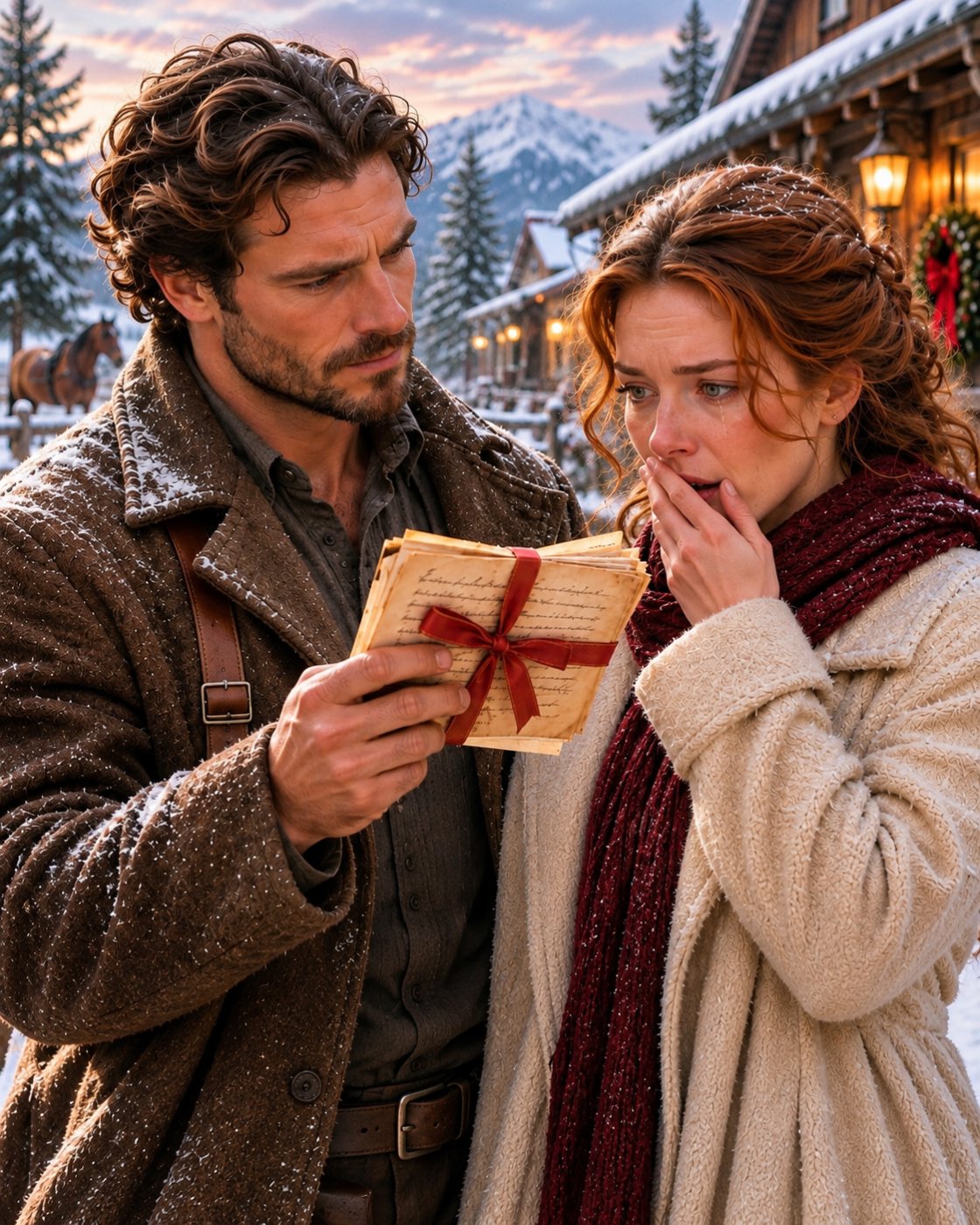
She had both hands pressed flat over her mouth.
"Those are mine," she whispered.
"Silas.
Those are mine".
Silas didn't answer.
He reached into the suitcase and untied the ribbon.
It came apart in his fingers, rotten with age.
He picked up the first envelope and turned it over.
The flap was still sealed.
Nobody had ever opened it.
He looked at the postmark.
Denver, Colo.
December 19.
Four days before the wedding.
His hands were shaking so badly that he couldn't get his thumb under the flap.
Walter quietly took a butter knife out of the drawer and handed it to him without a word.
Silas slit the envelope open.
He unfolded the single sheet inside.
He read it standing up, at his own kitchen table, twelve years too late.
My dearest Silas,
Papa is out of surgery.
The doctors say he will live, though he will be weak for a long time.
Cousin Margaret has been very kind.
She has found me work in her late husband's office, keeping the accounts, and she says if I work hard, the hospital will be paid by summer.
I know you must be worried.
I am so sorry I left in such a hurry.
There wasn't time to explain properly at the station, with Papa so ill.
But I will be home by June.
I promise you.
And then we will have our wedding, in the church, with lilacs instead of evergreens.
Wait for me, Silas.
Please wait for me.
I love you more than I know how to write.
Your Addie.
He set the letter down on the table very carefully.
He picked up the second one.
Then the third.
He read them in order, one after another, standing at the table, while the storm screamed outside and the burned coffee smoked on the stove and nobody moved.
They changed as they went.
The first two were full of news.
Denver.
The tall buildings.
The office where she worked twelve hours a day over ledgers.
Her father getting stronger.
The third asked why he hadn't written.
The fourth asked if he was ill.
The fifth said she'd had a letter from him.
A short letter.
A cruel letter.
It said he could not marry a woman whose family had become a burden.
She couldn't believe he had written it.
She begged him to tell her it wasn't true.
The sixth said she'd heard nothing back.
The seventh said she couldn't sleep.
That she couldn't eat.
That Cousin Margaret said she was making herself ill over a man who'd plainly made his choice.
By the ninth, the handwriting had changed.
It was smaller.
More careful.
As if the girl writing it was holding very still, so she wouldn't fly apart.
The eleventh was dated January 14th.
It was only five lines long.
Silas,
If you do not want me anymore, I will accept it.
But please, please tell me the truth in your own words.
I cannot bear to spend the rest of my life wondering why the man I loved disappeared without a word.
Addie.
Silas put the last letter down on top of the others.
He stood there with both hands flat on the table, his head bowed, and he didn't say anything for a very long time.
Adeline had come into the kitchen while he read.
She was standing beside him now.
She hadn't touched him.
She was crying without making a sound.
"I wrote that one," she whispered, "and then I didn't write anymore.
I thought if I didn't stop, I'd lose my mind.
Cousin Margaret said it was the healthiest thing I'd done all winter".
"Every week," Silas said hoarsely.
He didn't look up.
"Every single week, you wrote me.
And I sat in this house and thought you'd forgotten my name".
"Boss".
Walter's voice was very quiet.
"There's something else in there".
At the bottom of the suitcase, under where the letters had been, lay one more envelope.
It was larger than the others, and newer.
The handwriting on it wasn't Adeline's.
It was heavy and square and slanted hard to the right, the handwriting of a man who'd learned to write by lamplight on a homestead and never had much use for it after.
For my son, Silas.
To be opened after I am gone.
Silas stared at it.
He'd known that handwriting his whole life.
On feed bills.
On cattle tallies.
On the note his father had pinned to the barn door the morning Silas left for his first roundup at fifteen.
Ride careful.
Come home.
He picked it up.
He opened it.
It was dated February 3rd, seven years ago.
Two weeks before his father died.
My son,
I am writing this because Doc Harmon says I don't have much time, and because I am a coward, and I cannot say it to your face.
Twelve years ago, I did a terrible thing.
When Thomas Mercer took sick and his ranch went under, I was afraid.
I had seen the Mercer books.
That place was buried in debt to the bank and every feed store in three counties.
I believed that if you married Adeline, you'd spend the rest of your life paying off her family's ruin.
I believed it would pull Boone Ridge down with it.
I'd spent forty years building this ranch for you.
I couldn't stand to watch it go.
So I wrote to Margaret Whitmore in Denver.
I'd known her since she was a girl.
I asked her to take Adeline away and to keep her away.
I told her I would see to things on this end.
Margaret wrote you the letter that said Adeline had found another man.
She wrote Adeline the letter in your name.
And every week that winter, I went to the post office and took Adeline's letters out of your box before you could see them.
And I put them in this suitcase.
I couldn't bring myself to burn them.
I don't know why.
I told myself I was protecting you.
I have since learned that Adeline Mercer never wanted one dollar of your money.
She only ever wanted you.
And I watched you stand in that church on December 23rd until the sun went down.
I watched you come home and go into your study and close the door.
I've watched you every Christmas since.
You don't laugh anymore, son.
You haven't laughed in five years.
I did that.
Not her.
Me.
I'm ashamed.
I have been ashamed every day since.
If you ever read this, I hope you can find a way to forgive me.
And I hope, more than anything, you will find Adeline.
Because a man can inherit land and cattle and a thousand acres of Montana.
But if he loses the woman who truly loves him, he can spend the rest of his life owning everything and having nothing.
Your father,
Jacob Boone.
Silas finished reading.
He folded the letter.
He put it back in its envelope.
He set it on the table on top of Adeline's eleven letters.
Then he turned around and walked out of the kitchen.
"Silas," said Adeline.
He didn't stop.
He took his sheepskin coat off the peg by the back door and his hat off the hook.
He went out into the storm and pulled the door shut behind him.
Through the kitchen window, through the blowing snow, they watched him cross the yard to the barn.
Adeline stood in the kitchen with her hand pressed to her mouth.
"Walter.
Where's he going?"
Walter was looking out the window too.
His face was grim.
"North pasture fence came down in the wind this morning," he said.
"I told him I'd send the boys up when it let up some".
He shook his head slowly.
"That's where he's going, ma'am.
When Silas Boone can't stand being inside his own skin, he goes and finds the hardest piece of work on this ranch and he does it alone.
Always has".
"In this?"
"Always has".
Adeline looked out at the storm.
The snow was coming sideways now.
The barn was barely a gray shape.
Beyond it, the fields were gone, and the fences, and the mountains.
There was only white, moving and roaring.
She thought of Silas in the church twelve years ago, standing at the altar until the sun went down.
She thought of herself in Denver, writing letter after letter to a man who never answered, until she made herself stop.
She took her coat off the chair.
"Ma'am," said Walter.
"Miss Mercer.
You can't go out there".
"I've spent twelve years not going after him, Walter," said Adeline.
She wound her scarf around her neck.
"I'm not doing it again".
Walter looked at her for a long moment.
Then he went to the closet by the back door, took out a pair of his own heavy work gloves and a coil of rope, and held them out.
"Fence line runs straight north from the corner of the barn," he said.
"Keep your hand on it.
Don't let go.
If you can't see him in fifteen minutes, you come back on the fence and I'll go".
She took the gloves.
The storm hit her like a wall the moment she stepped off the porch.
She'd forgotten what Montana wind was like.
Twelve years in Denver, with its paved streets and its brick buildings, and she'd forgotten.
It went straight through her coat.
It filled her eyes with snow.
It took her breath and wouldn't give it back.
She found the corner of the barn.
She found the fence.
She put her gloved hand on the top rail, and she walked.
She found him a quarter mile out.
He was standing beside a broken section of the fence where two posts had snapped off in the wind.
He was trying to drag a frightened red calf back through the gap toward the herd.
The calf was bawling and digging in its hooves.
Silas's hat was gone.
His hair was white with snow.
His hands, without gloves, were raw and red.
He was working like a man who'd forgotten he was made of flesh.
"Silas!"
He turned.
When he saw her, his face went hard.
"What are you doing out here? Go back to the house!"
"You need help!"
"I don't need help!" He hauled on the calf's neck rope.
"I've never needed help!"
"That's the stupidest thing I've ever heard you say, Silas Boone!"
She waded through the drift to the other side of the calf and put her shoulder against its rump and shoved.
The calf lurched forward through the gap.
Silas stumbled backward into the snow.
The calf trotted off toward the dark shapes of the herd, bawling indignantly.
Silas lay on his back in the snow and stared up at her.
She held out her hand.
He looked at it for a long moment.
Then he took it, and she pulled him up.
They fixed the fence together.
She held the new posts while he drove them in with the maul.
She held the rails while he wired them.
Neither of them said a word.
It took an hour.
By the time they were done, she couldn't feel her feet, and his hands were bleeding where the wire had cut them.
They walked back to the house on the fence line.
Her hand was on the rail.
His hand was on her shoulder.
Walter had the fire roaring in the front room when they came in.
He took one look at them, put a pot of fresh coffee on the hearth, and went up to bed without being asked.