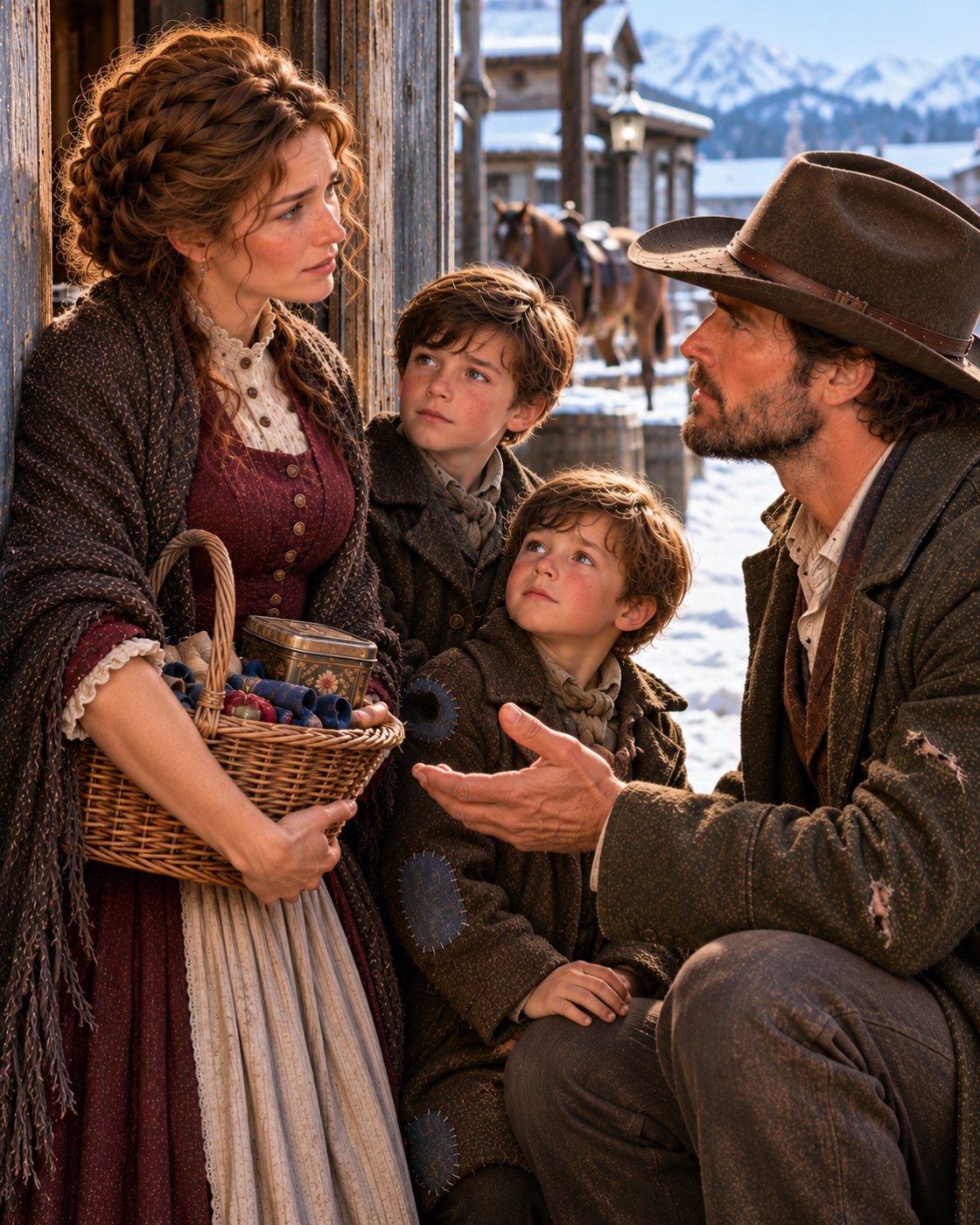
PART 3
“Abel, where are your horses?”
Marion's question cut through the murmuring crowd outside the Cedar Bend courthouse.
Abel Redfern stood beside the stone steps, his hat in one hand and a folded document in the other.
Behind him, Cyril Stubbs looked furious.
The banker had expected to seize Marion's belongings that morning. Instead, he had discovered that the quiet rancher from Creek Road had spent the previous evening arranging to purchase her outstanding debt.
Marion looked toward the empty wagon.
“Where are the grays?”
Abel hesitated.
“Sold them.”
Her stomach dropped.
Those horses had been his pride. He had raised them from colts, trained them himself, and refused generous offers from neighboring ranchers.
“You sold your team?”
“They brought a fair price.”
“For my debt?”
Abel didn't answer immediately.
He didn't need to.
Marion stepped backward.
“No.”
“Marion—”
“No, Abel. Those horses were yours.”
“And that debt was never supposed to become your prison.”
He held out the document.
“The note's paid. Stubbs has received his money. The clerk can record the lien released.”
Cyril's face darkened.
“This is highly irregular.”
Abel turned toward him.
“You signed the sale yourself.”
The banker opened his mouth, then closed it.
The county clerk stepped forward and examined the papers.
After several minutes, he nodded.
“The debt has been satisfied. Mrs. Oakes's property is no longer subject to this claim.”
A murmur spread through the crowd.
Marion barely heard it.
She was staring at Abel.
“You should have asked me.”
“I know.”
“You should have told me what you were planning.”
“I know that too.”
His willingness to admit it made her angrier.
“You've spent money you were saving for your boys.”
Abel looked toward Willie and Eddie, who stood beside the courthouse railing.
“I haven't touched what they need to live.”
“But you sold something you loved.”
He looked back at her.
“Some things matter more.”
Marion's eyes filled.
She wanted to embrace him.
She wanted to shout at him.
Most of all, she wanted to understand why a man who had known her only a few weeks would surrender something so valuable without asking for anything in return.
Then Drusilla Hackett spoke.
“How touching,” she said sharply. “A widow moves into a bachelor's house, and suddenly he pays her debts. I suppose we're expected to believe there's nothing improper about it.”
The crowd fell quiet.
Marion turned toward her.
For months, she had endured Drusilla's insults because she believed silence was the only dignity poverty allowed her.
Not anymore.
“Mrs. Hackett, I earn my wages caring for Mr. Redfern's household. I have never taken anything that wasn't offered honestly.”
Drusilla lifted her chin.
“Except the Ladies' Aid cotton.”
A voice came from the courthouse doorway.
“About that cotton, Mrs. Hackett.”
The clerk emerged carrying a ledger.
He opened it to a page marked with a narrow strip of red ribbon.
“Eleven yards of blue cotton were signed out of the Ladies' Aid storeroom in October.”
Drusilla stiffened.
“Yes, and—”
“Signed out by you.”
The clerk turned the book so she could see.
“For church kitchen curtains.”
The crowd shifted.
He continued.
“The fabric Mrs. Oakes carried in November was purchased separately by Mr. Redfern. The mercantile has the receipt.”
Drusilla's face lost its color.
Marion looked at the ledger, then at the woman who had humiliated her before half the town.
“You knew I hadn't stolen it,” she whispered.
Drusilla said nothing.
“You knew.”
The older woman looked away.
Marion waited for an apology.
None came.
Then Willie stepped forward.
“My father paid Mrs. Oakes to fix our coats,” he announced, his voice shaking. “And she fixed my brother's coat first because he was cold.”
He swallowed.
“She didn't even charge extra when I tore mine again.”
A few people smiled.
Willie looked directly at Drusilla.
“She isn't a thief.”
Marion pressed a hand over her mouth.
The boy who had barely spoken to her for weeks had defended her before the entire town.
Abel rested a hand on his son's shoulder.
“That's enough, Willie.”
But Willie shook his head.
“No, Pa. It isn't.”
He turned toward Marion.
“I'm sorry I was mean to you.”
Her tears spilled over.
“Oh, Willie.”
The boy stepped into her arms.
And for the first time, he allowed her to hold him.
They returned to the ranch that afternoon.
The ride home was quiet.
Eddie fell asleep against Marion's shoulder. Willie sat beside his father, occasionally glancing backward as though checking that Marion was still there.
When they reached the farmhouse, Abel helped the boys down and carried the supplies inside.
Marion remained beside the wagon.
She was still angry about the horses.
Still grateful.
Still afraid of what accepting his sacrifice might mean.
After supper, she found Abel repairing a harness strap near the stove.
“Can we talk?”
He set down his tools.
“Of course.”
Marion sat opposite him.
“I need you to understand something.”
He waited.
“When Harold died, people began deciding everything for me. Where I could live. What work I could take. How much I deserved to earn.”
Her voice trembled.
“Even kindness became another way for people to remind me I was helpless.”
Abel lowered his eyes.
“And when you bought that debt without telling me, I felt helpless again.”
He nodded slowly.
“I should've spoken to you first.”
“Yes.”
“I was afraid Stubbs would take your things before we could settle it.”
“You could have trusted me to help decide.”
Abel looked up.
“You're right.”
Marion studied him.
He wasn't defending himself.
He wasn't asking her to be grateful.
He was listening.
And somehow that mattered more than any grand declaration.
“Thank you for saving my sewing machine,” she whispered.
A faint smile touched his mouth.
“You're welcome.”
“But don't ever make a sacrifice like that without telling me again.”
“I won't.”
She reached across the table.
Abel took her hand.
For several moments, neither moved.
Then he said, “There's something else I ought to tell you.”
Marion's heart quickened.
“What?”
“The grays weren't only for ranch work. I was hoping to sell them in spring and put the money toward a bigger place.”
“For the boys?”
“For all of us, perhaps.”
She stared at him.
Abel's face reddened.
“I hadn't meant to say that yet.”
Marion felt warmth rise into her cheeks.
“All of us?”
He looked at their joined hands.
“I've been thinking about it.”
“About what?”
He drew a slow breath.
“About waking up and knowing you'll be downstairs making coffee. About coming home and hearing you laugh with Eddie. About Willie finally looking like a boy again.”
His voice softened.
“About you.”
Marion couldn't speak.
Abel continued.
“I know you came here for work. I know you have your own life to rebuild. But somewhere along the way, I stopped thinking of Christmas as the day you'd leave.”
He looked directly into her eyes.
“I started hoping it would be the first Christmas we'd spend together.”
A tear slipped down Marion's cheek.
She squeezed his hand.
“Abel, I'm frightened.”
“So am I.”
“You?”
He gave a quiet laugh.
“More than I've been in years.”
She smiled through her tears.
Then she leaned forward and kissed his cheek.
It was a small gesture.
But Abel went perfectly still.
When she drew back, his eyes were shining.
“Was that all right?” she asked.
He smiled.
“More than all right.”
December brought heavy snow.
The creek froze beneath the cottonwoods, and the boys spent their afternoons building snow forts behind the barn.
Marion sewed fresh lining into their coats, baked gingerbread, and taught Eddie to write his name without reversing the letters.
Willie began sitting beside her while she worked.
Sometimes he read aloud.
Sometimes he asked questions about Omaha.
And sometimes he simply watched the needle move through cloth.
One evening, he brought her a small wooden box.
“I made this,” he said.
Inside were six buttons arranged in two neat rows.
Marion smiled.
“It's lovely.”
Willie shifted nervously.
“Pa says you keep buttons because you don't like throwing useful things away.”
“That's true.”
He looked at his boots.
“Do you think people can be useful even when they're sad?”
Marion set the box aside.
“People don't have to be useful to deserve love, Willie.”
He considered that.
“Even if they're angry?”
“Even then.”
“Even if they say something mean?”
Marion opened her arms.
“Especially when they're trying to learn how not to.”
Willie stepped forward.
She held him close.
After a moment, he whispered, “I miss Mama.”
“I know.”
“Sometimes I can't remember her voice.”
Marion closed her eyes.
“That must hurt terribly.”
He nodded against her shoulder.
“I don't want to forget her.”
“You won't have to.”
“Even if I like you?”
Marion kissed the top of his head.
“Loving someone new doesn't mean loving someone else less.”
Willie began to cry.
She held him until he was ready to let go.
From the kitchen doorway, Abel watched silently.
Later, after the boys were asleep, he found Marion folding their blankets.
“Thank you,” he said.
“For what?”
“For giving Willie something I couldn't.”
She shook her head.
“You've given him more than you know.”
Abel moved closer.
“Marion, I need to ask you something.”
She turned.
He looked suddenly nervous.
“I asked you once whether you could stay until Christmas.”
“I remember.”
“Well…”
He swallowed.
“I was wondering whether you might consider staying after.”
Marion smiled.
“How long after?”
Abel looked at her with such tenderness that her breath caught.
“As long as you'll have us.”
She stepped toward him.
“Abel Redfern, are you asking me to remain your housekeeper?”
“No.”
His answer came immediately.
“I'm asking whether you'd consider becoming my wife.”
Marion's eyes widened.
He continued quickly.
“You don't have to answer tonight. And if you say no, your room and your wages are still yours. Nothing changes.”
She watched him struggle for words.
“I know I've got two boys, a ranch that needs more work than it should, and a terrible habit of burning biscuits.”
She laughed softly.
“But I love you, Marion. I think I've loved you since the day you stood on that boardwalk and refused to let Drusilla Hackett make you ashamed.”
He paused.
“And I want to spend whatever years I've got left making sure you never feel unwanted again.”
Marion covered her mouth.
For so long, she had believed that losing Harold meant losing her chance at a family.
She had imagined growing old in a rented room, surrounded by other people's clothes, listening to other people's children laugh outside her window.
Now a good man stood before her, asking her to share his life.
Not because she owed him.
Not because he needed a servant.
Because he loved her.
“Yes,” she whispered.
Abel blinked.
“Yes?”
She laughed through her tears.
“Yes, Abel. I want to marry you.”
He gathered her into his arms.
Their first real kiss was gentle, hesitant, and filled with the wonder of two lonely people discovering that love had not finished with them.
Christmas morning arrived beneath a blanket of fresh snow.
Eddie woke everyone before sunrise.
Willie had made Marion a small wooden sewing box, carefully sanded and polished.
Eddie gave her a drawing of the farmhouse with four figures standing outside.
This time, every name was spelled correctly.
Marion held the picture against her heart.
Abel handed her a narrow package wrapped in brown paper.
Inside lay a pair of silver sewing scissors.
“I know you have a pair already,” he said.
“These are beautiful.”
“They're for your own work. Not the ranch's. Not the boys'. Yours.”
She looked at him.
“You understand me better than you realize.”
He smiled.
“I intend to keep learning.”
That evening, after the boys had fallen asleep, Marion sat beside Abel near the fire.
Outside, the wind rattled the windows.
Inside, the farmhouse glowed with warmth.
“Do you ever think about how we met?” she asked.
“Every day.”
“Really?”
He nodded.
“I remember how you stood there holding that cotton. You looked as though the whole town had turned against you.”
“It had.”
“Not the whole town.”
She smiled.
“No. Not the whole town.”
Abel took her hand.
“I wanted to tell you that day that you didn't deserve any of it.”
“You did better than telling me.”
“How?”
“You stood beside me.”
He kissed her forehead.
“And I always will.”
They married the following spring in the little Cedar Bend church.
Marion wore a blue cotton dress she had sewn herself.
Willie stood proudly beside his father.
Eddie carried the rings and nearly dropped them twice.
When the minister pronounced Abel and Marion husband and wife, Eddie shouted, “Does this mean she stays forever?”
The congregation burst into laughter.
Abel looked at Marion.
She smiled.
“Yes, Eddie. That's exactly what it means.”
The years that followed were not always easy.
There were droughts, harsh winters, broken fences, and seasons when money grew painfully scarce.
But the Redfern household never returned to its old silence.
Willie grew into a thoughtful young man and eventually became a schoolteacher.
Eddie inherited his father's love of horses and spent his adult life working the ranch.
Both boys called Marion “Mama.”
Not because they had forgotten the mother who gave them life.
But because they had been fortunate enough to be loved by two women.
Marion continued sewing for Cedar Bend, eventually opening a small shop of her own.
Abel built her a worktable beneath the front window, where afternoon sunlight fell across the fabric.
And every winter, no matter how old the boys became, she inspected their coats for loose buttons.
They teased her about it.
She pretended not to hear.
Forty Christmases passed.
On the fortieth, snow fell gently across the Redfern ranch.
Marion was seventy-two now, her hair silver and her hands marked by decades of careful work.
Abel, seventy-nine, sat beside the stove with a blanket across his knees.
Their sons had come home with their families.
Grandchildren filled the kitchen with laughter.
The old farmhouse was crowded, noisy, and wonderfully alive.
After supper, when everyone had gone outside to admire the snow, Abel reached for Marion's hand.
“Do you remember what I asked you that first winter?”
She smiled.
“Whether I could stay till Christmas?”
He nodded.
“I never imagined you'd give me forty of them.”
Marion leaned against his shoulder.
“Neither did I.”
He looked toward the window, where their grandchildren were building a snowman beneath the cottonwoods.
“Was it enough?” he asked softly.
She turned toward him.
“Abel Redfern, you gave me a home, two wonderful sons, and forty years of being loved.”
His eyes filled.
“I'd say that was more than enough.”
He kissed her hand.
“And you gave me my family back.”
Marion reached into the little sewing tin she still kept beside her chair.
Inside lay hundreds of buttons collected over a lifetime.
Among them was one small blue button Willie had given her that first December.
She held it in her palm.
A tiny thing.
Almost worthless to anyone else.
Yet it reminded her of the frightened little boy who had finally trusted her enough to stay.
Marion closed the tin and rested her head against Abel's shoulder.
Outside, the snow continued falling.
Inside, their family called for them to join the celebration.
And the woman who had once been given twelve days to find another place to live smiled at the man who had asked her to stay until Christmas.
She had stayed forty years.
And not one of them had been wasted.