PART 3
In case you missed it: in 1883, Zelda Garrison's stepfather sold her at auction in Calico, California, to pay his gambling debts.
A stranger named Zachary Aldridge bid five hundred dollars and his best mare, then told her he had bought her freedom, not her.
She chose to go to his ranch, the Double A, and over the following weeks they fell in love.
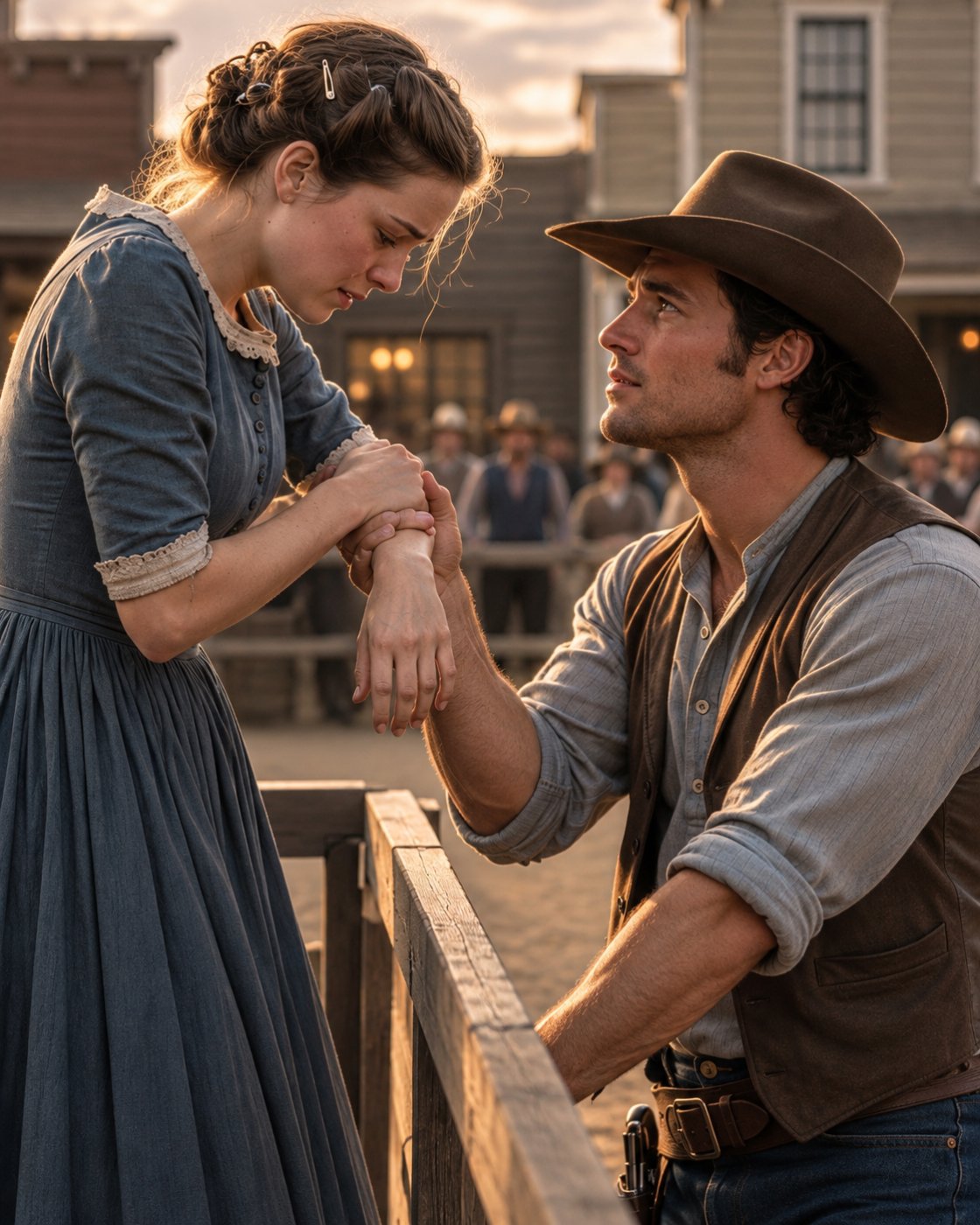
Then one cold afternoon, her stepfather Marcus Trent dragged her into an alley and told her she was coming home with him.
"Let go of me," Zelda said.
Her voice came out steadier than she felt.
Her heart was pounding so hard she could hear it in her ears.
"I'll do no such thing".
Marcus's face was blotched and red, his eyes bloodshot.
He hadn't shaved in days.
"You owe me.
Every crust of bread you ever ate in my house.
Every night under my roof.
You think you can go off with some cowboy and play queen of the ranch while I.
.
".
"You sold me," said Zelda.
"I fed you!"
"You sold me on a platform in front of the whole town like a heifer".
Her voice was rising now.
She couldn't stop it.
"You stood there and counted the money while men looked at my teeth.
I don't owe you anything, Marcus.
Not one crust.
Not one night.
Let go of my arm".
His fingers tightened until she gasped.
"You ungrateful little.
.
".
"Let go".
The voice came from the mouth of the alley.
Low and flat and very, very quiet.
Zachary stood there with the light behind him.
He had a sack of flour on one shoulder, which he set down very slowly on the boardwalk.
Then he came down the alley toward them, and Zelda had never seen his face like that.
All the kindness was gone out of it.
What was left was something hard and cold as winter iron.
Marcus let go of her arm so fast he stumbled backward into a rain barrel.
"We were just talking," he said.
He tried to sound defiant.
He mostly sounded scared.
"Looked like more than talking to me," said Zachary.
"Looked like you were putting your hands on her.
Against her will".
"She's my stepdaughter.
I've got a right.
.
".
"You have no rights where she's concerned".
Zachary stepped between them, so that Zelda was behind his shoulder.
His right hand rested easy on his gun belt.
He didn't draw.
He didn't need to.
"You gave up every one of them the day you stood her on that platform".
Marcus's eyes went to the gun, then back to Zachary's face.
"You go near her again," Zachary said, very quietly, "speak to her again, so much as look at her wrong again, and I'll make sure Sheriff Pruitt hears about it.
And if the sheriff doesn't handle it to my satisfaction, I'll handle it myself.
Are we clear?"
Marcus went pale under the drink.
"You can't threaten me".
"That wasn't a threat," said Zachary.
"That was a promise.
Now get out of here, before I change my mind about being civil".
Marcus fled.
He tripped over his own boots at the end of the alley, scrambled up, and was gone around the corner of the saloon.
Zachary stood watching the empty alley for a long moment.
Then he turned around, and all the iron went out of his face at once.
"Are you all right? Did he hurt you?"
"I'm fine," said Zelda.
But her hands were shaking, and he saw it.
He didn't grab her.
He never did.
He held out his arms and waited, and she stepped into them, and he closed them around her very gently and held her while she shook.
"I'll always protect you, Zelda," he said into her hair.
"Always.
I promise you that".
She stood in the alley behind the general store with her face pressed against his vest, breathing in the smell of leather and soap and horses that had come to mean safety.
Home.
"Thank you," she whispered.
"You never have to thank me for that".
Zachary went to Sheriff Pruitt that same afternoon anyway.
The sheriff, a weary, honest man who had watched the auction from his office window that autumn and said nothing, and had been ashamed of it ever since, listened without interrupting.
"I'll keep an eye on him," the sheriff said.
"Truth is, Aldridge, I should've stopped that sale.
Wasn't strictly legal, any of it.
I let the banker talk me out of it".
He shook his head.
"I'll not make that mistake twice".
They saw Marcus only once more after that, from a distance, on the far side of Main Street, two weeks later.
He saw them too.
He turned around and went the other way.
By Christmas, word came that he had sold his house for drinking money and taken the train to Barstow, and from there, nobody knew where.
Zelda didn't feel anything when she heard it.
Not anger.
Not sorrow.
Only a kind of quiet, like a door closing on a room she would never need to go into again.
Winter came to the high desert.
It came slowly, the way it does in that country.
The days grew short and gold.
The nights grew sharp and clear, with stars so thick across the sky that Zelda would stand in the yard after supper with her shawl around her shoulders and just look up until her neck ached.
Frost silvered the pasture in the mornings.
The creek ran thin and cold over its stones.
They worked side by side all through December, getting the ranch ready for the cold months.
They moved the cattle down into the sheltered draws.
They stacked hay in the barn to the rafters.
They split and stacked wood until the woodshed was full and then started a second pile against the house.
Zelda learned to drive the hay wagon and to mend a fence and to tell by the color of the sky in the west whether it would freeze that night.
In the evenings, they sat by the fire.
Zachary taught her to play chess on an old wooden set with a cracked board that had belonged to his father.
She was terrible at first.
He beat her eleven games in a row.
On the twelfth, she beat him, and was so astonished she knocked the board over, and he laughed so hard he had to wipe his eyes.
"You let me win," she accused him.
"I did not," said Zachary.
"I'd never do that.
You'd know, and you'd never forgive me".
That was true.
She would have known.
In return, she taught him to make proper biscuits.
Zachary's biscuits had always been sad, flat lumps that could have shingled a roof.
Zelda stood beside him at the kitchen table with her hands over his, showing him how to cut the lard in cold, how to fold the dough instead of kneading it, how to press the cutter straight down without twisting.
His first batch rose two inches high.
He stared at them as though they were a miracle.
"My mother tried to teach me that for ten years," he said.
"Your mother didn't stand over you with a wooden spoon," said Zelda.
They read to each other.
They talked about everything and nothing.
Zachary told her about cattle drives up the old trail to Nevada, and a stampede in a lightning storm on the Humboldt when he was nineteen, and a horse named Biscuit he'd loved when he was a boy.
Zelda told him about her father's vegetable farm in the San Joaquin, and the smell of his workshop where he carved wooden animals in the evenings, and her mother reading poetry aloud by the stove.
She showed him the little wooden horse her father had carved for her, the last thing he ever made before he died.
Zachary turned it over in his big hands very carefully, as if it might break.
"He was good," he said quietly.
"Look at that mane.
He carved every hair".
"He used to say a horse is the most honest animal God ever made," said Zelda.
"He said you can always trust a man who's good to his horses".
Zachary looked up at her.
"That's why I went with you," Zelda said softly.
"That first day.
You put your hand on Poppy's neck before you helped me up.
And you talked to Rebel the whole way home like he was a person.
I watched you, and I thought, Papa would have trusted him".
Zachary didn't answer.
He set the little wooden horse down on the mantel, very gently, beside his mother's clock.
It stayed there for the rest of their lives.
The snow came in the second week of December.
It was rare, that far down in the desert, and it came all at once, a howling storm off the mountains that blew for two days and buried the valley in white.
The wind screamed around the corners of the house.
Snow piled against the windows.
Zachary went out every few hours, roped to the porch, to check on the horses and the stock, and came back in with ice in his beard and his hands red and stiff with cold.
Zelda had hot coffee waiting every time.
On the second night, they sat on the floor in front of the fireplace, with the dogs asleep in a pile beside them and the storm raging outside.
Zelda leaned back against Zachary's chest with his arms around her, watching the flames.
"Zelda," Zachary said softly.
"Mm?"
His arms tightened around her.
"I know we said we'd wait.
Give it more time.
Make sure.
I know it's only been three months".
He was quiet for a moment.
"But I have to tell you.
I've never been more certain of anything in my life.
Not when I bought this land.
Not when I built this house.
You're it for me.
You're the one I want to spend my life with.
Grow old with.
Build something with".
Zelda turned around in his arms to face him.
Her heart had begun to race.
Zachary shifted and reached into his shirt pocket.
He drew out a small velvet box, worn soft and faded at the corners.
"This was my grandmother's ring," he said.
"My mother gave it to me the week before the cholera took her.
She said, 'Zach, you save this for the woman you can't live without.
'" He opened the box.
Inside lay a slender gold band with a single small sapphire, blue as a winter sky.
"I've carried it for nine years.
I never once thought I'd find anybody to give it to".
He took a breath.
"Zelda Garrison.
Would you do me the honor of becoming my wife? Not because of some auction.
Not because of any money or any debt or any platform in Calico.
But because we love each other.
And because I'd like to spend every day for the rest of my life making sure you know you're worth more than anything anybody could ever bid".
Tears streamed down Zelda's face.
She nodded.
She couldn't speak.
"Is that a yes?" Zachary asked, his voice shaking.
"Yes," she managed at last.
"Yes, Zachary.
I'll marry you.
I love you so much".
He slipped the ring onto her finger.
It fit perfectly, as if it had been waiting for her.
Then he kissed her, there on the floor in front of the fire, with the storm howling outside and the dogs snoring beside them, and Zelda felt as if the whole world had narrowed down to this one warm room.
They stayed up until the fire burned down to coals, wrapped in a quilt, talking about the future.