PART 3
The match burned between Sheriff Wade Collins's fingers.
Clara Hayes stood motionless in the Mercer ranch yard, watching the flame creep toward the black ledger that contained everything Silas Boone wanted destroyed.
Two deputies held Caleb by the arms.
Another stood between Clara and the sheriff.
“Where are the other records?” Collins demanded.
Clara lifted her chin.
“Somewhere you can't reach them.”
The sheriff's eyes narrowed.
“You're bluffing.”
“Then burn the book.”
For a moment, nobody moved.
Caleb stared at her, trying to understand the calmness in her voice.
He had seen Clara frightened before. He had watched her wake from nightmares and glance toward the mountains whenever an unfamiliar rider passed.
But he had never seen her surrender.
And he knew she wasn't surrendering now.
Collins dropped the match into the mud.
“Search her room.”
One deputy hurried toward the farmhouse.
Clara's expression didn't change.
“You won't find anything there.”
The sheriff stepped closer.
“Then perhaps Mercer can persuade you to cooperate.”
Caleb pulled against the men restraining him.
“Leave her alone.”
Collins smiled coldly.
“That's touching. A lonely rancher protecting a woman he barely knows.”
Clara looked at Caleb.
Something passed between them.
Not a promise.
Not a confession.
Only the understanding that neither intended to abandon the other.
Then she turned back to Collins.
“You should ask yourself why Boone wants this land so badly.”
“I know why.”
“Do you know what he buried beneath it?”
The sheriff's smile faded.
Clara noticed.
And for the first time that morning, she felt a small spark of hope.
Three years earlier, Clara had worked as a bookkeeper for a freight company near Cheyenne.
The business appeared respectable. It transported supplies, livestock, and mining equipment across the territory.
Its owner, Silas Boone, had offered her employment after her father's death left her penniless.
At first, she believed she had found security.
She kept the accounts, balanced payments, and prepared shipping records.
Then she noticed something strange.
Cattle listed as purchased from one ranch appeared again under another owner's name.
Land deeds carried identical signatures, although the supposed sellers lived hundreds of miles apart.
And whenever a rancher challenged a transaction, his name disappeared from the next month's records.
Clara began keeping private copies.
She told herself she was protecting the company from mistakes.
Then one winter evening, she overheard Boone discussing a rancher who had refused to sell.
“Make certain he doesn't have a place to come home to,” Boone told his foreman.
The following week, that rancher's barn burned.
Clara understood then that the accounts weren't merely dishonest.
They were dangerous.
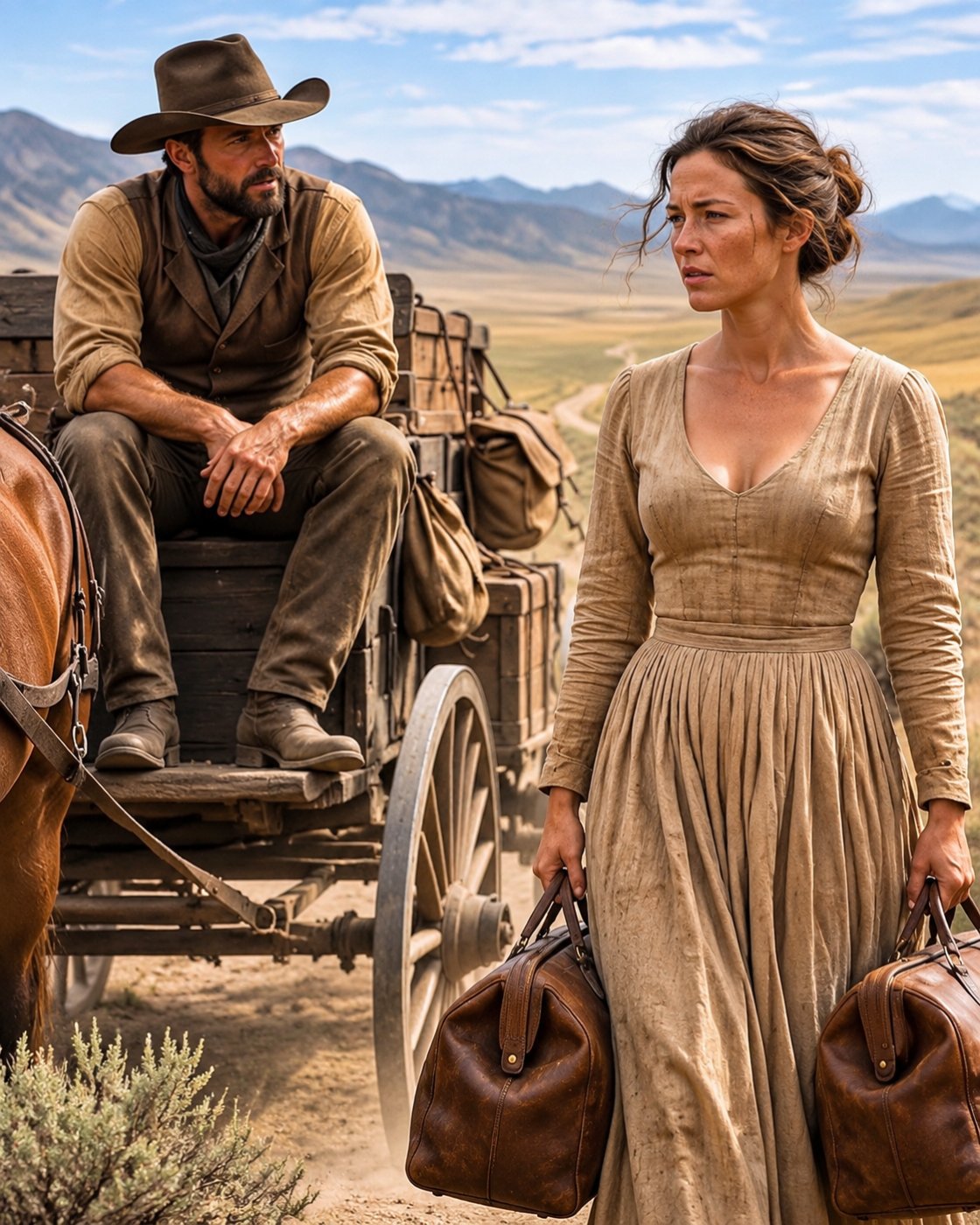
She copied everything she could and concealed the papers inside the lining of two leather traveling bags.
When Boone discovered missing pages, she fled.
For months, she moved between settlements, sleeping wherever she could and refusing to remain long enough for anyone to recognize her.
Until the afternoon Caleb Mercer stopped his wagon beside her on a mountain trail.
Now, standing in Caleb's yard, Clara understood why Boone had never stopped searching.
The hidden passage beneath the Mercer property was more valuable than she had realized.
It connected several remote cattle trails to an abandoned mining road beyond the western ridge.
Boone could move stolen herds through the mountains without passing the ordinary inspection points.
But there was another secret.
The original mining company had surveyed the passage decades earlier.
Those records established that the tunnel's western entrance lay within the boundaries of the Mercer ranch.
If the documents reached an honest court, Boone's forged claims would collapse.
Clara had found references to those surveys in his accounts.
And she knew where the surviving copies had been stored.
“Sheriff,” she said quietly, “the original land records are already on their way to the county judge.”
Collins stared at her.
“You're lying.”
“Am I?”
She glanced toward the eastern road.
“Three weeks ago, I sent a letter to a rancher whose cattle Boone stole. I told him where to find the evidence and whom to contact.”
Caleb looked at her sharply.
“You did that before the riders came?”
Clara nodded.
“I was afraid they would reach us first.”
The sheriff seized her arm.
“Who received the letter?”
She didn't answer.
Collins tightened his grip.
Caleb surged forward.
“Take your hands off her!”
One deputy lost his balance, and Caleb broke free long enough to push himself between Clara and the sheriff.
Collins stumbled backward.
His hand moved toward his holster.
“Enough!” a voice shouted from the road.
Everyone turned.
A group of riders was approaching beneath the rising sun.
At their front rode a gray-haired man carrying a leather document case.
Beside him were two federal marshals.
Clara recognized the older rider.
Judge Nathaniel Reeves.
Her knees nearly gave way.
“They came,” she whispered.
The judge dismounted and surveyed the scene.
“Sheriff Collins, I suggest you step away from those people.”
Collins attempted a smile.
“Your Honor, we've arrested a cattle thief.”
“Have you?”
The judge opened his document case.
“Then perhaps you can explain why your name appears on six fraudulent property transfers.”
The sheriff went rigid.
One marshal approached him.
The other moved toward the deputies.
Reeves turned to Clara.
“Miss Hayes, your letter reached Mr. Fletcher's ranch. He brought us the documents you described.”
Clara pressed a hand against her mouth.
The judge continued.
“We also recovered the original survey records from the mining office. They confirm that Mr. Mercer's property boundaries have not changed.”
Caleb released a breath he seemed to have been holding for days.
But Clara wasn't looking at him.
She was watching the western ridge.
“Where's Boone?” she asked.
The judge's expression darkened.
“We were hoping you could tell us.”
At that moment, a rider appeared near the canyon entrance.
Silas Boone.
He had watched the marshals arrive.
And now he was fleeing toward the abandoned mine.
Caleb reached for his horse.
Clara caught his sleeve.
“Don't go alone.”
He looked down at her.
“I won't.”
They mounted together.
For the first time since she had arrived at the ranch, Clara wasn't running away from Boone.
She was riding toward him.
The chase carried them across the rocky western pasture.
Boone knew the terrain well, but Caleb knew every bend in the creek and every narrow trail through the ridge.
He guided Clara along a shorter route.
They reached the canyon before Boone could enter the tunnel.
Caleb brought his horse across the path.
“It's finished, Boone.”
The older man reined in sharply.
His face twisted with anger.
“You think a judge can stop what I've built?”
Clara rode beside Caleb.
“No,” she answered. “But the truth can.”
Boone stared at her.
“You should have stayed in Cheyenne.”
“And kept helping you steal from people who trusted you?”
“I gave you a job.”
“You gave me a place to work,” Clara replied. “Then you expected me to become someone I couldn't live with.”
Boone looked toward the narrow trail behind them.
He was calculating his escape.
Caleb noticed.
“Don't.”
But Boone kicked his horse forward.
The animal lunged toward the rocky slope.
Loose stones scattered beneath its hooves.
For one terrifying instant, horse and rider slipped toward the canyon edge.
Caleb moved instinctively.
He caught the horse's bridle and pulled it toward stable ground.
Clara jumped down and helped steady the frightened animal.
Boone stared at them, stunned.
“You could have let me fall.”
Caleb's expression remained hard.
“I'm not becoming you just to stop you.”
The marshals arrived moments later.
Boone offered no further resistance.
As they led him away, Clara stood beside Caleb, trembling from exhaustion.
He touched her shoulder.
“It's over.”
She looked toward the departing riders.
“I've been afraid of that man for so long.”
“I know.”
“I thought I'd feel different.”
Caleb gently turned her toward him.
“Maybe you will tomorrow.”
Clara gave a shaky laugh.
“That's a very rancher-like answer.”
“Tomorrow's usually when the real work starts.”
She smiled.
Then, unexpectedly, she began to cry.
Caleb didn't tell her to stop.
He simply opened his arms.
And Clara stepped into them.
The investigation continued for several weeks.
Boone's fraudulent property claims were invalidated, and the officials who had accepted his payments faced prosecution.
Several ranchers recovered cattle or land they had believed lost forever.
The abandoned mining tunnel was closed until the authorities could secure the evidence and determine whether the passage was safe.
Caleb's ranch survived.
But survival did not mean everything immediately returned to normal.
The fences still needed repairing.
The missing cattle had to be located.
And Caleb had debts that would take another year to repay.
Clara stayed busy.
She organized the ranch accounts, negotiated fair prices for supplies, and helped Caleb identify which expenses could wait.
He discovered that she could argue with a merchant for twenty minutes without once raising her voice.
She discovered that he was perfectly capable of fixing a fence while forgetting to eat breakfast.
They began taking care of each other in small, unremarkable ways.
Caleb left coffee warming on the stove when Clara worked late.
Clara repaired the torn lining of his favorite coat.
When thunderstorms rolled over the mountains, he stayed beside her until the trembling in her hands stopped.
And sometimes, after supper, they sat together on the porch without speaking.
Clara had spent months believing that silence meant danger.
With Caleb, she discovered it could mean peace.
One evening, he found her standing beside the barn with her face turned toward the sunset.
“Penny for your thoughts?”
She smiled faintly.
“I'm wondering what happens next.”
“Tomorrow?”
“No. After all this.”
He leaned against the fence.
“What do you want to happen?”
She looked at him.
The question was so simple.
And yet, for most of her life, people had told her what she ought to want.
Security.
Respectability.
A roof.
A husband.
A place where she wouldn't be a burden.
Nobody had asked what would make her happy.
“I want to wake up somewhere without being afraid,” she said.
Caleb nodded.
“And?”
“I want work that matters.”
“You've got that.”
“And…”
She hesitated.
He waited.
Clara looked down at her hands.
“I want someone who'll be glad when I come home.”
Caleb's expression softened.
“Clara, I've been glad every evening since you arrived.”
She looked up.
He stepped closer.
“I used to think this ranch was all I needed. Then you came along and made me realize I was only keeping it alive because I didn't know what else to do.”
Her breath caught.
“Caleb…”
“I don't want you here because you saved my land.”
He took her hand.
“I want you here because I love you.”
Clara stared at him.
For months, she had been preparing herself to leave.
She had never prepared herself to be asked to stay.
“I love you too,” she whispered.
Caleb smiled.
Then he kissed her.
It was gentle at first, almost hesitant.
But when Clara rested her hands against his chest, he drew her closer.
Behind them, the mountains glowed gold in the fading sunlight.
And for the first time in years, Clara wasn't thinking about the road ahead.
She was thinking about the man holding her.
Three mornings later, Caleb found two leather bags beside the farmhouse door.
His heart sank.
Clara was standing at the kitchen table, folding a shawl.
“Are you leaving?”
She turned.
“What?”
He nodded toward the bags.
“You're packing.”
For a moment, she stared at him.
Then she laughed.
“Oh, Caleb.”
She crossed the room and took his hands.
“I'm not leaving.”
“Then why the bags?”
“Because I don't need them anymore.”
He looked confused.
Clara opened the first bag.
Its lining had been carefully removed.
The hidden pockets that once carried stolen records were empty.
She opened the second.
Inside lay a few old dresses and a small silver brooch that had belonged to her mother.
“For months,” she said, “everything I owned had to fit inside these bags. I kept them packed because I never knew when I'd have to run.”
She looked around the kitchen.
“Yesterday, I unpacked them properly.”
Caleb swallowed.
“And where did you put everything?”
“In the bedroom.”
He smiled.
“Which bedroom?”
She raised an eyebrow.
“The one you told me I could keep.”
Caleb stepped closer.
“Clara, there's something I've been meaning to ask.”
She laughed softly.
“You're beginning to sound nervous.”
“I am.”
He reached into his vest pocket and removed a small ring.
It was simple, made of gold, with no expensive stone.
“I can't promise you a life without trouble,” he said. “You've already seen how much of it finds me.”
Clara smiled through sudden tears.
“But I can promise you'll never have to face it alone if you'll marry me.”
She looked at the ring.
Then at the man who had stopped his wagon for a stranger standing beside a mountain trail.
“Yes,” she whispered.
Caleb's face lit with disbelief.
“Yes?”
She laughed.
“Yes, you stubborn cowboy.”
He slipped the ring onto her finger.
Then he lifted her into his arms and kissed her until they were both laughing.
They married the following spring beneath a cottonwood tree near the farmhouse.
The ceremony was small.
A neighboring rancher stood as Caleb's witness.
The wife of the county judge helped Clara arrange wildflowers in her hair.
And the preacher, who had traveled twenty miles to perform the marriage, declared that he had never seen two people look more certain of their choice.
Clara wore a pale blue dress she had sewn herself.
Caleb wore his best coat and the same weathered brown hat he'd been wearing when they first met.
After the ceremony, they rode together along the mountain trail.
At the place where Caleb had first discovered her, Clara asked him to stop.
He reined in his horse.
“Something wrong?”
She shook her head.
“I just wanted to see it again.”
The trail was quiet.
Wildflowers grew between the rocks.
Sunlight spilled across the valley.
Clara looked at the empty stretch of road where she'd once stood with everything she owned at her feet.
“I thought nobody would stop,” she said.
Caleb reached for her hand.
“I almost didn't.”
She turned toward him.
“Why did you?”
He considered the question.
“Because you looked like someone who needed a chance.”
Clara smiled.
“And you looked like someone who needed help.”
He laughed.
“Seems we were both right.”
She leaned across the space between their horses and kissed him.
Then they turned toward home.
Years later, travelers passing through the valley sometimes heard the story of the mysterious woman who arrived with two leather bags and saved the Mercer ranch from a powerful criminal.
But Caleb always told it differently.
“She saved more than my ranch,” he would say.
And when Clara heard him, she would smile and answer, “He gave me more than a job.”
Neither of them ever claimed to have rescued the other.
They had simply offered each other something neither had possessed for a very long time.
A reason to stay.
And a home worth coming back to.