PART 3
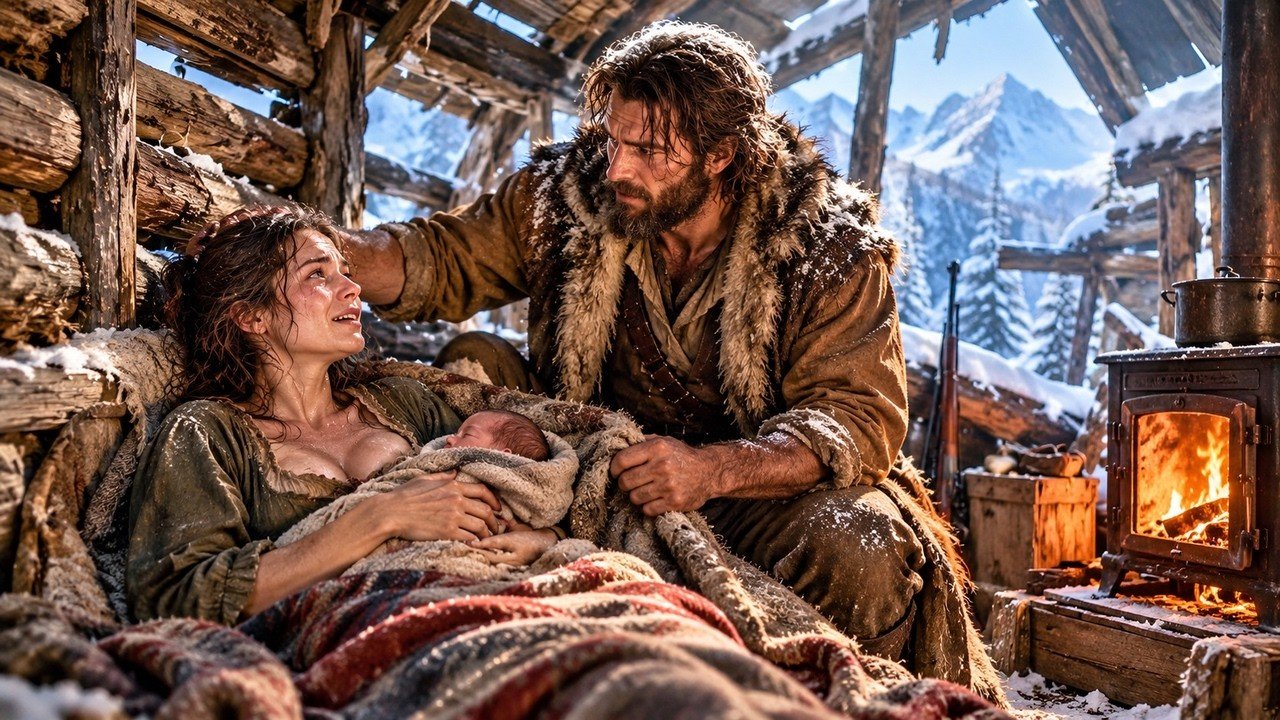
In case you missed it: Deep in the Selkirk Mountains after a November blizzard, the solitary mountain man Varo found a woman named Pell in labor, alone in an abandoned survey shack.
Her husband, Declan, had ridden off at dawn to find the stakes on their land and never came back.
Varo stayed and delivered her daughter by firelight, and he named the baby Rin, for the fast water in his creek.
Then Pell looked at the dark and asked whether Declan was ever coming back.
It wasn't really a question.
Varo answered it like one anyway, because she deserved that.
"The storm hit hard and fast," he said carefully.
"The passes above here were running eight or nine feet deep by yesterday noon.
Anyone caught out in that, who didn't know the ground.
.
".
He stopped.
"He didn't know the ground," Pell said.
"He grew up in Burnaby.
He thought the wilderness was something you drove through on the way to a cabin".
She was quiet for a long time.
The baby made a small, wet, searching sound against her chest.
Pell shifted to settle her and went still again.
"He meant well," she said.
"That's the most terrible thing I know how to say about anybody.
He meant well".
Varo looked at the stove.
The iron had gone from black to a dull red.
He fed it another stick of deadfall.
"I'm sorry," he said.
"So am I," said Pell.
They slept in shifts, or tried to.
Mostly, Varo didn't sleep.
He fed the stove and listened to the night through the walls.
The wood contracted and snapped.
The wind came in intervals.
The dark carried news to anyone who knew how to read it, and what it told him now was that the storm was over.
That wasn't good news by itself.
The cold that settles in after a storm is the dangerous kind.
It's deep and still and it moves into the vacancy and won't leave.
He'd seen it kill men who believed that surviving the blizzard meant surviving what came after.
At three in the morning, the baby began to cry.
It was a real cry, sustained and demanding.
It was the cry of a creature that had looked over its situation and found it unacceptable.
Pell was awake at once.
Varo turned his back and listened to the small sounds of a mother working out in the dark, by instinct and necessity, what her child needed and how to give it.
The crying stopped.
"She's hungry," Pell said to nobody in particular.
"That's good," said Varo.
"Is it always going to be like.
.
".
She didn't finish.
"I don't know," he said honestly.
"This is my first time too".
He heard something from her side of the stove that might have been a short, exhausted laugh.
A while later, when Rin was asleep, Pell spoke into the dark again.
"Where's home for you? Before here?"
"I moved around," said Varo.
"A long time ago".
"I'm from the ocean," Pell said.
"Tofino.
My father fished.
I grew up with the sea on three sides of me".
She paused.
"I've never been this far from salt water in my life".
"It's a long way from the ocean," he agreed.
"Yes," said Pell.
There was more in that single word than geography.
"What brought you up here?" she asked.
"You talk like a man who's been to school".
He fed the stove.
"I was a surveyor for the province," he said.
"Twelve years.
I put in half the stakes on half the Crown land between here and the Alberta line.
Then my marriage ended and my contract ended in the same month.
It felt like a message.
I was thirty-two".
He closed the stove door.
"I came up here and built a cabin two valleys east, on a creek that runs clear even in January.
That was eight years ago.
I've gotten very good at being alone".
"Are you?" said Pell.
"Good at it?"
He thought about that longer than he meant to.
"I was," he said.
They moved out at first light.
The snow had crusted overnight.
It held a man's weight if he moved carefully, and broke under him with a sound like a gunshot if he didn't.
Varo packed everything worth packing.
He strapped the baby against Pell's chest under his own wool overshirt and his canvas jacket.
Rin was a little bundle in a rabbit-skin vest he hadn't worn in two years, layered over so thickly she was invisible.
The whole cocoon smelled powerfully of him.
He hoped it would stay warm enough for as long as it had to.
His horse was where he'd left her, tethered in the lee of a big boulder two hundred meters from the camp.
She was a fourteen-year-old black mare, sensible and steady.
She tolerated him with the affectionate contempt of an animal who knew she had a better temper than her owner.
"What's her name?" Pell asked.
"She doesn't have one".
Pell looked at him.
"You've had her how long?"
"Four years".
"And you never named her?"
"I named her something when I bought her," said Varo.
"I can't remember what.
Nobody ever asked me since".
He helped Pell up into the saddle.
She went up stiffly, and her face turned white with the effort, but she didn't make a sound.
She sat with her chin up and her hands steady on the horn, with the baby an invisible warm weight beneath the layers.
"How far?" she asked.
"To the road, six hours if the crust holds".
He took the lead rope.
"Less if it doesn't, because then we'll have no choice but to make good time".
She looked down at him.
The morning light came over the ridgeline and caught her face.
It was hollow-cheeked and dark-eyed, smeared with grime and exhaustion.
And there was something else under it that hadn't been there yesterday.
It didn't have a name yet.
Later, it would be the particular knowledge that comes only from having done something that can't be undone.
"Why did you stay?" she asked.
Varo thought about it.
He could hear how small any answer would be before he gave it.
"I heard you," he said.
"You could have kept walking".
"I could have," he said.
"I'd have thought about it for a long time afterward".
He turned and started breaking trail.
The crust held for the first kilometer.
Then it gave way where an underground spring kept the ground from freezing solid, and they lost forty-five minutes floundering through thigh-deep powder before the land rose and the crust came back.
The mare was steady.
Pell was steadier.
Now and then, Varo heard her murmuring to the baby, very quietly, too low to carry.
He didn't try to listen.
The mountains don't eavesdrop on things that aren't their business.
By noon, the spruce gave way to young aspen, and the ground flattened.
An hour after that, Varo heard the sound he'd been listening for all morning.
It was the far-off mechanical groan of a sander truck working on pavement.
He stopped and tilted his head to confirm the direction.
"The road's a kilometer east," he said.
Pell let out a long breath that misted in the cold.
They reached the highway at two in the afternoon.
A Ministry of Transportation truck stopped within ten minutes.
The driver was already reaching for his radio before Varo had finished his first sentence.
An ambulance came up from Nakusp forty minutes later.
The paramedics were efficient and kind, and plainly startled by the details, though they did a fair job of hiding it.
They lifted Pell and Rin into the back.
One of the paramedics, a young woman with close-cropped hair and a no-nonsense manner, leaned out the doors and looked at Varo.
"You riding with her?"
He looked at Pell.
She was on the gurney now, with Rin unwrapped and being checked over by practiced hands.
The inside of the ambulance was bright and warm enough that Pell had stopped shivering for the first time in twenty hours.
She was watching the paramedic work with the sharp attention of a woman who'd learned in a single day to keep track of everything.
She looked up and found him standing at the open doors.
For a moment, neither of them spoke.
"There are going to be questions," Pell said finally.
"About Declan.
I'll need to.
.
".
She stopped.
"I don't even know what I'll need to do".
"The RCMP detachment in Nakusp knows that country," Varo said.
"They'll start a search as soon as the roads are clear".
She nodded once.
She looked at the paramedic and Rin, and then back at him.
"You could come to Nakusp," she said.
Her voice was steady and direct.
There was nothing put on about it.
"There'll be paperwork for you too, probably".
She paused.
"I don't know this country.
I don't even really know this province.
I came here because Declan had that land patent and I believed him when he said he knew what he was doing".
She looked past him at the line of mountains, white and enormous against the November sky.
"He didn't know what he was doing".
"No," Varo agreed.
"I'd like to know what I'm doing," said Pell, "before I try again".
The paramedic watched them both with professional discretion.
Varo looked back down the logging road they'd come out of, into the tree line.
He looked into the shadows between the spruce that went back and back for a hundred kilometers without a single town in them.
There was only rock and cold and the particular silence that had been his closest companion for eight years.
He thought about the cabin.
He thought about the creek.
He thought about eleven days without saying a word to anyone, and not minding.
And then he thought about the sound Pell had made when Rin was laid on her chest, the sound below all language.
He thought about feeding that stove in the dark and listening to the baby cry, and being, without ever having planned it, exactly where he was needed.
He handed the mare's lead rope to the Ministry driver, who took it with the bewildered cooperation of a man who understood that something outside his usual experience was going on.
"I'll be back for her," Varo said.
"She doesn't bite.
She'll just look at you like you've disappointed her".
Then he climbed into the ambulance.
The doors shut.
The plowed and sanded highway opened ahead of them, with the mountains huge on either side.
Rin made a sound.
She wasn't crying.
It was just the small, wet noises of a person in her first day in the world, still mostly astonished by all of it.
Varo watched her tiny red fingers open and close around nothing.
They were already reaching for whatever came next.
The hospital in Nakusp was small and clean and very warm.
It smelled of floor polish and coffee.
The doctor on call that afternoon was a gray-haired woman named Dr. Harriet Collier.
She had delivered babies up and down the Arrow Lakes for thirty-one years.
She examined Rin from top to bottom, then examined Pell, then came out into the hallway where Varo sat on a plastic chair with his hat in his hands.
He was still wearing the grime of eleven days in the bush.
"You're the one who delivered her?" Dr. Collier asked.
"Yes, ma'am".
"Face up," said Dr. Collier.
"In a shack, by a woodstove, in the Selkirks, in November.
You tied the cord with what?"
"Boiled linen thread.
Two ties, a few inches apart.
I cut between them with a knife I'd sterilized in the stove".
The doctor looked at him over her glasses for a long moment.
"Seven pounds, two ounces," she said.
"Strong lungs.
Good color.
The mother has lost some blood and she's badly worn out, and she'll stay here a few days.
But they're both going to be fine".
She tapped her clipboard against her palm.
"I've seen trained people do worse in a proper delivery room, Mr..
.
?"
"Varo".
"Mr. Varo," said Dr. Collier, apparently deciding that was enough.
"You can go in now.
She's been asking whether you left".
He went in.
Pell was sitting up in a white hospital bed, washed and changed into a blue gown, with her dark hair brushed back from her face.
Rin lay asleep in a clear plastic bassinet beside her, wrapped in a hospital blanket with pink and blue stripes.
The rabbit-skin vest was folded neatly on the bedside table.
"They wanted to throw that out," Pell said, nodding at the vest.
"I wouldn't let them".
"It's just an old vest".
"It's the first thing she ever wore," said Pell.
He sat down in the chair by the bed.
Neither of them seemed to know what to say.