PART 3
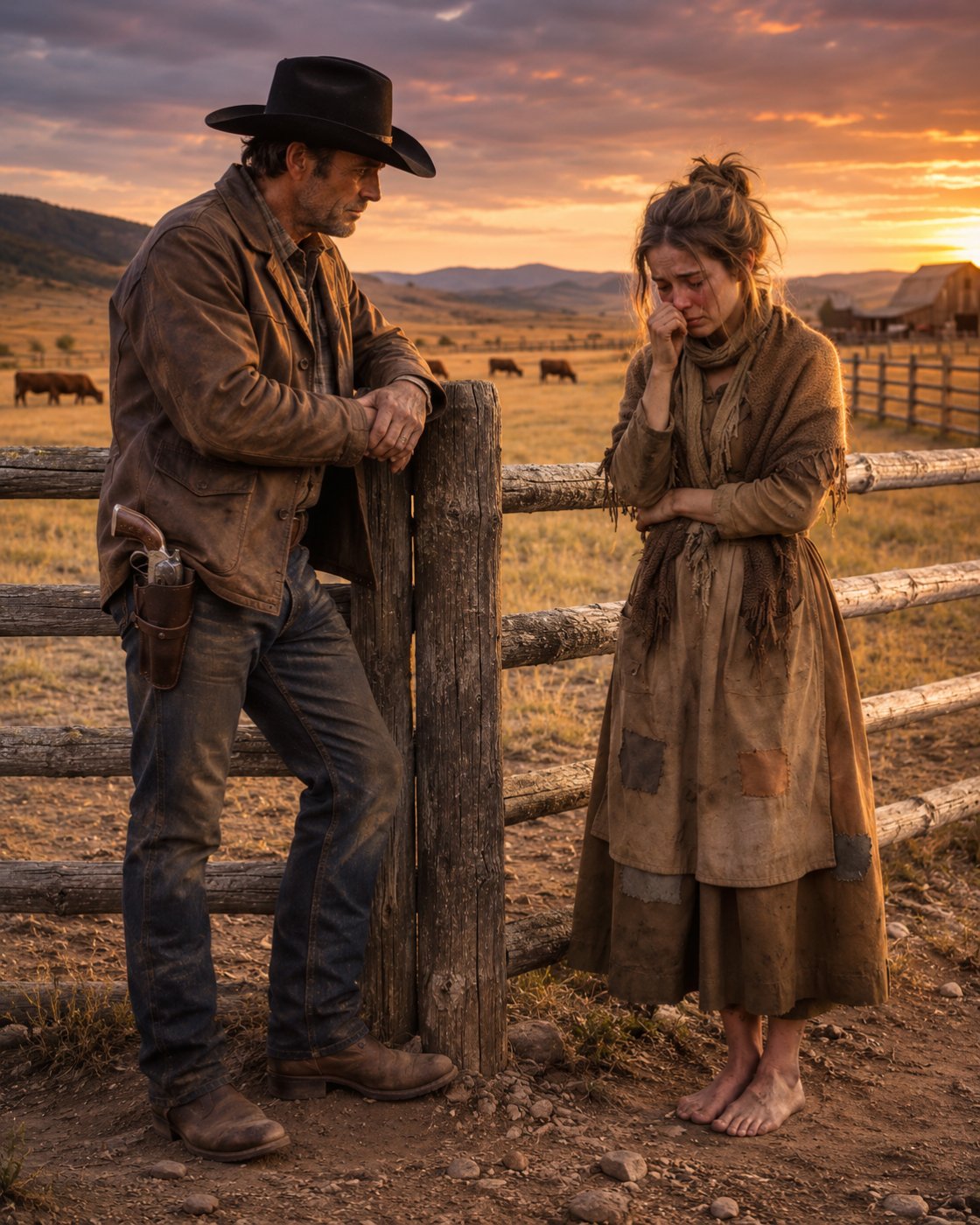
In case you missed it: For months, wealthy, lonely rancher Nathan Brooks watched young Anna Pierce walk past his land in a patched dress with an empty basket, while the town whispered cruel stories about her.
Then he found her crying over her late mother's photograph and learned the truth.
She'd sold everything for her mother's medicine and was still working off the doctor's bill, and she gave her own bread to a blind neighbor.
He gave her honest work on his ranch.
But the town's gossip only grew worse, until one morning Anna was gone, leaving a note: "I won't let my name ruin yours".
Nathan stood in the doorway of the little room at the top of the stairs for a long time.
It had been Benny's room once.
He hadn't been able to go into it for six years.
When Anna came to work at the ranch in October, he'd asked Gus Dawes to clear it out and put a proper bed in it, because it was the warmest room in the house.
He hadn't been able to do it himself.
He'd stood at the bottom of the stairs while Gus carried down the little wooden rocking horse, and the box of tin soldiers, and the small bed with the quilt Catherine had sewn.
Anna had never asked why the room had been shut up.
But on her first night in it, she'd come down to the kitchen and found the rocking horse in a corner of the pantry where Gus had stored it.
She'd stood looking at it for a long moment.
And the next morning, it had been back upstairs, in the corner of her room, with her mother's photograph propped on its saddle.
The rocking horse was still there now.
The photograph was gone.
He looked at the note in his hand again.
Thank you for everything.
I won't let my name ruin yours.
He folded it carefully and put it in his shirt pocket.
Then he went down the stairs two at a time, which he hadn't done in six years either.
Gus Dawes was in the yard, hitching the team to the hay wagon.
He was sixty-one, bowlegged and gray, and had been foreman on the Brooks place since before Nathan was married.
He looked at Nathan's face and stopped what he was doing.
"She's gone, Gus".
Gus didn't ask who.
"When?"
"Sometime in the night.
Bed's cold".
Gus took off his hat and turned it in his hands.
"It's that business at church Sunday," he said.
"And Cal Ritter shooting his mouth off at the store.
I heard about it last night.
I should've told you".
"Where would she go?"
Gus thought about it.
"She ain't got anybody, boss.
You know that.
Her ma was all she had.
There's the old shack by the creek, where they lived.
But she sold that to Pruitt's widow for the doctor bill back in the spring".
Nathan was already walking toward the barn.
"Saddle Jasper," he said.
"And Gus.
Ride into town.
Ask at the stage office if anybody bought a ticket this morning.
Ask at Mrs. Garrity's on Mill Street.
Ask everybody".
"Boss," said Gus.
"What if she don't want to be found?"
Nathan stopped in the barn doorway.
He didn't turn around.
"Then I'll tell her I found her anyway," he said.
"And she can tell me to my face".
He rode first to the creek.
The little shack where Anna and her mother had lived stood at the edge of town, by the willows.
It was empty.
The widow who'd bought it hadn't moved in yet.
The door hung open.
Inside, there was nothing at all.
A bare floor.
A cold stove.
A window with a cracked pane.
In the corner, on the floor, there was a faint rectangle where the floorboards were paler, where something had stood for years and then been taken away.
A sewing machine, maybe.
She wasn't there.
He rode to the stage office.
The morning stage to Cheyenne hadn't left yet.
The agent said no young woman had bought a ticket.
He rode to Mill Street.
Old Mrs. Garrity was sitting on her porch in a rocking chair with a shawl around her shoulders.
She was eighty-three and nearly blind, with milky eyes and a face as wrinkled as a dried apple.
She turned her head toward the sound of his horse.
"Who's that?"
"Nathan Brooks, ma'am".
"Brooks".
The old woman's face changed.
"You're the one Anna works for.
Out at the big ranch".
"Yes, ma'am.
Has she been here this morning?"
Mrs. Garrity was quiet for a moment.
Then she reached down beside her rocking chair and held up a basket.
There was a fresh loaf of bread in it, wrapped in a cloth.
Still warm.
"She came at dawn," said the old woman.
"Same as always.
Every single morning for two years, that girl has brought me bread.
Even when she didn't have any for herself.
Even the week her mama died".
Her voice shook.
"This morning she sat with me longer than usual.
She held my hand.
She said she might not be able to come for a while.
She said she was going away".
Mrs. Garrity's blind eyes filled with tears.
"I asked her where.
She wouldn't say.
She just kissed my forehead and said, 'Somebody will come, Mrs. Garrity.
I'll make sure somebody comes.
'"
Nathan sat on his horse and couldn't speak for a moment.
"Which way did she go, ma'am?"
"I can't see, Mr. Brooks.
But I heard her walk off toward the church".
He found her in the churchyard.
Not in the church.
Behind it.
In the far corner of the burying ground, past the neat rows of white headstones with their carved names and dates, there was a patch of rough ground by the back fence.
It was where the town buried people who couldn't pay for a plot.
There were no stones there.
Only wooden crosses, weathered gray, some of them leaning, some of them fallen over in the grass.
A few had names burned into them with a hot iron.
Most had nothing at all.
Anna was kneeling in the frost in front of one of them.
It was a small cross, made of two pieces of planed pine.
It wasn't weathered yet.
Burned into the crosspiece, in careful, uneven letters, as if somebody had done it with a heated nail, it said: Eleanor Pierce.
Beloved Mother.
1841–1885.
Anna had her carpetbag beside her on the frozen grass.
She was wearing her old patched blue dress again, not the gray wool one Nathan had bought her in November.
She had her mother's photograph pressed against her chest with both hands.
She didn't hear him come up.
"I'm sorry, Mama," she was whispering.
"I tried.
I tried so hard.
I thought, for a little while, I'd finally found somewhere.
But it's the same as always.
Wherever I go, they talk.
And now they're talking about him".
Her voice broke.
"He's a good man, Mama.
The best man I ever met, except Papa.
He gave me Benny's room.
He doesn't know I know it was Benny's room.
And they're saying such things about him, in town, because of me.
I can't let them.
I can't".
Nathan stood behind her in the frost with his hat in his hands.
"Anna," he said.
She spun around on her knees.
Her face went white, then red.
She scrambled to her feet, wiping her eyes with the back of her hand, the way she had behind the shed in October.
"Mr. Brooks.
You shouldn't be here.
You shouldn't have come".
"You left my coat on the bed".
She stared at him.
"It's November," said Nathan.
"You'll freeze in that dress".
"I'll manage".
"I know you will.
You've been managing for two years".
He looked down at the little pine cross.
"You made that yourself".
It wasn't a question.
Anna looked at the cross.
Her chin trembled.
"The town buried her," she said.
"In the pauper's corner.
Because I couldn't pay for a plot.
And they didn't even put up a cross.
Just a stake with a number on it.
Number forty-one".
Her voice cracked.
"So I went to the lumberyard and asked Mr. Haskell for two scraps of pine.
And I heated a nail in Mrs. Garrity's stove and burned her name in, letter by letter.
It took me three nights".
Nathan looked at the careful, uneven letters.
Eleanor Pierce.
Beloved Mother.
"It's a fine cross," he said quietly.
"It's two scraps of pine".
"It's the finest cross in this churchyard," said Nathan.
"Because somebody loved her enough to make it with her own hands".
Anna's face crumpled.
He came forward then and put his coat around her shoulders.
He'd brought it with him.
He'd picked it up off the quilt on her bed on his way out.
She didn't push it away.
"Anna," he said.
"Listen to me.
Will you sit down a minute?"
There was an old stone bench by the back fence, half grown over with dead grass.
They sat down on it together, with her carpetbag at her feet.
"Six years ago," Nathan said, "I buried my wife and my boy in this churchyard.
Up there".
He nodded toward the other end of the burying ground, toward a tall white stone with an angel carved on top, surrounded by a little iron fence.
"Catherine and Benny.
Diphtheria.
Benny was five".
He was quiet a moment.
"I paid three hundred dollars for that stone.
Had it shipped from Denver.
Marble.
With an angel".
Anna didn't say anything.
"I haven't been inside that iron fence since the day they put it up," Nathan said.
"Not once.
Six years.
I come to church every Sunday and sit in the front pew, and I never once walk back here".
He looked at the little pine cross.
"You've been walking back here every week since your mother died, haven't you?"
"Every Sunday," Anna whispered.
"After church.
After everybody leaves".
"I've seen you," said Nathan.
"From the road.
I thought you were waiting for somebody".
"I was".
She looked at the cross.
"I was visiting somebody".
He nodded slowly.
"That's the difference between us, Anna," he said.
"I bought the most expensive stone in Wyoming Territory, and then I never visited it.
You made a cross out of two scraps of wood, and you visit every week".
He turned his hat in his hands.
"I had all the money in the world and I didn't know how to grieve.
You had nothing at all, and you knew exactly how".
Anna turned and looked at him.
"Mr. Brooks—"
"When you came to the ranch," Nathan said, "I thought I was helping you.
I thought I was the rich man doing a kindness for a poor girl.
That's what I told myself".
He shook his head.
"But six years, Anna.
Six years that house was silent.
I'd come in from the range at night and eat my supper standing up at the kitchen counter, because I couldn't stand to sit at the table alone.
I couldn't stand to see Benny's chair".
She was crying again now.
Quietly.
"And then you came," said Nathan.
"And the first week, you set the table.
All of it.
You set a place for me at the head, and a place for yourself, and a place for Gus, because you said a foreman who's been with a family thirty years shouldn't eat in the bunkhouse.
And I came in from the barn and saw it".
His voice roughened.
"And I sat down at my own table for the first time in six years".
Anna pressed her hand over her mouth.
"You moved Benny's rocking horse back into his room," Nathan said.
"I saw it there.
With your mother's photograph on the saddle.
I stood in the doorway for an hour that night after you were asleep".
He swallowed.
"I didn't take it out.
I couldn't.
It looked like it belonged there".