PART 3
The parsonage parlor smelled of lemon oil and boiled coffee, and it was far too warm for June.
Five women sat waiting in a half circle of straight-backed chairs. Agatha Beale had the center seat, as she always did, her gray silk buttoned to the chin and her Bible resting on her knee like a gavel. Cora Whitlock sat to her right with her lips pressed thin. Little Mrs. Ashby, the reverend's wife, sat nearest the door and looked as if she wished she could slip through it.
No one offered Eleanor a chair. She stood in the middle of the rag rug with her hands folded at her waist, the way she used to stand at the front of a schoolroom in Ohio thirty years ago, back when she still believed that if a person told the truth plainly enough, people would listen.
"Mrs. Pruitt," Agatha began, "you understand why you've been asked here."
"I understand there is talk."
"There is more than talk. Mr. Ferris saw a horse tied behind your quarters at ten o'clock on Tuesday night. Mrs. Whitlock's boy saw the same horse on Thursday. A lamp burning past eleven." Agatha's eyes narrowed. "Do you deny it?"
"No."
A small sound went around the room, half gasp, half satisfaction.
"Then perhaps," Cora said, "you'll tell us whose horse it is."
Eleanor looked at the window. Outside, the afternoon light lay gold across the Neosho, and somewhere beyond the trees a meadowlark was singing as if nothing in the world was wrong. She thought of Wade's hand on the slate, the way his finger trembled over the curve of every letter. She thought of the way he'd said, Fifty-six years and nobody caught me. Not once. As if it were the only victory he'd ever had.
"I have done nothing I'm ashamed of," she said. "That is all I will say."
"That is not an answer."
"It's the only one I have, Mrs. Beale."
Agatha set her Bible on the side table with a small, deliberate click. "Eleanor. I have tried to be fair to you. When Harold Pruitt brought you here from Ohio, a schoolteacher no one knew, some of us had doubts. When he died and left everything to Lydia, as was right, some of us wondered how you'd manage. I told the Society to be patient. I said, she's a decent woman, she'll find her way." She leaned forward. "But a decent woman does not receive a man alone after dark and then refuse to name him."
"A decent woman doesn't owe this room an accounting of her kitchen," Eleanor said, and then wished she hadn't, because she saw Mrs. Ashby flinch.
She softened her voice. "I'm grateful to the church. Truly. I know I've not always been welcome here, but I know the kindness that was done for me all last winter. The wood and the flour on my step. I thanked the reverend for it, and I'd thank all of you now if you'd let me. I would never repay that kindness with shame."
The silence that followed was different from the others.
Agatha's brow drew together. "What wood?"
"The firewood. Split and stacked by my door. And the flour, every few weeks, from the first snow until March."
The women looked at one another.
"Mrs. Pruitt," Mrs. Ashby said gently, "the church didn't send anything to the Pruitt place. We assumed Lydia was providing for you. Thomas never said..." She trailed off. "I suppose he thought you meant something else."
Eleanor felt the floor tilt under her.
All winter. All those mornings she'd opened the door to find a fresh stack of oak, cut to the exact length of her little stove, the bark turned up to shed the snow. The fifty-pound sacks of flour leaned against the wall, never a word, never a name. She had knelt beside that door more than once and whispered a prayer of thanks for the people of this church, the same people who never quite smiled at her on Sunday. She had believed it was their quiet way of saying she belonged.
It had never been them at all.
Cora Whitlock's voice was almost gentle now, which was worse. "So all winter, someone's been keeping you. And you don't know who."
"I didn't know it was anyone but the church."
"Firewood doesn't split itself, Eleanor. Flour isn't free. A man doesn't give a widow woman a winter's keep for nothing."
"Cora," Mrs. Ashby murmured.
"Well, he doesn't."
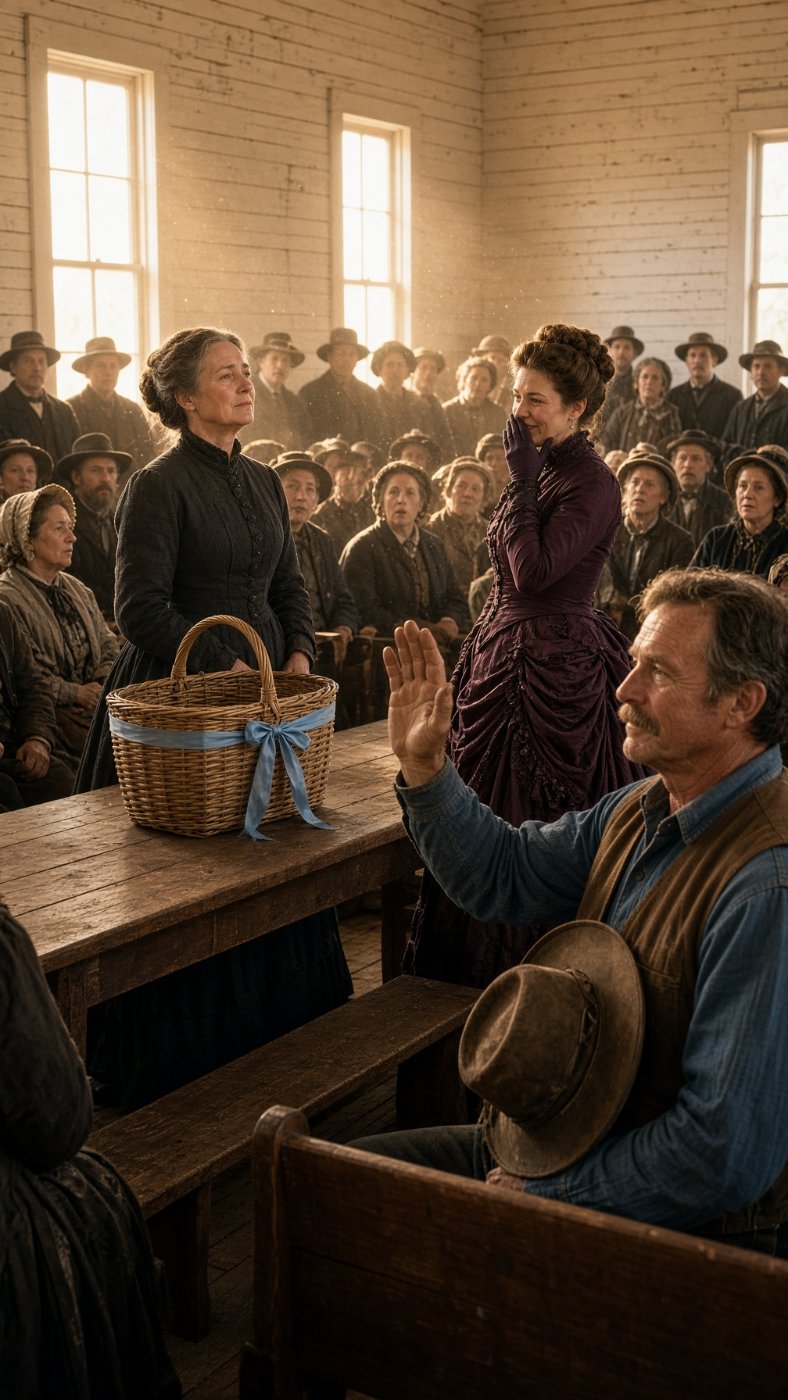
Agatha Beale rose. "I think we've heard enough. Until this matter is settled, the Society feels it would be best if you did not teach the infant class on Sundays. And if you did not bring a basket to the Fourth of July supper." She paused. "I'm sorry for you. I truly am. But this town has to have standards, or it has nothing at all."
Eleanor nodded once. She did not cry. She thanked them for their time, because her mother had raised her to thank people even when they had hurt her, and she walked out into the bright afternoon with her chin up and her heart pounding so hard she could hear it in her ears.
Lydia's buggy was gone from the hitching post. She had not waited.
Eleanor walked the three miles home.
Somewhere along the creek road, with the dust settling on her black hem and the cottonwood fluff drifting like warm snow, she stopped.
The firewood.
She saw it as clearly as if it were stacked in front of her. Every bundle had been tied with a thin braided cord, gray and black, strong as wire. She'd saved the cords in a crock by the stove because they were too good to throw away. She'd never once wondered where they came from.
Braided horsehair.
The same gray-and-black horsehair Wade Harlan used to mend his harness every evening at her kitchen table. She'd watched him braid it a dozen times, his big fingers moving faster than she could follow, the only time he ever looked completely at ease.
Eleanor put her hand over her mouth and stood in the middle of the road until a farm wagon came around the bend and the driver tipped his hat and stared.
He had fed her all winter. And he had never told her because he couldn't write a single word to sign it with.
Wade came at dusk, as he always did.
She heard the bay before she saw it, the soft blow and stamp of a horse being tied in the shadow of the woodpile. She had already decided what she would do. She had decided it on the long walk home and again while she packed her few things into her trunk: three dresses, her mother's Bible, her teaching certificate in its oilcloth sleeve, Harold's reading spectacles, and the crock of horsehair cords.
She opened the door before he could knock.
"You can't come in tonight, Wade."
He stopped on the step with the harness over his shoulder. In the last light his face looked older, the creases at his eyes deeper. "Something wrong?"
"The lessons are finished. You don't need me anymore. You read the whole first page of Ruth on Tuesday. You can go on by yourself now."
"I read it slow."
"Slow is still reading."
He looked past her, into the little room. At the trunk standing open by the cot. At the bare nail where her shawl usually hung.
"You're going somewhere."
"Mrs. Hays needs a cook at the hotel in town. I'll have a room there. It's a good position." It was not a good position. It was a cot behind the hotel kitchen and twelve dollars a month to cook for freighters from four in the morning until dark. But it was a place, and it was hers.
"Lydia putting you out?"
"Lydia owns the ranch. It's her right."
He shifted the harness. "Ma'am, I may be slow, but I ain't a fool. Somebody's done something."
She could not let him find out. If he knew, he would do something reckless. He would go to Lydia, or to Agatha Beale, and he would stand there with his hat in his hands and say it, and then every man at the feed store and every boy at the schoolhouse would know that Wade Harlan couldn't read a seed catalog. She had seen what this town did to a person it decided was less than it. She would not watch them do it to him.
So instead she asked the other thing. The thing she had to know.
"Wade. Was it you? The firewood. The flour."
He went very still. The way a horse goes still before it decides whether to bolt.
"Who told you?"
"Nobody told me. The church never sent anything. And every bundle was tied with your horsehair."
For a long moment he didn't say anything at all. The crickets had started up in the grass. Down at the big house, a lamp came on in Lydia's window.
"Saw you out here in November," he finally said. "Splitting wood in the sleet with Harold's old ax. The head was loose on it. Figured it'd fly off and take your foot." He stared at the ground. "Summer kitchen's got no insulation to speak of. Knew you'd freeze out here."
"Why didn't you tell me?"
"How?" The word came out rough. "I thought about leaving a note. Sat up three nights trying to figure how. All I could make was an X. Figured you'd find an X on a sack of flour and think some drunk cowhand was courting you. Or worse, you'd think it was pity." He swallowed. "Easier to let you think it was the church. Folks ought to think kindly of the church."
"Folks ought to think kindly of you."
"Folks think I'm slow, Eleanor. Been that way all my life. Don't much matter what they think of me."
It mattered to her. It mattered so much that she could not speak for a moment, and when she could, all she said was, "Thank you." It was not nearly enough, and they both knew it.
"You'll come back to church?" he asked.
"Sunday. One last time. Then I go to town."
He nodded slowly. He looked at the trunk again, and at her, and she thought for one terrible second he was going to ask. Instead he turned, untied the bay, and rode off into the dark without a word, the mended harness still hanging over his shoulder.
She shut the door and sat down on the edge of the cot and finally let herself cry, quietly, so the sound wouldn't carry to the big house.
Wade didn't find out until Thursday.
He was in the Kincaid bunkhouse after supper, oiling a saddle by lantern light, when Joe Ferris's cousin Dutch came in from town with a bottle and a grin.
"Hear about the Widow Pruitt?" Dutch said to no one in particular. "Old Agatha Beale hauled her up in front of the whole Ladies' Aid. Wouldn't say who her gentleman caller is. Not a word. Lydia's turning her out Sunday." He laughed. "Ferris says it's a bay with a white stocking. Hind leg. Anybody here ride a bay with a white stocking?"
The bunkhouse went quiet. Then a couple of the younger hands started laughing too, until they glanced at Wade and saw his face, and the laughter died out.
Wade set the saddle soap down very carefully.
"When was this?"
"Saturday last. Where you been?"
Saturday. She had known on Saturday. She had stood in front of those women and taken every word they threw at her, and then she'd walked home and packed her trunk, and on Monday night she had looked him in the eye and told him the lessons were finished because he didn't need her anymore.
She had let the whole county call her a fallen woman to keep a fifty-six-year-old horse breaker from being laughed at.
Sam Doyle, the Kincaid foreman, followed him out into the yard. Sam was the only man on the place Wade halfway trusted, and even Sam didn't know.
"Wade. That your horse they're talking about?"
"It is."
Sam let out a long breath. "Lord. Well. You want to marry her, marry her. Ride over to the Pruitt place and tell Lydia you're courting proper and the talk dies tomorrow."
"Wouldn't fix it." Wade looked toward the dark line of the Pruitt fence. "They'd say she was a widow throwing herself at the first fool who'd have her. Say I married her to stop the shame. She'd carry that. Folks'd still whisper about what went on in that kitchen." He rubbed the scar on the back of his hand. "Only thing that fixes it is the truth. All of it."
"What's the truth?"
Wade didn't answer. He went back into the bunkhouse, took the lantern off its hook, and carried it out to the tack room where nobody would bother him.