"You Came 900 Miles for Nothing"—The Rancher Saw His Own House in Her Love Letters
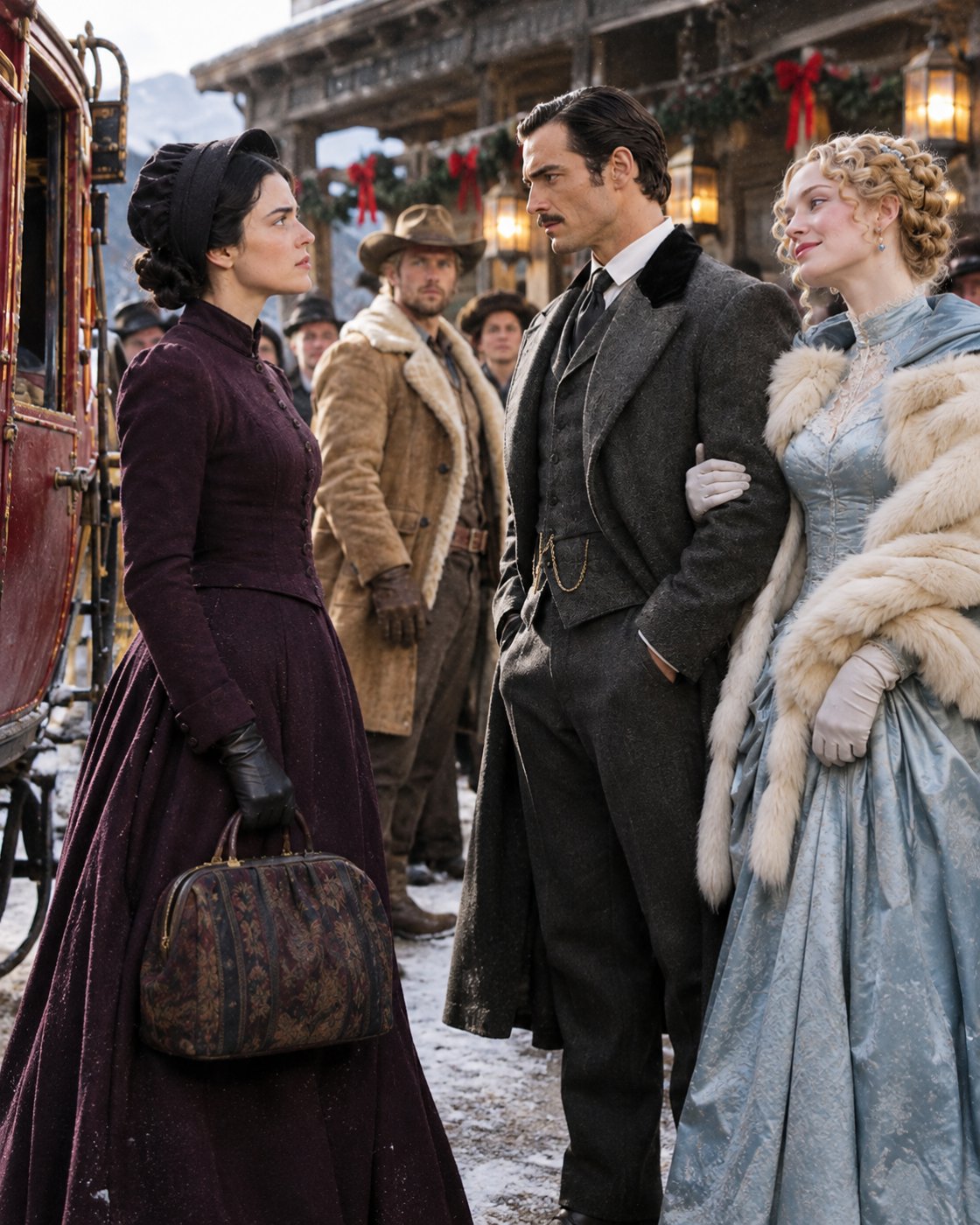
You have come 900 miles for nothing, Miss Brennick. You wrote that we would be married on Christmas Day. >> I'm afraid the poor woman is confused. >> You have come 900 miles for nothing, Miss Brennick, said Odessa Thorncraftoft loud enough for the whole street to hear. Lucien married me at 10:00 this morning, so you may as well get back on that coach. and somebody in the crowd laughed. It was Christmas Eve 1884 at the stage relay station in Antelope Springs, Wyoming territory. The sky was low and pale with coming snow. Six tired horses stood steaming in their harness while the hustler led out a fresh team. Across the frozen road in front of the Antelope House Hotel, a sleigh stood waiting, hung with red ribbons and silver bells. A wedding party had just come out from their celebration dinner, laughing and warm to see the afternoon stage come in. They had not expected a show, but they were getting one. On the step of the coach stood a young woman in a plain traveling dress of dark plum wool with a small black bonnet and a worn carpet bag in her hand. Her name was Lana Brennick. She was 26 years old and she was a dress maker from Otuma, Iowa. Her hair was raven black, thick and glossy, pinned in a low, neat shinon at the back of her neck. Her eyes were a warm hazel green, the color of creek water over moss in summer. Her skin was clear and healthy with the cold wind bringing a soft rose to her cheeks. She was so beautiful that the hustler stopped with the harness in his hands and stared. She looked past Odessa, past the ribbons and the bells to the man standing at the front of the wedding party. He was handsome. That was the first thing anyone noticed about Lucien Vardell, and he made sure of it. He was 34, slim and straight, with smooth dark hair, a neat mustache, and a long gray overcoat with a velvet collar. On his arm was his bride of 4 hours in a cloud of white fur and blue silk with golden curls and a small pretty pitile smile. "Mr. Vardell," Lana said quietly. Her voice did not shake, though her hand did. "You wrote that you would meet me here. You wrote that we would be married on Christmas Day." Lucien Vardell sighed as if she were a child who had broken something. Miss Brennick, I wrote to you in December and released you from our understanding. It is not my fault if the letter missed you on the road. I am sorry you made the journey truly. And my $640, said Lana. The money you asked me to send for our homestead. There was a little silence. Then Lucian smiled at the crowd and spread his gloved hands. I never received any money from this lady, he said gently. I am afraid the poor woman is confused. And then the laughter came in earnest. But at the hitch rail beside a tall gray horse, a man in a sheepkin coat had stopped laughing before he ever started. He was tall and broad in the shoulders with sandy blonde hair, a short trimmed fair beard, and steady blue eyes. and he knew Lucien Vardardell better than anyone in that street. His name was Coulter Hayes. For two years, he had been the foreman on Vardell's Diamond 5 ranch. And he knew exactly what that smile meant when Lucian Vardell was lying. My friend, what Coulter did next would change that whole town before the new year rang in. Because the truth about Lucian Vardell was not in his wedding ring. It was hidden in a packet of letters inside a dress maker's carpet bag. And in those letters was a secret that only Coulter Hayes could recognize. Stay with this story because that cold Christmas Eve at the relay station was only the beginning. To understand why Lana Bren stood frozen on that coach step, we have to go back a little way to a small dress shop on Main Street in Otmo, Iowa. Lana had been sewing since she was 8 years old. Her mother had passed away of a fever when Lana was small, and her father, a Swedish carpenter, had followed a few years later after an accident at a sawmill. She was raised by her aunt Britta, a widow who did fine sewing for the ladies of the town. Aunt Britta could not leave her much money, but she left her something better. She left her a pair of hands that could make a gown fit a woman like a whisper. By 20, Lana was the best seamstress at Madame Perau's dress shop. But the shop was not hers. The wages were small, and the evenings were long and lonely in a rented room above a harness makers. Every week, Lana put a little money into a tin box under her bed. 10 cents, 25 cents, sometimes a whole dollar. In 9 years, she saved $640. It was every cent she had in the world. Then in the spring of 1884, Aunt Britta passed away peacefully in her chair by the window, and Lana found herself alone. A girl at the shop showed her a newspaper called The Western Matrimonial Gazette, full of little notices from lonely men on the frontier looking for wives. One was different. It read, "Rancher 34 Su, of good character and steady habits, Wyoming territory. Owns a snug log home beneath three cottonwoods beside a spring that never freezes. Seeks a sensible, kindly woman who is not afraid of hard work or long winters. Write to El Vardell Antelope Springs. Lana read it four times. Then, half laughing at herself, she wrote back. His first letter came three weeks later. It was warm and clever and kind. He wrote about the long blue evenings on the prairie and the sound of the creek under the ice. He wrote about his gentle gray mare called Duly who would eat sugar from your hand. He wrote about the view from his door west toward the white shoulder of Elk Mountain. He asked about her work and he seemed to truly listen. Over 8 months he sent her 21 letters. She kept everyone tied with a blue ribbon. In September a letter came that was different. It was troubled. The land office, he wrote, required a final payment to prove up his homestead before winter. If he could not pay, he would lose the house. Their house, he hated to ask, but if she could send her savings, he would hold it in trust for them both. It was he wrote for our homestead. Lana sat with that letter for one whole night by the light of a single lamp. In the morning, she went to the bank, bought a draft for $640 made out to Lucien Vardell, and sent it by registered mail. She kept the bank's receipt folded inside the last letter. In November, he wrote back with joy. "Come at Christmas," he said. "The stage reaches Antelopee Springs on Christmas Eve. We will be married on Christmas Day." So, she packed her trunk. She sewed herself a wedding gown of ivory silk with tiny pearl buttons down the back, the most beautiful thing she had ever made. And she rode 900 miles across Iowa and Nebraska and the high windcoured plains of Wyoming on the Union Pacific to Medicine Bow and then north on the stage. She had dreamed of that house beneath the three cottonwoods for 8 months. She had never once imagined that it might not exist. Back on the frozen road in front of the relay station, the laughter was dying down, and Lucien Vardell reached into his coat. "Come now," he said in the tone of a generous man. He held out a folded bank note. "Here is $20, Miss Brennick. That will take you back to the railroad and buy you a hot supper besides. Consider it a Christmas kindness. Let us all part as friends." Lana looked at the $20. Then she looked at him. I did not come for $20, Mr. Vardell. She said, "I came for $640 of my own, and I will not take charity from the man who took it." Odessa Thorncraftoft laughed a bright little laugh like breaking glass. Listen to her. She has nothing but a carpet bag, and she is too proud to take money. Papa, do say something. A heavy man in a beaver hat and a furlined coat stepped forward. He was about 55 with a broad red face and a heavy gold watch chain. This was Malachi Thorncraftoft, president of the Thorncraftoft Bank of Antelopee Springs, the richest man for 60 miles. He looked at Lana the way he looked at a bad loan. young woman. He said, "This town does not care for scenes, and it does not care for strangers who make accusations against respectable men. The next southbound coach leaves on Friday morning. I suggest you be on it. Until then, I am sure the station can find you a bench." He turned his back, and the wedding party followed him to the b- ribboned sleigh. The silver bells jingled away up the street, and Lana was left alone in the blowing snow, with her carpet bag in one hand, and her pride in the other. Then an old woman in a brown shawl came out of the station door as fast as her bad hip would carry her. Child, you come inside before you freeze to that step, she said. I am Belva Larabe. My husband Ezekiel keeps this station and the post office both, and I keep him. Come in. Come in. Belva was 63, small and round and quick, with white hair under a lace cap and eyes as sharp as needles. Behind her came her husband, Ezekiel, a tall, stooped, gentle old man with spectacles on the end of his nose and ink on his fingers. "Thank you, Mrs. Larabe," Lana said. "But I can pay for a room. I have a little money for the journey, and if I haven't enough, I can work for it. I am a dress maker. I can mend. I can cook. I can scrub. I will not be a charity case. Belva looked her up and down, and something in her face softened. There is a little room behind the kitchen next to the stove. It has a bed and a lock on the door. My curtains are a disgrace, and Ezekiel's Sunday coat has a hole in the elbow. You fix those, and the room is paid for. Is that a bargain? It is a bargain," said Lana, and for the first time her chin trembled. Her trunk had been thrown down into the snow beside the coach. Before the hustler could reach it, the tall man in the sheep-skin coat had lifted it onto his shoulder as if it weighed nothing. He carried it inside, set it down by the kitchen door, and stepped back. He did not crowd her. He took off his hat. "Miss Brennick," he said, "my Coulter Hayes. I worked for Lucian Vardell for two years as foreman on his ranch. I left him last April. She looked up at him wearily. And why are you telling me this, Mr. Hayes? Because I watched his face out there, said Coulter quietly. And I believe you. That evening the Lar
A Mail-Order Bride Traveled 900 Miles to Marry a Rancher—Then Discovered His Love Letters Described Another Man’s Home
PART 1
“You came 900 miles for nothing, Miss Brennick. My husband married me this morning.”
The words struck Lana Brennick harder than the Wyoming winter wind.
She stood beside the Christmas Eve stagecoach, clutching a worn carpetbag while strangers laughed at her humiliation.
Only hours earlier, she had imagined becoming a bride on Christmas Day.
Now the man who had promised to marry her stood beside another woman.
Lucien Vardell looked handsome in his expensive gray coat, his new bride, Odessa Thorncraft, clinging to his arm.
“I'm afraid there's been a misunderstanding,” he announced pleasantly. “I wrote to release Miss Brennick from our arrangement.”
Lana's cheeks burned.
“You wrote twenty-one letters promising me a future. And you took my $640.”
The laughter stopped briefly.
Then Lucien smiled.
“I never received money from this woman. I'm afraid she's confused.”
Nine years.
That was how long Lana had saved those $640, stitching dresses in a little Iowa shop until her fingers ached.
She had sent every dollar because Lucien claimed he needed to secure their homestead.
A log house beneath three cottonwoods.
A spring that never froze.
A gentle gray mare named Dulce.
He had described everything so beautifully that Lana could picture the place whenever she closed her eyes.
Now he offered her twenty dollars to disappear.
Lana refused.
“I won't accept charity from a man who stole my future.”
Odessa laughed. Her wealthy father ordered Lana to leave town.
But one man watching from beside a gray horse did not laugh.
His name was Coulter Hayes.
He had once worked as Lucien's ranch foreman, and he knew the difference between a misunderstanding and a deliberate lie.
When the wedding party departed, Coulter quietly carried Lana's trunk into the nearby relay station.
An elderly couple, Belva and Ezekiel Larabe, offered her a warm room in exchange for sewing.
That evening, Coulter returned.
“I believe you, Miss Brennick,” he said.
Lana hesitated before bringing out her treasured letters, still tied with blue ribbon.
Coulter opened the first.
His expression changed.
He read the description of the cottonwoods, the spring, and the gray mare.
Then he looked at Lana.
“Miss Brennick, Lucien doesn't own a house like this.”
Her heart sank.
“Then whose house have I been dreaming about?”
Coulter's voice grew quiet.
“Mine.”
He unfolded another letter, and suddenly his face went pale.
“There's something else. This letter describes a room inside my house that Lucien has never seen.”
Lana stared at him.
“Then how could he possibly know about it?”
Coulter looked toward the dark window.
“That's what frightens me.”
Read PART 2 in the first comment below.
PART 2
Coulter spread Lucien's letters across the Larabes' kitchen table. One described a cedar chest beside the bedroom window, another mentioned the initials carved into the mantel. Both details belonged to Coulter's home on Little Antelope Creek. “Lucien visited my place several times,” Coulter admitted. “But I never imagined he'd use it to deceive a woman.”
Lana stared at the handwriting. For eight months she had believed every word. She had imagined tending the spring, feeding sugar to Dulce, and growing old beside a husband who loved her. “So he borrowed your home,” she whispered, “and sold me a future that was never his.”
Before Coulter could answer, Ezekiel Larabe brought out the post office's registered-mail ledger. He found Lana's payment from Iowa, signed for by Lucien. Then he discovered five more registered letters addressed to the same man, each arriving from a different state. Coulter studied the entries. “Six women,” he said. “He may have taken money from every one.”
Lana's grief turned to determination. She refused to return to Iowa while five other women might still be waiting for promises that would never be kept. Ezekiel contacted federal postal authorities, while Coulter helped request records from the bank and land office.
On Christmas morning, Lana sacrificed the ivory wedding gown she had sewn for herself, turning its beautiful silk into a christening dress for a stranded mother's baby. The congregation admired her extraordinary needlework, and soon the town's women began offering her paid sewing commissions.
But Lucien discovered she was investigating him. He appeared at the station with $640 in gold, demanding that she sign a statement withdrawing every accusation. Lana pushed the money away. “If I accept this, you'll simply find another woman to cheat.” His smile disappeared. “Winter roads are dangerous, Miss Brennick. Accidents happen.”
That night, someone forced open Lana's bedroom window and searched her belongings. Her trunk was overturned, her dresses scattered, and the blue ribbon from her letters lay abandoned on the floor. Fortunately, Ezekiel had already locked the letters inside the post office safe.
A telegram arrived confirming that Lucien had cashed Lana's bank draft. Another revealed he had never owned the homestead he described. A federal inspector was coming, but a terrible blizzard had blocked the mountain pass. Coulter volunteered to ride fifty miles through the snow to bring him back.
Before dawn, Lana secretly mended Coulter's torn coat pocket and tucked two lumps of sugar inside for Dulce.
“Promise you'll come back,” she whispered.
Coulter took her hand.
“Before midnight on New Year's Eve.”
But as he disappeared into the snow, Lana received another message.
Lucien planned to leave for San Francisco that very night—with his new wife's fortune.
Comment exactly one word, “PROMISE”, to read PART 3 and discover whether Coulter returns before Lucien escapes.
PART 3
The first thing Lana Brennick noticed when she entered the relay station kitchen was the silence.
Belva Larabe stood beside the stove with a telegram in her hand. Her husband, Ezekiel, sat at the table, his spectacles pushed high on his forehead. Neither looked pleased.
Lana closed the door behind her.
“What is it?”
Belva handed her the message.
It had come from Winnie Lindell, the young telegraph operator who had been helping them contact the bank and federal authorities.
Lucien Vardell had arranged to leave Antelope Springs before the New Year's Eve celebrations ended.
His destination was San Francisco.
And according to the bank clerk who had spoken too freely in Winnie's office, he intended to carry a bank draft containing nearly all of Malachi Thorncraft's available personal funds.
Lana read the telegram twice.
Then she looked up.
“He's going to steal from his new wife.”
Ezekiel nodded grimly.
“That's what it looks like.”
Belva folded her arms.
“After everything he did to you, that man still isn't satisfied.”
Lana stared at the message.
She remembered Odessa standing beside Lucien outside the hotel on Christmas Eve, laughing at the penniless dressmaker who had traveled nine hundred miles for a wedding that would never happen.
She remembered the young woman's beautiful white fur, the expensive blue silk, and the cruel pleasure in her voice.
It would have been easy to feel satisfaction now.
Odessa had helped humiliate her.
Perhaps she deserved to discover what kind of man she had married.
But Lana thought of the other five women whose names had appeared in Ezekiel's registered-mail ledger.
She thought of the lonely nights they might have spent waiting for letters.
And she thought of how terrible it felt to discover that a promise had never been real.
“No,” she whispered.
Belva looked at her.
“No what, child?”
“We cannot let him take her money.”
Ezekiel sighed.
“We have no proof that he intends to steal it.”
“Then we need to find some.”
Belva shook her head.
“Lana, you have already done more than enough. Coulter is risking his life bringing the inspector through those mountains. Let the law handle this.”
Lana looked toward the window.
Outside, snow drifted past the glass in pale, restless ribbons.
Somewhere beyond the town, Coulter Hayes was riding toward Medicine Bow.
She imagined him bent against the wind, his fair beard covered in frost, his gray mare struggling through the deep snow.
He had promised to return before midnight.
But a promise could not make a mountain pass safe.
For the first time since meeting him, Lana felt a fear that had nothing to do with her own future.
She was afraid for someone else.
Someone who had believed her when the whole town laughed.
Someone who had lifted her trunk without asking for gratitude.
Someone who had stood beside her without ever making her feel small.
She pressed the telegram flat against the table.
“Then I'll do what I can until he returns.”
Belva studied her.
“You've taken a liking to that man.”
Lana's cheeks warmed.
“Mrs. Larabe.”
“Don't Mrs. Larabe me. I've been married forty years. I know what it looks like when a woman keeps watching the road.”
Ezekiel cleared his throat.
“Belva, perhaps—”
“And you hush,” she told him affectionately. “You watched the road for me once.”
Ezekiel smiled.
“Still do.”
Despite everything, Lana laughed.
The warmth of the little kitchen settled around her.
She had arrived in Antelope Springs with nothing but a carpetbag, a trunk, and a broken promise.
Now she had people who worried about her.
People who listened.
People who would stand beside her.
She was beginning to understand that a home could exist long before a person possessed a house.
The following morning, Lana rose before dawn.
She had promised Augustina Merritt that her wine-colored satin gown would be ready for the New Year's Eve dance.
The work required patience.
The old bodice had to be carefully opened, the waist adjusted, and the sleeves reshaped without damaging the delicate fabric.
Lana spread the gown across the table beneath the window.
Outside, Antelope Springs lay buried beneath snow.
The town seemed almost peaceful.
But she knew Lucien Vardell was preparing to disappear.
And Coulter had not yet returned.
By nine o'clock, the station door opened.
Malachi Thorncraft entered with Marshal Quimby behind him.
The banker wore a heavy fur coat and a face full of displeasure.
“Miss Brennick.”
Lana set down her needle.
“Mr. Thorncraft.”
“I understand you have been spreading accusations about my son-in-law.”
“I have reported facts to the proper authorities.”
Malachi snorted.
“Facts? You arrived here with a ridiculous story about a marriage that never happened.”
Lana stood.
“I arrived with twenty-one letters and proof that I sent him six hundred and forty dollars.”
The banker waved his hand.
“Enough.”
He turned toward the marshal.
“This woman has no employment, no family, and no legitimate reason to remain in Antelope Springs. I want her placed on the next coach out.”
Marshal Quimby looked uncomfortable.
“Well, now, Mr. Thorncraft—”
“She is a public nuisance.”
Lana felt the familiar humiliation rising in her chest.
It was the same feeling she had experienced outside the hotel.
The same helplessness.
The same certainty that a wealthy man believed his money gave him the right to decide where she belonged.
But this time she was not standing alone on a frozen road.
She looked at the marshal.
“I pay for my room with my work. I have sewing commissions waiting, and I have harmed no one.”
Malachi laughed.
“Curtains and patched coats do not make a respectable livelihood.”
Before Lana could answer, the station door opened again.
Augustina Merritt stepped inside.
She wore a dark green coat and carried a large parcel beneath one arm.
“Good morning, Malachi.”
The banker stiffened.
“Mrs. Merritt.”
Augustina glanced at Lana.
“I hope I'm not interrupting.”
“Not at all,” Lana said.
Augustina placed her parcel on the table.
“Miss Brennick, I've brought the lace for my daughter's wedding gown.”
Then she turned toward Malachi.
“I believe you were questioning this young woman's livelihood.”
Malachi frowned.
“That is none of your concern.”
Augustina smiled.
“Oh, but it is.”
Behind her came Mrs. Faraday, the doctor's wife.
Then the two Lindell sisters from the bakery.
Then the schoolteacher.
Then three ranch wives who had traveled through the snow because they had heard about the extraordinary christening gown Lana had made for little Maisie Medlin.
One by one, the women placed fabric, measurements, and written orders on the table.
Augustina folded her hands.
“There. I believe that settles the question of employment.”
Malachi stared at the growing pile.
“This is absurd.”
Mrs. Faraday lifted her chin.
“What is absurd is attempting to drive a working woman out of town because she refuses to be bullied.”
The schoolteacher nodded.
“And I would like to remind the marshal that being poor is not a crime.”
Marshal Quimby removed his hat.
“I am aware of that, ma'am.”
Malachi's face reddened.
“You are all taking the side of a stranger.”
Augustina stepped closer.
“No, Malachi. We are taking the side of a woman whose character we have seen with our own eyes.”
She glanced toward Lana.
“She gave up her own wedding gown to clothe a baby who had nothing suitable to wear on Christmas morning.”
Belva nodded.
“She worked through the night and never asked for a penny.”
Mrs. Faraday added, “And she has charged every one of us a fair price for honest work.”
Augustina looked directly at the banker.
“That is more than I can say for some of the men who consider themselves respectable in this town.”
A silence followed.
Malachi's jaw tightened.
Then he turned toward Marshal Quimby.
“Are you going to do your duty?”
The marshal looked at the women gathered around Lana.
He looked at the sewing orders.
Then he looked at the banker.
“I don't believe there's any lawful reason to remove Miss Brennick, sir.”
Malachi stared at him.
For a moment, Lana thought he might explode.
Instead, he turned sharply and left.
The door slammed behind him.
Belva let out a long breath.
“Well,” she said, “I suppose that's settled.”
Augustina smiled.
“For today.”
Lana looked around the room.
She wanted to thank them.
But the words would not come.
Her eyes filled.
Mrs. Faraday reached for her hand.
“You needn't cry, dear.”
Lana shook her head.
“I'm not sad.”
Augustina touched her shoulder.
“Then keep sewing. We have a dance tomorrow, and half the county intends to look beautiful because of you.”
The women laughed.
And for the first time since Christmas Eve, Lana felt that Antelope Springs might truly become a place where she belonged.
That afternoon, Augustina remained behind.
She waited until the other women had gone, then placed a second parcel on the table.
“I brought something for you.”
Lana frowned.
“What is it?”
“Open it.”
Inside lay a length of emerald-green silk.
It shimmered beneath the winter light.
Lana touched it carefully.
“Mrs. Merritt, this is beautiful.”
“It has been sitting in my storeroom for two years.”
“I couldn't possibly afford it.”
Augustina smiled.
“Then consider it payment toward the alterations on my gown.”
“That would be far too much.”
“Then consider it an investment.”
“In what?”
“In a young woman who has spent too many years making beautiful things for everyone except herself.”
Lana looked down at the silk.
Its deep green color reminded her of the creek water Lucien had described in his letters.
But the memory no longer hurt quite as sharply.
Perhaps because she had seen the real creek now.
Perhaps because she had met the man who had built the house beside it.
She folded the silk gently.
“Thank you.”
Augustina nodded.
“Now make yourself something worthy of the New Year's Eve dance.”
Lana smiled.
“I'll try.”
That evening, while she worked on the emerald gown, she found herself thinking about Coulter.
He was thirty-two years old.
He had built his own home beside Little Antelope Creek.
He had left a well-paid position rather than participate in dishonesty.
He brought firewood to a poor widow every winter without telling anyone.
And he had ridden into a blizzard because he believed a woman deserved justice.
Lana's needle paused.
She remembered the way he had looked at her when she gave Dulce a lump of sugar beside the spring.
He had seemed almost surprised.
Not by her kindness.
But by the simple fact that she had remembered something important to him.
She smiled to herself.
Then she returned to her sewing.
Far to the south, Coulter Hayes was fighting his way through Hatchet Pass.
The snow had packed between the rocks in deep, hard drifts.
Dulce struggled beside him.
For nearly two hours, Coulter walked ahead of the mare, breaking a path through snow that reached his waist.
His hands had gone numb.
His legs ached.
And the cold had settled so deeply into his bones that he could barely remember what warmth felt like.
At last, he reached a sheltered place beneath an overhanging rock.
He stopped to rest.
Dulce lowered her head.
“Just a little farther, girl,” he murmured.
He reached into his coat pocket for his matches.
His fingers touched something unexpected.
A small paper packet.
He opened it.
Inside lay a lump of sugar.
Coulter stared.
Then he found another.
Two lumps.
Carefully wrapped.
He remembered Lana standing beside him at the barn door before dawn.
He remembered her hands smoothing the torn pocket of his sheepskin coat.
He had thought she was merely brushing away loose threads.
Now he understood.
She had mended it.
And she had remembered Dulce.
Coulter laughed softly.
“Well, girl,” he told the mare, holding out the sugar, “I believe we've found ourselves a remarkable woman.”
Dulce accepted the treat.
Coulter looked toward the distant mountains.
Then he climbed back into the saddle.
He had promised Lana he would return.
And he intended to keep that promise.
By late afternoon, he reached Medicine Bow.
The railroad town was little more than a depot, a hotel, a water tower, and a row of buildings standing against the endless plains.
Coulter stabled Dulce and hurried toward the platform.
The westbound train arrived just as the sun disappeared.
Two men stepped down.
The first was small and neatly dressed, with gray hair, spectacles, and a leather case.
The second was broad-shouldered, wearing a deputy United States marshal's badge.
“Mr. Hayes?” the smaller man asked.
Coulter nodded.
“That's me.”
“Inspector Leopold Pomeroy, Post Office Department.”
The man beside him extended a hand.
“Deputy Marshal Rowan Booker.”
Coulter shook their hands.
“Thank you for coming.”
Pomeroy opened his leather case.
“Your postmaster's report was unusually thorough.”
He removed a photograph.
“Do you recognize this man?”
Coulter studied it.
The photograph showed Lucien Vardell.
But the name written beneath it was different.
Lucius Vane.
Coulter looked up.
“That's him.”
Pomeroy nodded.
“He used that name in Missouri four years ago.”
He produced another document.
“In Kansas, he called himself Louis Varden.”
Coulter felt his jaw tighten.
“How many women?”
“At least seven from earlier investigations.”
The inspector closed the case.
“And now six more registered letters have appeared in Wyoming.”
Coulter looked toward the darkening sky.
“Then we need to leave immediately.”
Booker glanced outside.
“Can we make it through the pass?”
Coulter hesitated.
He thought of the drifts.
The freezing wind.
The exhausted mare resting in the livery.
Then he remembered Lana standing on the stagecoach step while the town laughed.
He remembered the blue ribbon around her letters.
And the look in her eyes when she learned that the house she loved belonged to someone else.
“We can,” he said.
“But we'll need a fresh team and a sleigh.”
Pomeroy nodded.
“Arrange it.”
They left before dawn.
The journey north was worse than Coulter expected.
The wind had risen during the night.
Snow swept across the trail, hiding the road beneath shifting white ridges.
The horses struggled.
The sleigh runners caught against buried rocks.
Twice, the men had to climb down and dig a path with shovels.
At one point, the lead horse stumbled and fell to its knees.
Coulter hurried forward.
He loosened the harness and helped the animal stand.
Booker looked toward the mountains.
“How far?”
“Twenty miles.”
Pomeroy checked his watch.
“We may not arrive before midnight.”
Coulter looked at the sky.
He thought of Lana waiting.
He had given his word.
And for reasons he was only beginning to understand, breaking that promise felt impossible.
“We keep going.”
Back in Antelope Springs, New Year's Eve arrived beneath a pale winter sky.
Lana had barely slept.
She finished Augustina's gown.
She completed the alterations for Mrs. Faraday.
And she worked on her own emerald silk dress whenever she could spare a moment.
But her thoughts kept returning to Coulter.
Every time the station door opened, she looked up.
Every time a horse passed outside, she listened.
By afternoon, there was still no word.
Belva watched her from beside the stove.
“He'll come, child.”
Lana nodded.
“I know.”
But her voice lacked conviction.
Then the station door opened.
Odessa Vardell stood on the threshold.
She wore white fur and a blue velvet hood.
Behind her, a maid carried a large flat box.
For a moment, Lana could only stare.
The woman who had laughed at her on Christmas Eve had come to the very room where she now worked.
Odessa lifted her chin.
“I need your services.”
Belva folded her arms.
“Well, that's a surprise.”
Odessa ignored her.
“My gown for tonight arrived from Chicago. It doesn't fit.”
Lana looked at the box.
The maid opened it.
Inside lay a pale rose silk gown.
It was beautifully made, but the bodice was too narrow and one sleeve had torn at the shoulder.
Lana examined the seams.
“How long until you need it?”
“Six hours.”
Belva snorted.
“Impossible.”
Lana studied the gown again.
Then she looked at Odessa.
“I can do it.”
Odessa blinked.
“You can?”
“Yes.”
“How much?”
“Two dollars.”
Odessa stared.
“Only two?”
“That is my price.”
The young woman looked confused.
After everything she had done, she had expected refusal.
Perhaps anger.
Perhaps humiliation in return.
Instead, Lana was already reaching for her measuring tape.
“Stand on the stool, please.”
Odessa obeyed.
For the next six hours, Lana worked.
She opened the bodice seams.
Adjusted the waist.
Reset the torn sleeve.
And repaired the skirt so neatly that the damage disappeared.
At first, Odessa sat stiffly beside the stove.
Then, little by little, she began to speak.
“Lucien says we're leaving tomorrow.”
Lana's needle paused.
“For San Francisco?”
Odessa nodded.
“He says there are business opportunities there.”
“Does your father approve?”
Odessa hesitated.
“Papa trusts him.”
She twisted her handkerchief.
“Lucien made him move a great deal of money into a draft.”
Lana kept her voice calm.
“Why?”
“He says it's safer.”
“Safer from what?”
Odessa looked down.
“I don't know.”
Lana continued sewing.
She wanted to warn her.
But she had no proof that Odessa would believe her.
And if Lucien learned that she had spoken, he might disappear before the inspector arrived.
So she asked only one question.
“Do you trust your husband?”
Odessa looked toward the window.
For a long moment, she said nothing.
Then she whispered, “I thought I did.”
Lana's heart softened.
She remembered the day she had stepped off the stagecoach.
The certainty that Lucien loved her.
The humiliation of discovering the truth.
Odessa was younger than she was.
Only twenty-two.
And beneath the expensive silk and spoiled manners, she was frightened.
Lana returned to her work.
At four o'clock, Odessa stood before the mirror.
The gown fitted perfectly.
She turned slowly.
For the first time that day, she smiled.
“It looks beautiful.”
Lana nodded.
“It suits you.”
Odessa looked at her reflection.
Then at Lana.
“Why did you help me?”
Lana set down her needle.
“Because you needed help.”
Odessa swallowed.
“After what I did to you?”
Lana met her eyes.
“I know what it feels like to be humiliated in front of people.”
Odessa looked away.
For a moment, Lana thought she might apologize.
Instead, she reached into her purse and placed two dollars on the table.
“Thank you.”
Then she left.
Belva watched the door close.
“Well,” she said, “that girl has a great deal to learn.”
Lana smiled faintly.
“So did I once.”
That evening, the relay station became a whirl of activity.
Belva helped Lana dress.
Elodie Medlin pinned her hair.
Ezekiel polished his shoes and put on the Sunday coat Lana had mended.
When Lana emerged from her room, everyone fell silent.
The emerald gown shimmered beneath the lamplight.
Its fitted bodice and graceful skirt were simple but elegant.
A narrow black ribbon circled her throat.
From it hung a single pearl button.
The last button from the wedding gown she had cut apart on Christmas Eve.
Belva pressed a hand to her mouth.
“Oh, child.”
Lana looked down nervously.
“Is it too much?”
“Too much?”
Belva laughed through sudden tears.
“You look like every good thing that ever happened to this town.”
Ezekiel cleared his throat.
“I believe we had better leave before every young cowboy in Wyoming hears about this dress.”
Lana smiled.
But as they stepped outside, she looked toward the southern road.
There was no sleigh.
No sound of horses.
No sign of Coulter.
The town hall blazed with light.
Music floated through the open doors.
Inside, ranchers, merchants, and families gathered beneath pine boughs and red ribbons.
The fiddlers played lively reels.
The floorboards shook beneath dancing boots.
Lana entered between Belva and Ezekiel.
A murmur moved through the room.
People turned.
Some stared.
Others smiled.
Augustina Merritt approached immediately.
“Lana, you look magnificent.”
“Thank you.”
Augustina glanced at the dress.
“You've made my silk look better than it ever did in the store.”
Lana laughed.
Then she noticed something else.
Everywhere she looked, women were wearing garments she had sewn or repaired.
Mrs. Faraday's gray wool suit.
The Lindell sisters' lace collars.
Elodie's blue dress.
Augustina's wine-colored satin.
Even Odessa stood near the platform in her perfectly fitted rose silk gown.
For the first time, Lana understood what her work had accomplished.
She had not merely earned money.
She had become part of the town.
But her happiness faded when she saw Lucien Vardell.
He stood beside Odessa, smiling and shaking hands.
His luggage was already packed.
And when he noticed Lana, his expression changed.
Only briefly.
Then he smiled again.
Lana turned away.
She would not let him ruin another evening.
At eleven o'clock, Malachi Thorncraft climbed onto the platform.
He raised his glass.
“Friends and neighbors!”
The music stopped.
People turned.
“Tonight we celebrate the passing of another year.”
Applause followed.
“And we also wish my daughter Odessa and her husband Lucien every happiness as they begin their new life in San Francisco.”
The room cheered.
Lucien stepped forward.
He looked handsome and confident.
“Thank you,” he said.
Then his gaze found Lana.
“And before I leave, there is one unfortunate matter I must address.”
Lana felt her stomach tighten.
Lucien pointed toward her.
“That woman came here from Iowa claiming I promised to marry her.”
The room fell silent.
“She has spent the past week spreading lies about me.”
Belva stiffened.
Augustina frowned.
Lucien continued.
“I have shown her kindness. I have offered her money. Yet she persists.”
He turned toward Marshal Quimby.
“I believe it is time she was escorted out.”
Every face turned toward Lana.
Her heart pounded.
For a moment, she was back on the stagecoach step.
Cold.
Humiliated.
Alone.
Then she remembered the women who had defended her at the station.
She remembered the letters locked in Ezekiel's safe.
And she remembered Coulter's voice.
I believe you.
Lana stepped into the middle of the floor.
“Mr. Vardell.”
Her voice carried clearly.
“I did not follow you here without invitation.”
Lucien smiled thinly.
“You see?”
“You wrote me twenty-one letters.”
A murmur spread.
“You promised marriage on Christmas Day.”
Lucien shook his head.
“And you asked me to send you my savings.”
“Lies.”
Lana lifted her chin.
“I still have every letter.”
The room grew quieter.
Lucien's smile faded.
Then Augustina Merritt stepped beside Lana.
Belva joined her.
Mrs. Faraday followed.
Then Elodie.
Then the Lindell sisters.
One by one, women moved across the floor until Lana stood surrounded by people who believed her.
Lucien looked furious.
“How touching.”
He turned toward the door.
“And where is your champion, Miss Brennick? That sour former foreman?”
Lana's heart tightened.
Lucien laughed.
“Perhaps he's lying in a snowdrift somewhere.”
She looked toward the clock.
Eighteen minutes to midnight.
Outside, the wind rose.
There was no sound of sleigh bells.
No footsteps.
No sign of Coulter.
Lucien folded his arms.
“Well?”
Lana swallowed.
Then she spoke quietly.
“He gave me his word.”
Lucien laughed.
“And you believe him?”
“Yes.”
The word surprised even her.
But she meant it.
She believed Coulter Hayes.
Not because he had written beautiful letters.
Not because he had promised her a house.
Not because he had asked for her savings.
She believed him because every action he had taken since meeting her had matched his words.
The clock ticked.
Seventeen minutes.
Sixteen.
Fifteen.
Lana stared toward the door.
Then, at thirteen minutes to midnight, the doors burst open.
A gust of snow swept across the floor.
Three men entered.
The first was tall and broad-shouldered, his sheepskin coat stiff with ice.
His fair beard was white with frost.
His blue eyes searched the room.
Then found Lana.
Coulter Hayes.
For one heartbeat, neither moved.
Then he smiled.
“I gave you my word, Miss Brennick.”
Lana felt tears rush to her eyes.
“You came back.”
“I said I would.”
Behind him stood Inspector Leopold Pomeroy and Deputy Marshal Rowan Booker.
Coulter turned toward the platform.
“Folks, these gentlemen have come from the federal government.”
The room fell silent.
Inspector Pomeroy stepped forward.
He opened his leather case.
“Ladies and gentlemen, I am investigating a series of fraudulent transactions conducted through the United States mail.”
Lucien's face went pale.
Pomeroy held up a document.
“Miss Lana Brennick sent a bank draft for six hundred and forty dollars to Lucien Vardell.”
He turned toward the banker.
“The draft was endorsed by Mr. Vardell and deposited in the Thorncraft Bank.”
Malachi stared.
“That cannot be.”
Pomeroy produced another paper.
“The land office confirms that Mr. Vardell has never owned the homestead he described in his correspondence.”
A murmur swept through the room.
Then Ezekiel stepped forward.
He carried the packet of letters tied with blue ribbon.
Pomeroy opened one.
He read aloud the description of the log house beneath three cottonwoods, the spring that never froze, and the gray mare named Dulce.
Then he looked toward Coulter.
“Mr. Hayes, whose property is described here?”
Coulter stepped forward.
“Mine.”
The room erupted in whispers.
“My house. My spring. My mare.”
Lucien opened his mouth.
But Pomeroy continued.
“The post office records show six registered letters sent to Mr. Vardell from six women in different states.”
He paused.
“And we have evidence of similar fraud under other names in Missouri and Kansas.”
Lucien backed away.
“This is nonsense.”
Pomeroy removed a photograph.
“In Missouri, you were known as Lucius Vane.”
Lucien's face twisted.
“In Kansas, Louis Varden.”
“Lies!”
Deputy Marshal Booker stepped forward.
“Mr. Vardell, I have a warrant for your arrest.”
Lucien turned suddenly.
He shoved past Ezekiel and ran toward the side door.
But Booker moved faster.
The marshal stepped into his path.
Lucien collided with him.
A moment later, iron handcuffs closed around his wrists.
The room went silent.
Malachi Thorncraft sank onto a chair.
“My money,” he whispered.
Pomeroy looked at him.
“What money?”
“The San Francisco draft.”
The banker stared at his daughter.
“Every dollar I gave him.”
Odessa stood motionless.
Her beautiful rose silk gown seemed suddenly too bright.
She looked at Lucien.
Then at Lana.
Her lips trembled.
“You knew.”
Lana shook her head gently.
“I suspected.”
Odessa swallowed.
“And you still fixed my dress.”
Lana met her eyes.
“You needed help.”
For a moment, Odessa looked as though she might collapse.
Then she turned away.
Booker led Lucien toward the door.
The man who had laughed at Lana on Christmas Eve now walked through the same town in handcuffs.
The door closed behind him.
And for several seconds, nobody moved.
Then Augustina Merritt began to clap.
Slowly.
Deliberately.
Belva joined her.
Then Mrs. Faraday.
Then Elodie.
Then the ranchers and merchants.
Soon the entire hall was applauding.
Lana stood in the middle of the floor.
Her cheeks burned.
But this time, the people were not laughing at her.
They were honoring her courage.
Coulter walked toward her.
He had removed his frozen coat.
Beneath it, he wore a plain dark suit.
His hair was disordered.
His face was tired.
But his eyes were warm.
He stopped before her.
“Miss Brennick.”
She smiled.
“Mr. Hayes.”
He held out his hand.
“I'm not much of a dancer.”
Lana laughed softly.
“Neither am I.”
He smiled.
“I'd be honored if you'd dance with me.”
She looked at his hand.
The hand that had carried her trunk.
The hand that had lifted her from a snowbank.
The hand that had broken a path through fifty miles of snow because he had promised to return.
She placed her hand in his.
“The honor is mine.”
The fiddler raised his bow.
A slow waltz filled the hall.
Coulter led Lana onto the floor.
At first, they moved carefully.
Then the music seemed to settle around them.
Lana looked up at him.
“You really came through Hatchet Pass?”
He nodded.
“It was deep.”
“How deep?”
He smiled.
“Deep enough that I spent a good part of the journey walking.”
She laughed.
“You foolish man.”
“Probably.”
Then he leaned closer.
“I found the sugar.”
Lana blinked.
“What sugar?”
“In my coat pocket.”
Her cheeks warmed.
“Oh.”
“Dulce appreciated it.”
Lana smiled.
“And you?”
Coulter looked at her.
“I appreciated the pocket.”
She laughed.
Then his expression softened.
“And the woman who mended it.”
Lana's heart fluttered.
The music continued.
Around them, other couples began to dance.
Belva and Ezekiel joined the floor.
Augustina laughed with her husband.
Even Marshal Quimby found the courage to ask the schoolteacher for a waltz.
Then the clock began to strike midnight.
One.
Two.
Three.
The room counted aloud.
At twelve, everyone shouted.
“Happy New Year!”
Outside, the church bells rang.
Inside, the fiddlers began a lively tune.
But Lana and Coulter remained still for a moment, holding hands.
It was January 1, 1885.
A new year.
A new beginning.
And for the first time since leaving Iowa, Lana no longer felt as though she had traveled nine hundred miles for nothing.
The weeks that followed brought changes to Antelope Springs.
Lucien Vardell was taken south to face federal charges.
Investigators uncovered additional victims.
Women from several states came forward with letters, receipts, and stories painfully similar to Lana's.
The evidence established a pattern of deception that had continued for years.
Lucien was eventually convicted and sentenced to prison.
The courts recovered funds from accounts connected to his fraud.
Lana received her six hundred and forty dollars back.
So did several of the other women who had been cheated.
When the money arrived, Lana sat alone in her little sewing room and stared at the bank draft.
Nine years of savings.
Returned at last.
She thought of the tin box beneath her bed in Iowa.
The lonely evenings.
The small coins.
The dreams she had built around a man she had never met.
Then she folded the draft carefully.
She would not use it to return home.
She would use it to build a future.
Augustina Merritt helped her rent a small room beside the mercantile.
Ezekiel painted a sign for the window.
Lana Brennick — Dressmaker.
Within a month, she had more orders than she could finish.
She hired a young apprentice.
Then another.
And every Saturday afternoon, Coulter Hayes came into town.
Sometimes he brought eggs.
Sometimes he brought firewood.
Sometimes he claimed he needed a button sewn onto his coat.
Belva laughed every time.
“That man has more missing buttons than any rancher in Wyoming.”
Lana smiled.
“Perhaps he's hard on his clothes.”
Belva shook her head.
“Or perhaps he's trying to find reasons to see you.”
Lana looked down at her sewing.
But she could not hide her smile.
Coulter never rushed her.
He never asked her to forget what had happened.
He never treated her gratitude as something she owed him.
Instead, he asked about her work.
He listened when she spoke.
He helped her carry heavy parcels.
And when the evenings grew cold, he walked her back to the Larabes' station.
Sometimes they talked for an hour.
Sometimes they said very little.
But Lana began to look forward to those walks more than anything else in her week.
One evening, as they stood beneath the station lamp, Coulter asked her a question.
“Do you ever wish you'd gone back to Iowa?”
Lana considered it.
“No.”
He looked surprised.
“Not even after everything?”
She smiled.
“Especially after everything.”
Coulter studied her.
“Why?”
“Because I would never have met Belva and Ezekiel.”
He nodded.
“Or Augustina.”
“Or Elodie.”
“Or Dulce.”
Lana laughed.
“Especially Dulce.”
Coulter smiled.
Then he grew quiet.
“And me?”
Lana looked at him.
For a moment, the winter air seemed very still.
“Yes,” she whispered.
“You too.”
Coulter reached for her hand.
He did not kiss her.
He simply held it.
And somehow, that meant more.
On the last Sunday in January, Coulter arrived with his red sleigh.
Belva climbed into the middle seat.
Lana sat beside her.
They drove west along Little Antelope Creek.
The sky was bright and blue.
Snow glittered across the valley.
Dulce trotted steadily, her breath rising in white clouds.
When they reached the bend in the creek, Lana saw the house again.
The log walls.
The stone chimney.
The three cottonwoods.
The spring that never froze.
It was exactly as Lucien had described.
But now it belonged to a different story.
Coulter helped her from the sleigh.
Belva announced that her hip was troubling her and went straight inside to sit beside the stove.
Lana smiled knowingly.
“She isn't very subtle.”
Coulter laughed.
“No.”
They walked toward the spring.
Dulce followed them.
Lana took a lump of sugar from her pocket.
The mare accepted it gently.
Coulter watched.
Then he removed his hat.
“Lana.”
She turned.
It was the first time he had spoken her name without the formal Miss Brennick.
Her heart quickened.
“Yes?”
Coulter looked toward the house.
“I built this place with my own hands.”
“I know.”
“I cut the logs. Hauled the stone. Dug the foundation.”
She smiled.
“You've told me.”
He nodded.
“I thought I was building a home.”
Lana looked at him.
“Weren't you?”
He shook his head.
“I was building a house.”
Then he stepped closer.
“A house is timber and stone. A home is something else.”
Lana felt tears rise.
Coulter took her hand.
“I didn't know what was missing until you came.”
She looked into his blue eyes.
He continued.
“I know you came here expecting to marry another man.”
Lana swallowed.
“And I know you've had every reason to be careful with your heart.”
She nodded.
Coulter's voice grew softer.
“But if you'll let me, I'd like to spend the rest of my life showing you what an honest promise looks like.”
He knelt in the snow.
Lana covered her mouth.
“Coulter…”
He smiled nervously.
“I don't have a fortune.”
She laughed through tears.
“I don't want one.”
“I have a little land.”
“I know.”
“A stubborn gray mare.”
“She is not stubborn.”
Coulter laughed.
“And a house beneath three cottonwoods.”
Lana's tears fell.
He looked up at her.
“Lana Brennick, will you marry me?”
For a moment, she could not speak.
She thought of the journey from Iowa.
The stagecoach.
The humiliation.
The letters.
The house she had imagined.
And the man who had never once asked her for anything except the chance to stand beside her.
Then she smiled.
“Yes.”
Coulter's face changed.
“Truly?”
“Yes, Coulter.”
She laughed.
“With all my heart.”
He stood and drew her gently into his arms.
She held him tightly.
For the first time, she kissed him without fear.
Behind them, the spring bubbled softly beneath the winter sky.
And from the house came a loud tapping on the window.
Belva was waving both hands.
Lana burst out laughing.
Coulter shook his head.
“I suppose she approves.”
Lana smiled.
“I believe she does.”
They were married in May.
The little white church in Antelope Springs was filled beyond capacity.
People stood outside beneath the open windows.
Reverend Merryweather conducted the ceremony.
Ezekiel Larabe walked Lana down the aisle.
Belva cried openly.
Augustina Merritt sat in the front pew.
Elodie Medlin held little Maisie, who wore a tiny ribbon Lana had sewn for her.
And Coulter waited at the altar.
He wore a dark suit.
His fair beard was neatly trimmed.
His blue eyes never left Lana.
Her wedding gown was simple white muslin with fine lace sleeves.
She had made it herself.
Down the back ran a row of small buttons.
All were new except one.
At the very top, near the nape of her neck, she had sewn the last pearl button from the ivory silk gown she had cut apart on Christmas Eve.
The button that had traveled with her through humiliation, heartbreak, and hope.
When she reached the altar, Coulter took her hand.
“You're beautiful,” he whispered.
Lana smiled.
“So are you.”
He laughed softly.
The reverend cleared his throat.
And the ceremony began.
They promised to love each other.
To honor each other.
To stand together in hardship and joy.
And when Coulter placed the ring on Lana's finger, she felt no fear.
Only peace.
After the ceremony, they rode west toward Little Antelope Creek.
The cottonwoods were green again.
The spring sparkled in the sunlight.
Dulce waited beside the fence.
Lana stepped down from the wagon.
She looked at the house.
Then at Coulter.
“Do you remember what I said when I first saw this place?”
He smiled.
“You said it deserved a better story.”
She nodded.
“And now?”
He took her hand.
“Now we get to write one.”
Lana smiled through tears.
They walked toward the door together.
Years later, people in Antelope Springs still told the story of the dressmaker who traveled nine hundred miles to marry the wrong man.
They remembered how she refused to accept hush money.
How she stood against a wealthy banker.
How she helped expose a fraud that had ruined the hopes of women across several states.
But those who knew Lana best remembered something else.
They remembered her kindness.
The christening gown she made from her own wedding silk.
The work she gave to young women who needed employment.
The warm room she always kept ready for travelers who arrived alone.
And every Christmas Eve, Lana and Coulter drove into Antelope Springs to meet the afternoon stage.
If a frightened young woman stepped down with nowhere to go, Lana was always the first to offer her a warm meal.
If a tired traveler needed help, Coulter was always ready to carry a trunk.
They raised four children in the log house beneath the three cottonwoods.
And every child learned to give Dulce sugar from an open hand.
The house was the same one Lucien had described in his letters.
The spring still flowed through winter.
The cottonwoods still stood beside the creek.
But the story had changed.
Because the house had never belonged to the man who promised it.
It belonged to the man who kept his word.
And Lana Brennick Hayes, who had once believed she had traveled nine hundred miles for nothing, finally understood that the greatest journeys do not always take us where we expected.
Sometimes they take us exactly where we belong.