PART 3
In case you missed it: In the hungry winter of 1865, Willa Prather found that merchant Barlow Quint's fifty-pound flour sacks were six and a half pounds short.
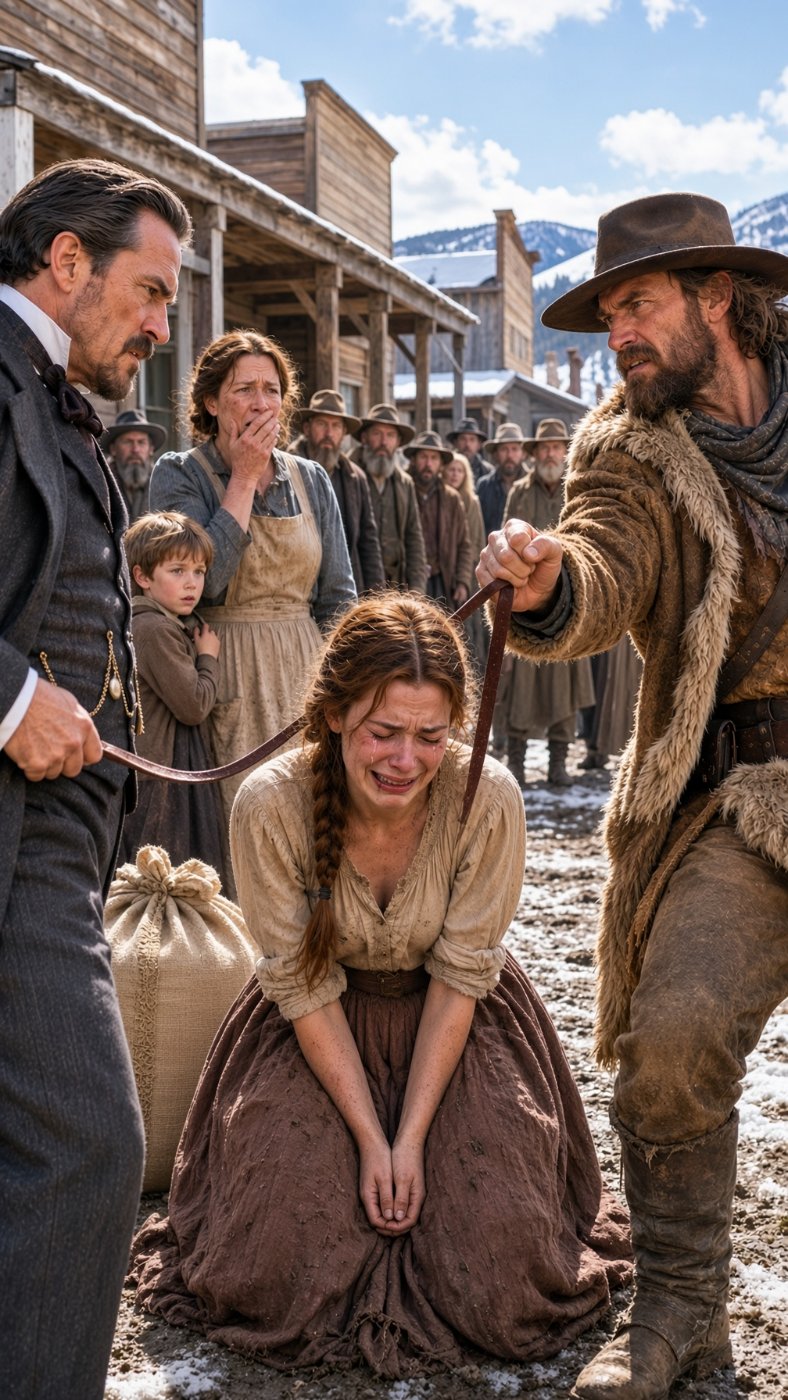
When she refused to marry him, his teamster strapped her in the street until mountain man Amos Teague caught the strap and asked her the one question nobody else had: "Do you want to be here?" She went up the mountain as his hired hand.
She took her father's sourdough crock, his daybook, and a sealed sack of Quint's flour.
And she swore she'd owe nobody anything.
The snow came down in earnest once the last cabin of Ransom Gulch dropped out of sight.
Willa walked beside Pearl with her chin tucked into her collar.
Her shoulders burned under the wet wool where the strap had landed.
Old blood still tasted faintly at the back of her teeth, and frozen mud had gone stiff in her braid.
She walked faster than her legs wanted to, because a woman who is no burden does not lag.
Amos led Deacon and didn't look back any more than the trail required.
He said nothing.
Willa couldn't decide whether that was courtesy or cowardice.
Their breath went up in two separate clouds.
They camped the first night in the lee of a split boulder.
He built the fire, spread an elkhide and a blanket for her, and set a tin plate of roasted meat in her hands.
He didn't ask whether she was hurt.
She'd braced herself all afternoon for the question, and when it didn't come, she felt oddly cheated.
Near dark the next day, on a shelf of glazed rock, her boot went out from under her and she dropped to one knee.
Amos didn't grab her arm.
He held out the end of Pearl's lead rope and waited.
She took it and hauled herself up.
"Thank you".
"Pearl's idea," he said.
Her mouth twitched before she could stop it.
She carried her father's sourdough crock inside her coat against her ribs, where her own warmth would keep the starter from freezing.
Amos glanced at the lump twice before he spoke.
"Do I ask?"
"It's a sourdough crock.
My father named it Old Sherman, for the general.
He said it marched through everything".
She hadn't meant to give him anything of her father's.
It was out before she'd weighed it.
"Then it's welcome," said Amos.
"I've no objection to a veteran".
The cabin came out of the dusk on the second evening, low and dark under a hump of snow, in a little hollow below Cutter Peak.
It was one room with a cast-iron stove, a loft under the eaves, a table, and two chairs.
One chair was worn pale at the arms.
The other stood against the wall under a skin of dust, as if nobody had sat in it in years.
Willa saw it and said nothing.
"Came with the cabin," Amos said, though she hadn't asked.
He strung a blanket across the loft rail to make a wall and told her the loft was hers.
He'd sleep by the fire.
She climbed up and said, "Good night, Mr. Teague," and no more than that.
She set Old Sherman on a shelf near the stovepipe where the warmth would find him.
In the morning, she opened her father's clothbound daybook on the table and ruled a fresh page into columns.
"Firewood, cooking and labor," she said, "against board and a roof.
I'll split and carry and cook.
You'll supply the meat, the stove and the roof.
We'll see who comes out ahead".
Amos poured coffee that smelled like scorched harness.
He watched her write with the quiet interest of a man watching a heron fish.
"I don't keep a ledger," he said.
"Write it however suits you".
He didn't argue, and he didn't refuse.
That unsettled her more than an argument would have.
She wrote it all down anyway.
Two nights of trail meals, owed.
One roof, owed.
One blanket, owed.
Against them, she set her labor, line by line, and watched the columns settle toward balance.
Her shoulders loosened a little.
She knew what that meant, and she didn't look at it.
Amos had nine pounds of flour, a little salt he guarded like gold dust, and a coffee habit he described as a bad idea with good manners.
Willa measured the flour by eye in her palm.
She set a share aside to feed Old Sherman.
Then she mixed four small loaves and baked them in the iron stove, crouching to squint at the draft.
"Your fire's too hot at the top and sulking at the bottom," she said.
"You've been feeding it like a man who dislikes it".
"We've had our differences".
"And your coffee isn't brewed.
It's been punished".
"It knows what it did," said Amos.
The first loaf came out with a crust that crackled when she tapped it.
He cut a slice, holding the loaf steady against the board with his bad hand, and sat down.
He ate slowly, looking at nothing.
"Three years," he said at last.
"Since I've had real bread".
She waited for more.
There wasn't any.
"Good crust," he said finally, a little sideways, the way a man speaks of something so big he can only get at it by the edge.
Willa realized she was laughing, a small, rusty sound, and she put her hand over her mouth in surprise.
Later, with the stove ticking, he asked what he'd been wondering since the street.
"Why does a man like Quint want a bride that bad? He could hire a clerk".
So she told him.
She told it in order, the way she'd set it down in the daybook.
The fifty-pound sack that came to forty-three and a half.
Six and a half pounds missing from every sack, in every kitchen in camp.
"My father was a miller in Missouri," she said.
"I know what that number means.
And Quint knows I know.
A wife can't testify against her husband".
She waited for the question.
Every man she'd ever known would have asked how she could be so sure.
"What would you need to prove it?" said Amos.
She looked at him.
"A certified scale," she said slowly.
"And a lot of sacks weighed in front of somebody who can't be bought".
He nodded once, as if she'd told him the price of salt.
He'd believed her before she finished.
She understood that she'd never once in her life been taken at her word so completely, and she didn't know where to put it.
The weeks ran on in small skirmishes.
She corrected his knots, his stove and his spelling of her name.
He answered every correction with a deadpan so mild she sometimes didn't notice it until she'd walked away.
By the time the cold set its teeth, she was keeping his woodpile better than he ever had.
By the middle of December, the salt was nearly gone, and with it his hope of curing enough meat to carry them to spring.
Quint had kept his word.
No merchant nearer than Virginia City would deal with Amos Teague.
Willa laid it out at the table.
"There's that hardware man in Virginia City you mentioned.
Pettibone.
You said he has salt and a certified platform scale".
"He does.
And he can't be bought, which is bad for his business and good for his soul".
"Then I'll weigh the earnest sack there".
It sat in the corner, still sealed in its sacking, where she'd put it the first night.
She hadn't eaten a spoonful of it.
She never would.
She touched the folded scrap in her pocket, "I'd sooner you eat," and felt a pain as small and sharp as a splinter.
Then she put the thought away.
"It's evidence," she said.
"Not charity".
"Then we go together," said Amos.
"Both of us, one trail".
She noticed he'd asked her to decide it with him.
So they decided it.
On the morning they left, he held out his snow goggles, two slits cut in horn on a leather thong.
They were the only pair he owned.
She started to refuse.
"I've crossed the Bald Bench more times than you have," he said simply.
She took them, and wrote it in her head under "owed".
On the second day, they climbed onto the Bald Bench, a bare shoulder of mountain where the wind had scoured every drift into a hard white glare.
The sky was cloudless.
The light came off the snow like a blow.
Willa walked behind the mules with the goggles on, and the world turned dim and bearable.
She noticed that Amos had begun to squint.
He spoke less.
He slowed.
When she asked if he was all right, he said, "Sun's bright".
She let it go, because he was a man who said true things in the smallest portions he could manage.
An hour later, Pearl stopped dead, because the man in front of her had walked off the trail.
Amos stood a dozen yards to one side, turning his face slowly, like a man listening for a voice in a dark room.
His eyes were red and streaming and squeezed shut against the white.
"Amos".
"It's the light.
It'll pass".
"You can't see".
"I can see well enough".
Then, after a moment, flatly: "No.
I can't".
The sun was sliding toward the western ridge.
The nearest shelter was an old trapper's lean-to, and it lay six miles off, across nothing but glare.
"Take the mules and go," he said.
"Follow the line of the ridge.
I'll sit here till it clears".
"You'll freeze".
"I've been alone in worse".
"I'm not asking whether you've been alone".
Her voice came out hard, and she let it.
She had a miller's head, and she did the sum out loud.
"Six miles to shelter.
An hour and a half of light.
One blind man and two mules.
Turning back is eleven miles, and it costs us the salt, the meat and the winter.
If I leave you, you walk off a ledge.
So I don't leave you, and I don't turn back.
We go on, and I lead".
He was silent.
The wind pulled at his coat.
He'd spent twenty years being the one who left.
Being the one left behind in the white was the only thing he'd never practiced.
And she was refusing to do it.
"Notched pine," he said at last, quietly.
"Past the second drift.
Then a fir with a dead top.
Then a cairn, about a man's height".
She wrapped Pearl's lead around her left wrist and took his sleeve in her right hand, and she walked.
She found the notched pine by the slash in its trunk.
She found the fir by its bare silver crown.
At each landmark, she said it out loud, and he said, "Good," and nothing else.
The cairn rose out of the dusk with the last of the light behind it.
The lean-to was still two miles off, and the dark was coming fast.
"We dig in," she said.
She cut a hollow into the lee side of a drift with the camp shovel and packed the mules close along the open side.
She dragged in blankets and hides.
She boiled tea in the little pot, cooled it in the snow, soaked strips of cloth in it and laid them over his eyes.
She didn't press against him for warmth, and he didn't ask her to.
There was a hide between them and the warmth of a small fire.
She kept him talking in the dark.
"Tell me about your coffee.
How long have you been doing it wrong?"
He told her about the first pot he ever burned, in the Wind River country in '49, and the partner who'd drunk it anyway out of loyalty and wept.
He told her about a mule named Judge who'd once carried him out of a flooded river.
He told her he didn't care to be helped, that he never had.
"I'd noticed," she said.
He was quiet.
Then, carefully, the way a man steps out onto ice: "There was a time I might have".
The sentence stopped.
He turned his face toward the wall of snow.
She heard the shape of what he hadn't said, and she didn't ask for it.
She wrung out another strip of cloth and laid it over his eyes.
At dawn, he could see blurred shapes.
They reached the lean-to by noon, and by that second night he could tell a mule from a stump.
On the third day, she walked him down into Virginia City with one hand on his sleeve.
In the middle of the street, he stopped.
"I'm obliged to you," he said.
It came out clumsy as a split rail.
He promised nothing else.
She understood that she'd helped him and he owed her nothing for it.
She'd walked a few steps before she recognized the feeling.
Virginia City hit her like a wall of noise after the white silence.
Hammers rang.
Coal smoke hung in the air.
The smell of coffee leaked from a dozen doors.
Alonzo Pettibone met them at the door of his hardware store.
He was a lean, brisk man of sixty with spectacles pushed up into his gray hair.
He'd known Amos for seventeen years, since a wagon train on the Oregon road.
"Amos Teague.
You look like something the cat declined".
"Alonzo," said Amos, "this is Miss Prather.
She's a miller's daughter.
She'll want to inspect your scale".
She did.
She checked every notch on the beam and every weight against the territorial certificate, while Pettibone watched with growing approval.
Then they lifted the earnest sack onto the platform.
Forty-three pounds, six ounces.
She said the number out loud twice.
It sounded like a stone dropped into a well.
As it turned out, a court date was waiting for them.
Quint had sworn out a complaint that Amos Teague had carried off his betrothed.
It came before Judge Orrin Tull the next afternoon.
The judge was a heavy, deliberate man whose pen never hurried.
Quint didn't appear.
His complaint was written in a clerk's fine copperplate.
Willa stood before the bench.
"I went of my own will, Your Honor.
I never agreed to the marriage.
I tore up the bond myself".
The judge looked at Amos.
"Mr. Teague, anything to add?"
"No, sir.
Not unless you ask".
The judge dismissed the complaint.
Then he folded his hands.
"As to the weights, Miss Prather.
One sack is not a pattern.