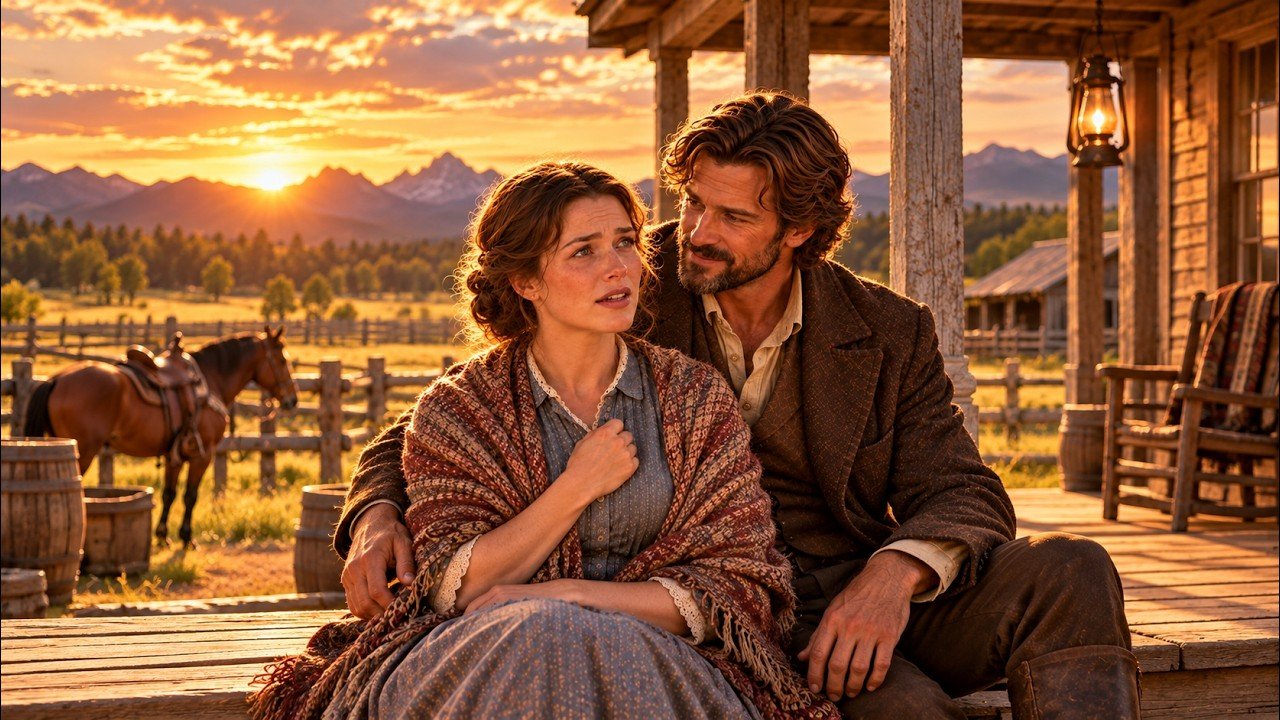
PART 3
In case you missed it: Eliza Marlow's husband, Thomas, left for the gold fields and never came back, so she raised their daughter Rosie and kept her dress shop going alone in Cedar Bluff, Wyoming Territory.
Then Daniel Whittaker, the rich family's youngest son, walked in with a torn coat.
She charged him twenty cents and refused a penny more, and he kept coming back.
After a stormy night stranded on a delivery, the town turned on her and the bank threatened her loan.
Then, after three years of silence, a stranger stepped off the stagecoach and said he was her husband.
He came back with nothing.
That was the first thing Eliza noticed when Thomas Marlow walked through the door of her shop that afternoon.
No bag of gold.
No new coat.
Not even a carpetbag.
He had the same old canvas jacket he'd left in, worn through at both elbows now, and a three-day beard, and the look of a man who'd been practicing a speech for two hundred miles and had just forgotten the first line.
Eliza's mother, Ruth, was at the cutting table.
Rosie was on the floor sorting buttons into a cigar box.
Rosie looked up.
"Grandma," she said, "who's that?"
Thomas went very still.
"Rosie?" His voice cracked.
"Look how big you've grown".
Rosie looked at him with polite, careful interest, the way she looked at any customer.
"She doesn't remember you," said Ruth Hale, putting down her shears.
"You've got the nerve to walk through this door, Thomas?"
"Mother.
I've come to apologize".
"I'm not your mother," said Ruth.
"I'm that child's grandmother.
And I remember the empty tin box on the shelf the morning after you left".
Thomas flinched.
He turned to Eliza.
"I didn't find any gold, Eliza.
Not an ounce worth the name.
But I've learned my lesson.
Give me a chance.
We're a family".
Eliza had imagined this moment a thousand times.
Lying awake in the dark that first winter, she'd imagined him walking through the door, and in her imagination she'd always run to him.
By the second winter, she'd imagined throwing the shears at him.
By the third, she'd stopped imagining it at all.
Now that it was here, she felt something she hadn't expected.
She felt calm.
"Family means the people who stay when winter comes," she said.
"You chose to leave.
I chose to stay".
Thomas looked around the shop.
He looked at the bolts of calico on the shelves and the finished dresses hanging on the rack, and at the sewing machine in the window with the afternoon light on it.
"Business looks good," he said.
"Whose name is it in?"
Before Eliza could answer, the bell over the door rang.
Daniel Whittaker came in with a shirt over his arm.
He saw Thomas and stopped.
"And who might this be?" said Thomas.
Eliza took a breath.
"A customer".
"Daniel Whittaker," said Daniel evenly.
"Whittaker".
Thomas's eyebrows went up.
"Well.
My wife certainly attracts important customers".
"I know who you are, Mr. Marlow," said Daniel.
"And I don't know a thing about you beyond your last name".
He laid the shirt on the counter.
"The cuff, Mrs. Marlow.
Whenever you have time".
He tipped his hat to Ruth, smiled at Rosie, and went out.
He didn't look at Thomas again.
That night, after Thomas had gone off to find a room at the boarding house, Rosie climbed into her mother's bed.
"Was that my papa, Mama?"
"Yes, sweetheart".
"Is he going to stay?"
"I don't know".
Rosie was quiet in the dark a long time.
"I wanted him to come back," she said in a small voice.
"Every night, I wanted him to.
But Mama, I can't remember his face.
Even when I'm looking at it".
She swallowed.
"Does that make me bad?"
Eliza pulled her close.
"No," she said.
"It doesn't make you bad.
It means you're an honest little girl".
Out in the front room, Ruth sat at the cutting table in the lamplight and didn't go to bed.
When Eliza came out at last, her mother spoke without looking up.
"This decision isn't about him, child," Ruth said.
"It's about who you want to become".
At the Whittaker ranch, Garrett Whittaker was waiting for his son.
He was sixty, broad and gray, and he had built Whittaker Freight and Land out of a single wagon and a team of mules.
He'd been in Cedar Bluff since before the town had a name.
He stood by the stone fireplace in the big front room with his hands behind his back.
"I hear the dressmaker's husband has returned".
"Yes, Father".
"Then this nonsense is over.
A married woman with a child and a debt is not a match for the Whittaker family".
"She was abandoned for three years, Father".
Daniel's voice was quiet.
"Her husband has only just come back.
And she means to file for divorce".
"Divorces take time.
And they're not easy to win".
Garrett turned around.
"Honor is not something you experiment with, Daniel".
"What does being a Whittaker mean, Father? Honor on paper? Or how we treat people?"
His father looked at him a long moment.
"If you choose that woman," Garrett Whittaker said, "you leave this ranch and the Whittaker name behind".
Daniel didn't raise his voice.
"I understand, Father".
He went upstairs and packed one bag.
When he came down, his mother was waiting at the foot of the stairs.
Clara Whittaker was a small, quiet woman with gray hair pinned up neatly.
Daniel had never once heard her contradict his father in front of anyone.
She took his hand and pressed something into it.
It was a silver thimble, worn thin at the top.
"Mother, this is.
.
".
"Mine," said Clara Whittaker.
"From before I became Mrs. Whittaker.
I can't stop your father.
But I can give you this".
She closed his fingers around it.
"Give it to her if she ever needs reminding that there's no shame in having hands that know how to sew".
His older brother, Ben, walked him to the door.
Ben was thirty-four, heavyset and practical.
He'd always done exactly what their father wanted, and he'd never once seemed to mind.
"Where will you go?"
"Jed's letting me sleep in the storeroom at the depot," said Daniel.
"It's enough".
Ben shook his head slowly.
"You're a fool, little brother".
"Maybe," said Daniel.
Ben was quiet a moment.
Then he clapped Daniel on the shoulder, hard.
"I always did wish I was one".
Daniel walked to Main Street that night and stood outside the dark dress shop until Eliza came to the door in her shawl.
"I've left home," he said.
"I'm not asking you to answer me.
I just wanted you to know I've made my choice".
She stared at him.
"You'll regret it".
"Maybe.
But I'd regret it more if I never tried".
"I'm not promising you anything, Daniel.
I'm still a married woman.
My husband is in the boarding house down the street".
"I don't need a promise," said Daniel.
"I only need to know you aren't sending me away".
She looked at him a long time in the dark doorway.
"I'm not sending you away," she said.
Thomas came to the shop every day after that.
He brought Rosie a little wooden horse he'd carved on the stage ride from Deadwood.
He'd done it well.
He'd always been clever with his hands, when he chose to use them.
"I wanted you to have something from your papa," he said.
"Thank you, sir," said Rosie politely.
Thomas winced.
"Could you call me Papa?"
Rosie turned the little horse over in her hands.
She looked at him with that same careful, honest look.
"I don't know yet," she said.
Hattie Greer, who kept the dry goods store across the street and had sold Eliza her thread at the old price for three years, watched it all through her window with her arms folded.
"He's putting on a show, Eliza," Hattie said that afternoon, bringing over a box of red thread.
"I've seen men put on shows before".
"He's her father, Hattie".
"A father is somebody who stays," said Hattie.
"Not somebody who turns up".
The next morning, Eliza put on her good gray dress and walked to the office of Judge Amos Carroway, the circuit judge, who held court in Cedar Bluff twice a month.
"Deserted for more than three years," the judge read from her paper.
"No letters.
No money sent home.
Do you have a witness, Mrs. Marlow?"
"Me," said Hattie Greer, who'd walked over with her.
"I've sold her sewing thread every week for three years, Your Honor, and never once laid eyes on a husband".
The judge made a note.
"Your hearing will be on the 15th of this month.
You'll have to speak in his presence, Mrs. Marlow".
"I've waited three years to speak," said Eliza.
"I won't tremble".
When she got back to the shop, Mr. Pruitt was waiting for her.
He stood by the counter in his black banker's coat, turning his hat in his hands, looking at the sewing machine as though he were adding up its price.
"The terms of your loan allow me to move up the due date if your income falls," he said.
"It has fallen.
The new deadline is this Saturday".
"It's due at the end of the month," said Eliza.
"I still have two weeks".
"Some people," said Mr. Pruitt, "don't want their town dragged through a scandal.
A divorce.
A Whittaker son sleeping in a freight storeroom.
People talk".
"People talk because people like you start them," said Eliza.
"You'll have your money, Mr. Pruitt.
As for my reputation, I'll take care of that myself".
He went out.
In the doorway, he passed his daughter Margaret, who'd come for her traveling dress fitting.
Margaret looked at her father, and then at Eliza's face.
"Father," she said.
"What are you doing?"
"Business, daughter.
Stay out of it".
When he'd gone, Margaret stood in the doorway a moment longer.
"I'm sorry," she said quietly.
"He's angry about Daniel.
He thinks if he ruins you, Daniel will come home and marry me, and he'll get the Whittaker riverfront after all".
"I know," said Eliza.
"I'm going to tell him.
About Chicago".
Margaret's chin came up.
"Soon".
"Then let's make sure that dress fits," said Eliza.
Thomas heard about the divorce hearing from the boarding house keeper the next day.
He came into the shop at noon, red-faced.
"You're taking me to court?"
"I am".
"The law protects a husband, Eliza.
This shop.
This money.
I'm entitled to a share of it.
I'm still your husband".
"Your share," said Eliza, "is three years of silence.
I'll tell the judge all about it".
"You'd dare take me to court?"
She set down her shears and looked at him.
"I dared to live, Thomas.
You missed that part".
His face twisted.
"Then I'll take what's mine before the court decides".
He went out and slammed the door so hard the bell fell off its hook.
What Eliza didn't know was that Thomas Marlow owed money.
Three years before, on the night before he'd left for the Black Hills, he'd sat in the back room of the Gilded Spur saloon and lost sixty dollars at faro to a gambler named Dutch Keller.
He'd left town the next morning without paying it.
Then the first thing he did when he stepped off the stage was walk into the Gilded Spur for a drink.
Dutch Keller had remembered him.
"Marlow," Dutch had said.
"Thought you'd died in some gold mine".
"Not dead.
Just poorer".
"You still owe me sixty dollars.
With three years of interest".
"My wife's doing well, Dutch.
They say half the town wears her dresses.
I'll pay you this month".
That night, after the slammed door, Dutch found Thomas in the alley behind the saloon and put him against the wall.
"Sixty dollars," he said softly.
"By Friday.
Or you lose two fingers".
"My wife will pay.
Just give me a few more days".
"The bank's closing in on your wife.