PART 3
In case you missed it: Hattie Sorrel, a big-hearted orphan who'd spent her life being laughed at for her size, became the cook for rancher Wade Callister's two dozen cowhands. They mocked her the day she arrived. After one supper, they stopped. Wade washed her dishes every night, and during a January blizzard, Hattie saved a lost Shoshone boy. Then Wade's former fiancée, Vivian, came back to the ranch. In front of everyone, she said Wade kept a fat cook out of pity and the whole valley was laughing. Hattie said she'd pack that night.
For a moment, nobody in that ranch yard moved.
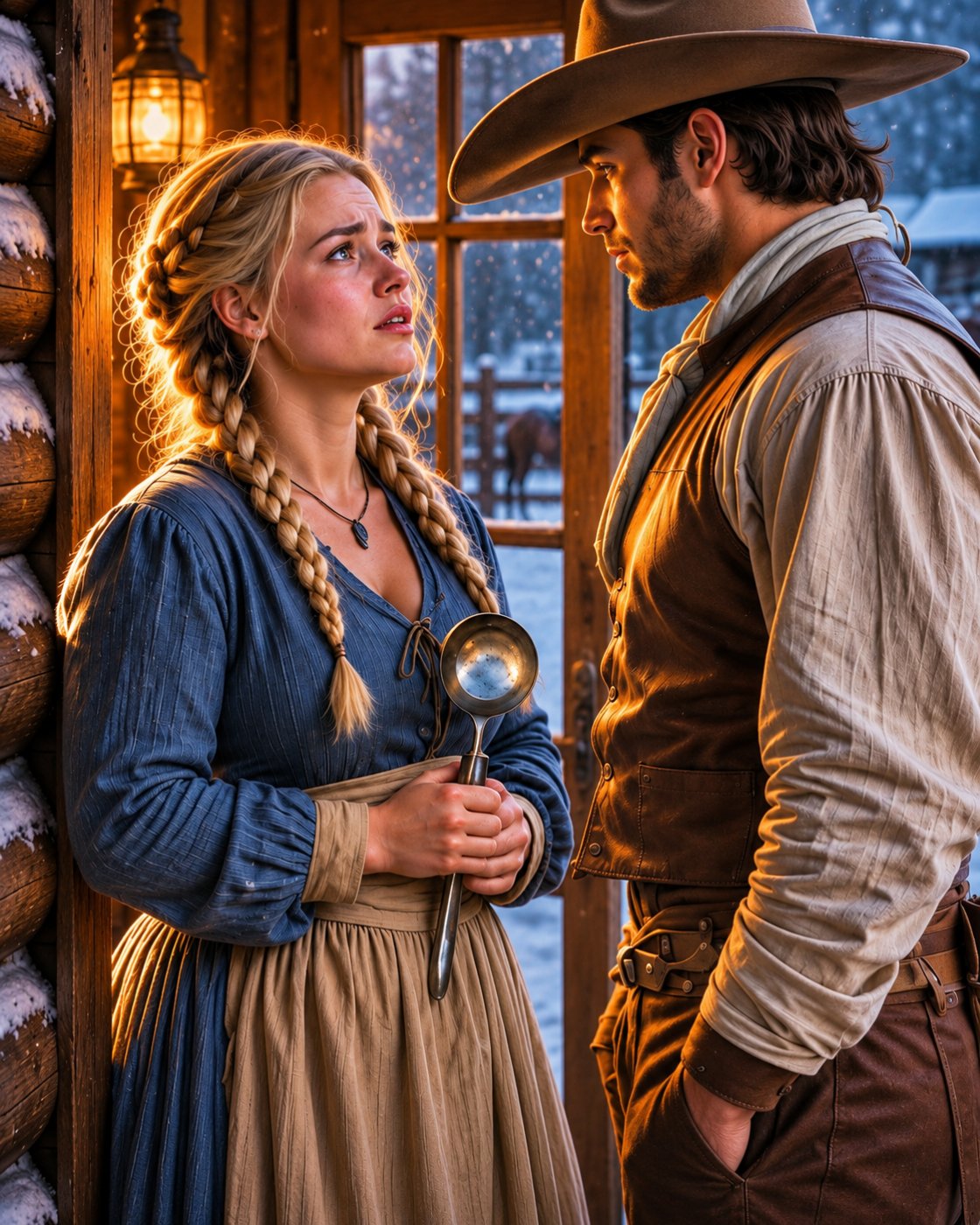
Two dozen cowhands stood frozen along the corral fence and in the bunkhouse doorway. The February wind blew dry snow across the frozen ground. Vivian Lisle stood beside her buggy in her fur collar and her little velvet hat, smiling her small, satisfied smile. And Hattie stood on the porch of the cook house with her hands knotted in her apron, white to the lips, looking at the ground.
She'd heard it all before. All her life. In the orphanage yard, where the other girls called her Butter Churn. At the church socials in Laramie, where the boys asked every girl to dance but her. In the general store in Cinder Creek, every single day, over every warm loaf of bread. She'd heard it so many times that she'd stopped hearing it, almost.
But she'd never heard it here. Not in four months. Not since the first week.
She had let herself forget. That was the trouble. She'd let herself believe, for a little while, that this place was different. That she was different here.
"I'll pack tonight," she said again, very low. "I'll be gone by morning. You won't have to explain me to anybody, Wade."
She turned to go inside.
"Hattie."
It wasn't loud. Wade Callister never raised his voice. But it stopped her like a hand on her arm.
She turned around.
Wade was looking at her across the yard. He wasn't looking at Vivian at all. He hadn't looked at Vivian since the first moment.
"You think," he said slowly, "I give one damn what that woman says?"
Somebody along the corral fence sucked in his breath. Vivian's smile slipped.
"She's beautiful, Wade," Hattie said. Her voice shook. "You loved her once. Everybody knows it."
"Thought I did." Wade came across the yard. He came slowly, one step at a time, until he was standing at the foot of the porch steps, looking up at her. "That was before I knew the difference between being wanted and being used."
Then, at last, he turned around and faced Vivian Lisle.
"Vivian," he said. "Four years ago, my herd died on the trail to Ogallala. Eight hundred head, dead in the dust in a single summer. The bank was coming for the land. I didn't know if I'd have a roof by Christmas." His voice didn't change. It stayed level and quiet. "You walked out on me the same month. With the first banker who came through. You didn't even say goodbye. You left a note on my saddle."
Vivian's face had gone very still.
"Hattie Sorrel walked in here the week we had nothing left to eat but burnt beans," Wade went on. "My cook was down with a fever, and my men were half starved and mean as snakes. And she fed every single soul on this place. Three meals a day. Dark to dark. Never a word of complaint. She dug a lost child out of a snowdrift in a blizzard with nobody to help her." He paused. "You came looking for a rich man, Vivian. She came looking for work. That's the whole difference between you, and it's the only one that matters."
He turned back to the yard. To the two dozen men standing silent along the corral fence.
"And any man on this ranch," Wade said, "who wants to make fun of the woman who's kept him fed all winter can pack his roll today and go find himself another outfit. I'll pay him what he's owed, and I'll saddle his horse for him. Today. Right now."
Nobody moved.
Down at the end of the fence, Boyd Hatch took off his hat. He looked at it in his hands. Then he looked at the ground.
Wade turned back to Hattie.
"If you want to go, Hattie," he said quietly, "I won't stop you. That's your right. You're nobody's property here, and you never will be." He took a breath. "But if you stay, I want you to stay knowing that I choose you. Not out of pity. Not for your cooking, even if it's the best in Wyoming. I choose you because you're the only person who ever looked at me and saw the man I could be, instead of the man I'd been."
Hattie stood on the porch with her mouth open.
Vivian Lisle made a small, sharp sound. She climbed back into her buggy without a word. She snapped the reins, and the buggy went rattling away down the ranch road toward Cinder Creek. Nobody on the place ever saw her again.
Wade didn't watch her go. He was still looking up at Hattie.
She couldn't speak. She turned around and went into the cook house and shut the door behind her.
She didn't pack that night.
She sat on the edge of her narrow bed, in the little room off the kitchen that Wade had promised her, and looked at the old wooden box on her washstand.
It was a recipe box. Plain pine, worn smooth at the corners, with a brass latch. It had been Wade's mother's.
He'd given it to her three weeks before. She remembered every minute of that day.
It had been a bitter morning in late January, the week after the blizzard. Hattie had been hauling water from the well to the cook house. She did it twice every morning, four buckets each trip, while the hands were still asleep. Wade had come out of the barn and seen her and taken two of the buckets out of her hands without a word.
"You've got two dozen men to boss, Mr. Callister," she'd protested. "You don't need to haul water for the cook."
"Wade."
"Wade, then."
"And I ain't hauling water," he'd said. "I'm walking. The water's just coming along with me."
She'd laughed. She couldn't help it. And they'd walked back to the cook house together through the crunching snow, side by side, with the buckets slopping.
"Sorrel," he'd said, halfway there. "Like the horse?"
"Exactly like the horse." She'd smiled a little. "Nobody knew my real name when they left me on the orphanage step. I was about two, the matron thought. There was a sorrel mare tied in the yard that morning, belonged to the doctor. And the matron said I was every bit as stubborn as that mare. So I got named for her."
"Good horses, sorrels," Wade had said. "They don't quit."
"And you?" she'd asked him. "Did you always have all this? Three barns and nine hundred head?"
He'd been quiet for a moment, crunching through the snow.
"Near lost every bit of it, four years back," he'd said. "Drought. The herd died on the trail. Bank wanted the land."
"What kept you?"
He'd glanced sideways at her, and the corner of his mouth had moved.
"Stubborn," he'd said. "Like a sorrel."
And then he'd stepped on a patch of ice by the cook house door and gone down flat on his back, both buckets flying, and drenched himself to the skin in the freezing water.
Hattie had stood there frozen with horror. The boss. Flat on his back in the yard.
"Are you hurt?"
Wade had lain there in the snow, soaked, staring up at the sky.
"Only my pride," he'd said. "And there's plenty of that left over."
And then the ranch cat, a fat yellow tom named General Grant who had been sitting on the cook house step watching the whole thing, had taken fright at the flying buckets. He'd shot through the open door into the kitchen and straight into Hattie's open flour barrel. He came out again like a small white ghost, yowling, trailing clouds of flour across the floor, and fled out the back door.
Hattie had laughed until she had to sit down on the cook house step. Wade had lain on his back in the snow, laughing so hard he couldn't get up. And the hands had come stumbling out of the bunkhouse in their long johns to see what all the noise was, and found the boss lying in a puddle and the cook crying with laughter on the step and a white cat streaking across the yard.
"Cookie never once made me laugh like that," Wade had said, when he could finally speak.
"Cookie never once threw a cat in the flour," said Hattie.
Old Cookie had been up and grumbling by then, out of his fever. That afternoon, he'd told Wade he was going to his sister's place in Cheyenne come spring. He said he was too old for Wyoming winters, and besides, he'd tasted Hattie's dumplings and seen no reason to go on competing.
"Kitchen's yours, Hattie," Wade had told her that evening. "If you want it. For good."
And that night, after the dishes were done, he'd come to her door with the pine box under his arm.
"Hattie. Been looking for you."
"What is it?"
He'd held it out.
"My mother's," he'd said. "She wrote down every recipe she ever cooked. And other things. Things she didn't want to forget." He'd opened the lid and taken out a small card, soft and yellow with age. "She told me once, love don't come in through the eyes. It's whatever's still keeping you warm after the plate's empty." He'd put the card back. "Thought maybe you'd want to add to it."
Hattie had stared at the box in his hands.
"Your mother's box, Wade? I can't."
"Ain't nobody else I'd hand it to."
"I never had anything that belonged to a mother," she'd whispered. "Not a ribbon. Not a spoon. Not one thing."
"Well," Wade had said. "Now you've got a whole box of her."
And he'd set it in her hands and gone back to the main house.
Now, on the night Vivian Lisle came and went, Hattie sat on the edge of her bed and opened the box.
She took out the cards one by one. Biscuits. Venison stew. Dried-apple pie. Molasses cake for a birthday. And in between the recipes, other things, in the same faded, slanting hand. Wade's first word was "horse." He fell out of the hayloft today and didn't cry. Joseph came home from the cattle drive safe. Thank you, Lord.
And on one card near the back, by itself, the line Wade had told her about. Love don't come in through the eyes. It's whatever's still keeping you warm after the plate's empty.
Hattie sat there for a long time, reading by the light of her candle.
Then she got up. She took her carpetbag down from the top of the wardrobe, where she'd put it to pack. And she put it back up again.
The next morning, there were biscuits at breakfast. Fifty of them, golden and high, with honey and fresh butter. Nobody said a word about the day before. But when Hattie came out to clear the plates, she found every single cup and plate already stacked and scraped clean at the end of the long table.
Boyd Hatch was standing beside them with his hat in his hands.
"Ma'am," he said. He didn't look at her. He looked at the floor. "I said some things. The first day."
Hattie waited.
"I was raised better than that," Boyd said. "My ma would've tanned me." He turned his hat around. "That's all."
He went out before she could answer.
It wasn't an apology, exactly. But it was a start.
Spring came late that year, and it came hard.
The snowpack in the Bighorns had been the deepest anyone could remember. When it melted in May, all at once in a week of warm rain, the Powder Fork came roaring down out of the mountains brown and furious. It overflowed its banks for three miles. It flooded the lower pasture, washed out two bridges, and tore the roof off the line shack at the south camp.
And it fouled the creek.
Nobody understood it at the time. The water looked clear enough, a few days after the flood went down. The men drank it the way they always had, from the creek, from the troughs, from the barrels in the bunkhouse. Nobody thought about it twice.
Then, a week later, Pip got sick.
Pip was the youngest hand on the ranch, sixteen years old, freckled, and so skinny that Hattie had been putting extra milk in his coffee all winter. He came in from the south pasture at noon gray-faced and sweating, and couldn't eat his dinner, and went to the bunkhouse to lie down.
By evening, he was burning with fever and doubled over with cramps.
By the next morning, so were six more.
By the end of the week, half the men on the ranch were down. They lay on their bunks with fever and cramps and the terrible flux that came with them. They were weak as kittens, too sick to stand. Boyd Hatch was one of them. So was Mr. Keel, and Mr. Tulle, and old Amos Rook, who was sixty-three.
Wade rode to Cinder Creek for the doctor himself.
Doc Hargrove was a stooped, tired man with a gray mustache and a black bag. He walked down the row of bunks in the bunkhouse, looking at each man, laying his hand on their foreheads. Then he came outside into the yard and stood with Wade and Hattie in the sun.
"Bad water," he said heavily. "Creek's been fouled by the flood. Every outhouse and dead cow for thirty miles upstream washed into it. It'll go through all of them." He rubbed his face. "I've got the same in town. Nine families. Not typhoid, thank God. Not yet. But bad enough. Keep them drinking. Keep them clean. And pray they hold on."
"Keep them drinking what?" said Hattie. "If the water's bad?"
The doctor looked at her.
"Boil it," he said. "Everything. Every drop."
Hattie turned around and walked straight back into the cook house.
"Nobody drinks a single drop of water on this ranch that hasn't been boiled," she announced to the kitchen at large. "Not one drop. Not to drink, not to wash, not to brush their teeth. Toby!"
Toby was fourteen, the wrangler's boy, who helped her in the kitchen. He appeared in the doorway.
"Yes, ma'am?"
"Bring me every pot and kettle on this ranch. Every one. From the bunkhouse and the main house and the line shacks. Bring me the wash boilers. Bring me the big copper the boss uses for scalding hogs."
"Yes, ma'am."
When Toby had run off, she turned to Wade.
"Wade. That boy in the blizzard. His grandmother."
Wade looked at her.
"She knows medicine," Hattie said. "I saw her that morning. She looked at what I'd done for the boy and nodded. She had a pouch of dried things on her belt. I want her here."
Wade didn't argue. He didn't ask a single question.
"Toby!" he shouted across the yard. "Saddle the bay! Ride up the river to the Shoshone camp at the forks! Fetch the grandmother who came for the little boy. Tell her Mrs. Sorrel needs her. Tell her please."
The grandmother came at sundown.
She was small and very old, with white hair in two long braids and a face as brown and creased as a walnut. She rode an old paint pony, with a heavy deerskin bag tied behind the saddle. Her name was Ruth Many Horses. She'd been given the Ruth by a missionary in her girlhood and had kept it, she said, because it was a good name for a woman who'd followed her people into strange country.
She looked at the men in the bunkhouse, one by one. Then she came into the cook house, where Hattie had every pot on the ranch boiling on the stove and two more fires going in the yard.
She opened her deerskin bag on the kitchen table and took out bundles of dried leaves and bark and roots, each tied with a strip of hide.
"Willow bark," she said, holding up a bundle of gray curling strips. "For the fever. Boil it long. Long, until the water is dark like coffee." She held up another, small feathery leaves. "Yarrow. For the stomach. For the flux." Another. "Sage. And this, birch. For tea." She looked at Hattie. "Small sips. Many times. Not much at once. Many times."
Hattie repeated it back. "Willow. Yarrow. Sage. Birch. Small sips. Many times."
Ruth Many Horses nodded.
Then she reached out and took Hattie's hands in her own, the same way she had on that January morning when she came for her grandson.
"You saved my grandson in the snow," she said. "Now I help you save yours."
Hattie couldn't speak.
For six days and six nights, Hattie Sorrel didn't sleep more than an hour at a time.
She boiled water. She boiled it in every pot and kettle and wash boiler and hog scalder on the ranch, over three fires, day and night, until the cook house was so full of steam that the windows ran with water. She made willow bark tea until her hands were stained brown to the wrists. She made yarrow tea and sage tea and birch tea. She made broth, gallons of it, thin beef broth with salt, because the doctor said the flux took the salt out of a man.
And she carried it all to the bunkhouse herself.
Ruth Many Horses stayed with her. Toby did whatever either of them told him, running back and forth from the well to the fires with buckets until he was gray with exhaustion. The men who weren't sick hauled firewood and water. And Wade did everything else. He did the chores of twenty men by himself. He rode out to check the herd at dawn and came back at noon to haul buckets and stoke fires and carry sick men to the outhouse when they couldn't walk.
Hattie went from bunk to bunk with her teapot and her cup. Small sips. Many times. She held up their heads. She wiped their faces with cool boiled water. She changed their bedding and washed it in boiling water and hung it in the sun. She sat with them in the night when they were out of their heads with fever, talking to them in a low voice, the way she'd once sat with the little ones in the orphanage when they had the measles.
On the third night, she came to Boyd Hatch's bunk.
He was very bad. Worse than any of the others except old Amos. His big red-bearded face had gone gaunt and gray. His eyes were sunken. He was shaking with fever under three blankets.
She knelt beside his bunk and lifted his head and held the cup of willow tea to his cracked lips.
"Drink, Mr. Hatch. Small sips."
He drank a little. He coughed. He drank a little more.
Then he looked up at her in the lamplight. His eyes were wet.
"Why are you doing this?" he croaked. "After what I said. That first day. In front of everybody."
Hattie wiped his face with the cool cloth.
"Because you're sick, Mr. Hatch," she said simply. "And you're hungry. That's all a kitchen ever asks." She held the cup up again. "Now drink."
He drank. And then he turned his face to the wall, and his big shoulders shook. Hattie sat with him until he fell asleep.
On the sixth morning, Hattie was asleep at the kitchen table with her head on her arms, beside the empty teapot. Toby came bursting through the cook house door.
"Miss Hattie! Miss Hattie! Mr. Callister! Mr. Callister!"
She jerked awake. "What? What is it? Who—"
"The fever broke last night!" Toby was nearly crying. "Every one of them! Every single one! Mr. Rook sat up and asked for coffee! Pip's eating crackers! Mr. Hatch said a swear word!"
Hattie put her face in her hands.
Wade came in through the back door a moment later. He'd been up all night too. His face was gray with exhaustion and his shirt was soaked through. He'd heard Toby from the barn.
He crossed the kitchen and stood beside her chair. He didn't say anything at first. He just stood there.
"You saved them, Hattie," he said at last. Very low. "All of them."
"I couldn't have done more," she whispered.
"You did everything."
She looked up at him. And he saw her face, really saw it, for the first time in six days. The gray shadows under her eyes. Her cracked, raw hands, stained brown to the wrists. The way her whole body was trembling with exhaustion, even sitting down.
Something changed in his face.
"I watched you," Wade said. His voice was rough. "Six days. I watched you wear yourself down to nothing. For men who laughed at you, the day you got here. For a place that was never once kind to you. For a man—" He stopped. "For a man who took too damn long to say thank you."
"Wade—"
"Let me finish." He knelt down beside her chair, so that his face was level with hers. "If you're the hearth that keeps this place alive, Hattie, then let me be the roof. I'll keep the storm off your back. Every storm. For as long as I live. I swear it."
Hattie looked at him.
Then her eyes rolled up, and she slid sideways out of the chair.
Wade caught her before she hit the floor.
She'd caught the fever herself.
It came on her that same afternoon, and it was the worst of all of them. For four days, she lay in her narrow bed in the little room off the kitchen, burning and shaking and out of her head.
Ruth Many Horses sat with her. Wade sat with her. And the hands, the same two dozen men who'd hung on the corral fence that first day and laughed, came to her door one by one, still weak and gaunt from their own sickness, with their hats in their hands.
They came to ask how she was. They came to stand in the doorway and look at her and go away again. Pip came every hour. Boyd Hatch came, and stood there a long time, and went out to the barn, and somebody heard him banging around in the tack room for most of the day.
On the fourth evening, her fever broke.
She woke up weak as a newborn calf, with her head clear for the first time in days. The window was open. She could hear meadowlarks in the pasture. She could smell something.
Something burning, slightly.
There was a tap at the door. Toby came in, with Pip and Mr. Keel crowded behind him in the doorway, and Boyd Hatch looming at the back. Toby was carrying a tin bowl very carefully in both hands.
"We made you some broth, Miss Hattie," Toby said. "Toby made it. I mean, I made it." He set it down on the washstand beside her bed. "It ain't—it ain't very good."
Hattie looked at the broth. It was gray. It had a skin on top. There was something floating in it that might once have been an onion.
She tasted it.
"It's terrible," she said.
Toby's face fell.
"But it's hot," Hattie said softly. She took another spoonful. Then another. Her eyes filled with tears. "It's the best thing anybody ever cooked for me. In my whole life. Thank you, boys."
Pip burst into tears in the doorway. Mr. Keel pretended to cough. Boyd Hatch looked at the ceiling.
Two days later, Hattie walked back into her own kitchen for the first time in a week, leaning on Wade's arm.
Every man on the ranch was there, crowded into the cook house. They burst into cheers so loud it scared General Grant off the windowsill.
"Ma'am!" said Mr. Tulle. "Glad you're back! Toby's biscuits like to killed us all over again!"
"They wasn't that bad!" said Toby, outraged.
"They was," said the whole room at once.
Hattie laughed until she had to sit down.
Then Boyd Hatch stepped forward. He was carrying something wrapped in a feed sack. He held it out to her with both hands, turning red to the roots of his beard.
"Ain't nothing," he mumbled. "Had a spare afternoon."
Hattie unwrapped it.
It was a sign. A long board of seasoned pine, planed smooth as glass and oiled till it glowed. Carved into it, deep and careful, in letters as tall as her hand, were three words:
A LITTLE HEARTH
Underneath, in smaller letters: For the Keeper of It.
And underneath that, carved into the wood or burned in with a hot nail, were names. Twenty-four of them. Every man on the place. Boyd Hatch. Amos Rook. Joseph Keel. Hiram Tulle. Toby. All of them.
At the very bottom, crooked and enormous, in letters that leaned every which way: PIP.
"It's beautiful, Mr. Hatch," Hattie whispered. "Thank you."
"Boyd," he said gruffly. "Just Boyd. Ma'am."
"Took Pip an hour to burn his name in," said Amos Rook. "He kept spelling it with three P's."
Wade hung the sign over the cook house door that same afternoon, while every man on the ranch watched and offered advice.
It stayed there for the next forty years.
In June, when Hattie was strong again, Wade came to the cook house after supper.
"Come walk with me," he said.
They walked up the long slope behind the barns, through the new grass, as the sun went down gold and red behind the Bighorns. At the top of the hill, there was a single old cottonwood, and under it, a flat gray rock. From there, you could see the whole ranch spread out below. The three barns. The bunkhouse with its lamps coming on. The cook house with its new sign over the door. The cattle scattered across the green pasture like toys. And the Powder Fork, running clear and quiet again, silver in the evening light.
"I used to climb up here," Wade said, "when I forgot why I started all this. After the drought. After Vivian. After the bank." He looked down at it all. "I'd sit on this rock and try to remember."
"And now?" said Hattie.
"I don't forget anymore."
He turned to her.
"I don't want a proper wife, Hattie," he said. "Not the kind folks write poems about. Not some woman who fits into a Sunday dress off a catalog page." He took her hands, her rough, scarred, capable hands, still faintly stained brown from the willow bark. "I want somebody who gives the way you give. Without counting. Without asking what it'll get her back." His voice dropped. "I want you."
Hattie stood very still under the cottonwood.
"I never once thought," she whispered, "I was somebody a man like you could love. Not once. Not in my whole life. I thought—" Her voice broke. "I thought the best I could hope for was to be useful."
"You fed everybody in this whole valley, Hattie," said Wade. "The hands. The doctor's whole family. That boy in the snow. Half the town of Cinder Creek, in the flux, when you sent Toby down with a wagonload of willow tea and boiled water." He held her hands tighter. "Let me do the cooking for once. Marry me, Hattie. Let me cook us a life where you never go hungry for love again."
She was crying now. She couldn't stop.
"Yes," she said. "Lord help me. Yes."
Somewhere down the hill behind them, in the long grass, someone sniffed loudly.
Wade turned around.
Boyd Hatch and Pip and Amos Rook and about half a dozen other hands were crouched in the grass twenty yards down the slope, where they'd crept up to watch.
"Boyd," said Pip, in a loud whisper. "Are you crying?"
"Got chaff in my eye," said Boyd Hatch. "Hush up."
They were married in July, under the old cottonwood on the hill.
The whole ranch came, and half of Cinder Creek. Doc Hargrove came, with the nine families from town whom Hattie's willow tea had helped pull through the flux. Old Cookie came all the way from Cheyenne on the train. Ruth Many Horses came down from the river camp with her grandson, who was six now and fat and healthy, and who held Hattie's hand through the whole ceremony and refused to let go.
Boyd Hatch stood up with Wade. Pip was the ring bearer and dropped the ring twice. Toby baked the wedding cake. It was terrible. Everyone ate two pieces.
And Hattie wore a dress the color of honey, which she'd made herself. It didn't come from any catalog page. It fit her exactly right.
Three years later, there was a new building on the main street of Cinder Creek, right across from the general store where Mr. Abernathy had once made his joke about marrying a loaf of bread.
It was an eating house. It had a long porch and green shutters and checked curtains in the windows, and on the sign over the door, in big gold letters, it said:
IRON AND HONEY
Folks said it served the best food between Cheyenne and Billings. Cowhands rode in from fifty miles around on payday just to eat there. Hattie ran it three days a week, with Toby as her head cook. Toby had become, against all odds, a very good cook indeed. The other four days, she was out at the ranch, cooking for two dozen men who had long since stopped laughing at anything but her jokes.
A cattle buyer from Omaha came in one afternoon, read the sign over the door, and laughed.
"Iron and Honey," he said. "Now what kind of a name is that for an eating house?"
Hattie set down his plate of hickory chicken.
"Love needs iron to last, sir," she said, "and honey to be worth it. Same goes for a good supper. Now sit down and eat."
He sat down and ate. He came back every time he passed through Cinder Creek for the next ten years.
One evening that autumn, a girl came in through the kitchen door.
Her name was Lucy Pettibone. She was fourteen, the daughter of the blacksmith, and she washed dishes at Iron and Honey after school. She was a big girl, tall and broad and soft. Hattie had seen the boys outside the schoolhouse laughing at her, and had seen her walk home alone with her head down.
Lucy stood at the big kitchen table, drying a plate she had already dried three times.
"Mrs. Callister," she said, without looking up. "Can I ask you something?"
"Always, sweetheart."
"How could anybody ever love me?" Lucy's voice cracked. "When the boys only laugh at my size?"
Hattie put down her spoon.
She came around the table and sat down on the bench beside Lucy, and took the plate out of her hands, and set it aside.
"Dear Lucy," she said quietly. "I believed the very same thing once. Every day of my life, until I was twenty-four years old. I thought love was for the shiny ones. The bold ones. The pretty girls in the catalog pages. I thought I had to wait for somebody to pick me before I was allowed to belong anywhere."
Lucy looked up at her.
"But here's the secret nobody ever told me," said Hattie. "You don't wait for love to find you. You become it. You pour it into your cooking and your kindness and your laughing and your stubborn hope. You feed the world with your fire. And maybe, just maybe, somebody good will smell the warmth in your kitchen and decide to stay."
She took Lucy's hand.
"Don't wait to be chosen, sweetheart," she said. "Choose yourself first. And if you're lucky, somebody worthy will choose you too."
Out in the dining room, the door banged open. A big, gray-bearded voice called out, "Hattie! You in the kitchen?"
It was Wade, come to drive her home to the ranch.
Hattie smiled. She stood up and patted Lucy's hand.
"Now dry that plate, sweetheart," she said. "For the fourth time. And then go home and get some supper. You've worked hard today."
And she went out to meet her husband, wiping her hands on her apron, with the warmth of the kitchen following her all the way out the door.
Hattie believed no one could ever love a woman like her, until the people she fed discovered that what she gave them mattered far more than how she looked. Who in your life showed you that love doesn't come in through the eyes? Tell me in the comments.