PART 3
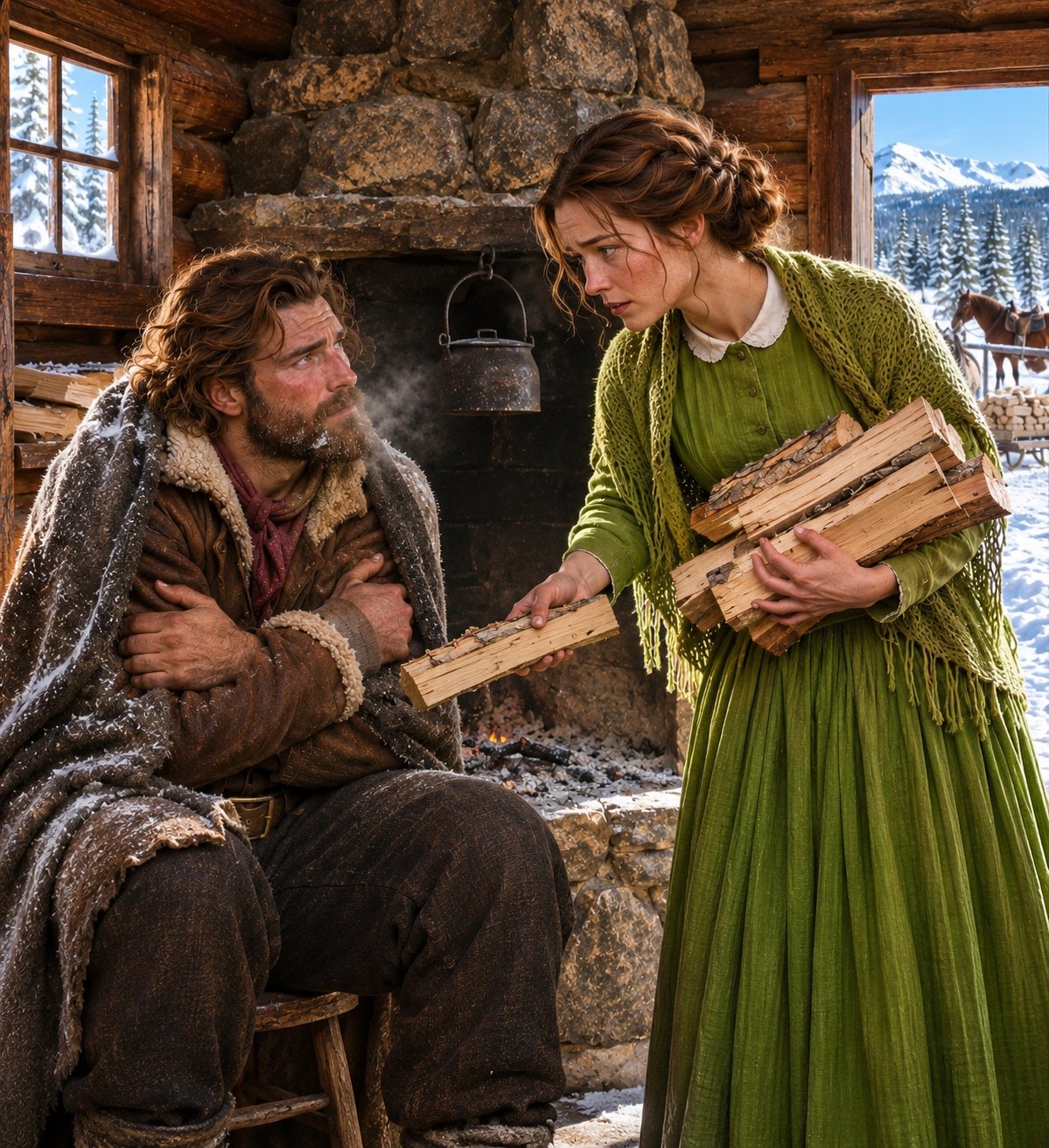
In case you missed it: In December 1888, weaver Britta Lindahl delivered blankets to mountain man Luke Varner and found him with a cold hearth and seven sticks of wood.
His woodshed had collapsed and his arm was hurt, but he kept insisting he was fine.
Britta hauled him five cords of her own winter wood anyway, counting every time he said "I'm fine".
Then the deep cold came.
Riding past her cabin, Luke saw that half her woodpile was gone and her chimney barely smoked.
When she told him she was fine, he said, "I counted.
That's one".
Britta stared at him in the doorway.
And then Britta Lindahl began to laugh.
She'd been cold since Sunday and proud of it.
She'd told herself every hour for three days that she was managing, that it was only a few more weeks, that she'd known exactly what she was doing when she gave the wood away.
And now this enormous man stood on her step with snow on his hat and threw her own tally back in her face, and she couldn't help it.
She laughed.
But somewhere in the middle, the laugh broke.
It turned into something else entirely.
She pressed the back of her wrist hard against her mouth.
"My fingers won't do the shed," she said, when she could speak.
"The warp is stiff as wire.
I've been tying the heddles with my teeth.
I have eight blankets to finish for the dry goods man in Missoula by the first of March, Mr. Varner.
Eight.
And I can't hold the shuttle more than twenty minutes before I have to put my hands inside my coat to get the feeling back".
Luke didn't say anything.
"I did the arithmetic," Britta said.
Her voice was shaking.
"I did it out loud to Tansy, all the way home.
I knew what it would cost.
I'm good at arithmetic.
I just didn't count on the cold coming this early, or this hard".
"May I come in?" said Luke.
"It isn't any warmer in here than it is out there".
"I know," said Luke.
"That's what I came to look at".
He walked her cabin the way he had walked every cabin in the valley for six years, with the flat of his hand.
He laid his palm on the north wall and held it there.
He moved it a foot to the left and held it again.
He found a gap between two logs where a sliver of gray daylight showed through, and he pushed his finger into it up to the second knuckle.
Then he found another.
And another.
Five more, in the north wall alone.
At the window frame, he stopped and felt the cold air pouring in around the sash like water.
At the door.
At the hatch to the loft, where a thin, freezing draft came down onto the back of his neck.
Her father had built this cabin in one hurried autumn, the year the Lindahls came out from Minnesota.
He'd been a carpenter, but he'd been sick even then, and in a hurry.
It was plain and square and solid, and it leaked heat from every seam like a sieve with a roof on it.
"Miss Lindahl," said Luke.
"Let me fix your walls".
"I can't pay you".
"I'm not asking to be paid".
Britta's chin came up.
"I gave you that wood because I wanted to, Mr. Varner.
It wasn't a trade.
I don't want anything back for it".
"I know you don't".
He turned from the wall.
"That's exactly why I can't take it for nothing.
And I can't pay you in money, because you wouldn't take that either".
He looked around her cold cabin.
"But I can do this.
It's the one thing I'm good at that isn't trapping.
I can make that wall hold heat".
She considered him for a long moment.
There was no pity in the look, and no pride either.
It was only a woman reckoning a bargain, the way she reckoned the cost of wool against the price of a blanket.
"On one condition," she said.
"Name it".
"You eat dinner here.
Every day you work.
At my table".
"Done".
"And you will not say you're fine".
"I'll try," said Luke.
"I don't promise".
He started on Wednesday morning.
The ground was frozen too hard to dig clay, and clay wouldn't have set at twenty below in any case.
So he came down the creek road with a sled full of spruce boughs, a wooden wedge, a mallet, and a bundle of split cedar laths.
He asked Britta if she had any wool she couldn't use.
She had a sack of tow in the loft.
Forty pounds of it.
It was the waste of her trade, the short, matted, broken fibers that wouldn't spin into yarn.
She'd been meaning to burn it.
Luke packed it into the gaps between her logs, one handful at a time.
He drove it in with the wedge and the mallet, tamping and tamping until each seam was as hard and tight as the sole of a boot.
Over every seam, he nailed a lath of split cedar to hold it in.
"Wool?" said Britta, watching from the loom.
"In a wall?"
"Wool doesn't mind the cold," said Luke.
"It's been through a good many winters on the backs of sheep".
Then he went outside and banked the foundation of her cabin.
First with spruce boughs, laid thick all the way around.
Then with snow, shoveled up against the boughs and stamped down hard with his own boots until it made a wall three feet high around the bottom of the house.
Britta watched through the window.
"It looks like a grave," she called out.
"It's a blanket," said Luke.
"The snow does the work.
Snow's mostly air.
And air holds heat".
On the second day, he built a second sash for the north window.
He made it out of a broken shutter from her barn and a single pane of glass he'd bought at the Hollow store for twelve cents.
He fitted it on the inside of the old window, so there were two panes with a layer of still air between them.
On the third day, he hung a heavy wool blanket inside the door, weighted at the bottom with a length of log chain so it wouldn't blow, and sealed the loft hatch shut with a plank Britta had been using as a bench.
He did most of it left-handed.
By Friday, his right arm had begun to take a little of the weight.
He didn't mention it.
Neither did she.
But she noticed, and set his coffee down on his right side at dinner so he'd have to reach for it.
Dinner was boiled potatoes and bacon, mostly.
Once, a pot of venison stew he brought down in a lard pail.
They ate at the loom bench because it was the only flat surface in the cabin not covered with wool.
Over potatoes on the third day, she told him why she'd come to Larch Hollow.
"My mother died in Minnesota," she said.
"In the spring of '86.
Papa couldn't bear the house after.
So we sold the farm and came west, the two of us, with a loom and one ewe and a crate of Mama's dishes.
He built this cabin in six weeks.
Then he took sick that winter.
Lung fever.
And he died the autumn after".
She turned a potato over with her fork.
"I was twenty-nine.
Alone with a loom and a sheep.
I didn't even know how to shear her".
Luke listened.
"I went into that winter with no wood," Britta said.
"None.
Papa had been too sick to cut any.
Four weeks of nothing.
I burned a bench.
I burned a crate.
I was about to start on Mama's chairs".
She was quiet a moment.
"And then one Saturday morning, I opened the door, and there was a cord of wood on the step.
Split and stacked.
No track in the snow but a wagon's.
Nobody there".
"And six Saturdays after," said Luke.
She looked up.
"You know?"
"I guessed.
I figured somebody did it.
Who?"
"Zeb Marsh".
Britta set down her fork.
"I didn't find out until April.
I was at his place returning a pie dish.
And there was a birch axe handle hanging on the nail by his woodpile.
Cut wrong for any hand in the Hollow but his.
It's got a notch in it where he broke it once and mended it.
And every one of those logs on my step had the same notch marks, where he'd split them".
She looked at her blue-stained fingers.
"I've never once said thank you to that man.
Not once.
In eight months.
He leaves the room when I try.
He crosses the road".
"Why?"
"He doesn't want it," said Britta.
"He wants to be the kind of man who doesn't need to be thanked, and doesn't need to be helped either.
Either way".
She looked at Luke sidelong, and the corner of her mouth twitched.
"I recognize the type".
Luke had the grace to look at his plate.
They ate in silence for a while.
"I'll tell you mine," Luke said finally.
"Why I stood in the door like that.
You needn't say anything after".
And in his plain way, without any fuss, he told her.
The mill in Ohio closing in the winter of '62.
The church, and the deacon reading out the list.
The woman in the pew in front who turned all the way around to look at him.
The two cords of charity wood, and carrying it himself, stick by stick, in front of the Hennessey boys, because his father couldn't bear to watch.
Leaving Ohio at fifteen and walking west, and swearing on the road that nobody would ever read his name off a list again.
"That's all," he said, when he'd finished.
"That's the whole of it.
That's why I stood in the door.
It isn't a good reason".
Britta laid down her fork.
She took a long time to answer.
"It's a reason a boy had," she said at last.
"I'm thirty-seven".
"Then a man who's been carrying a boy's reason a long while".
She wiped her fingers on her apron.
They were stained blue to the second joint from the dye vat, and not one of them was quite steady.
"I'll say what I think, and then I'll leave it.
I think a person ought to be allowed to be given something without anybody reading it out loud".
Luke looked at her for a long time across the loom bench.
"So do I," he said.
By Saturday evening, the cabin was warm enough to use the dye vat again.
The thermometer Britta had hung inside by the door read fifty-one degrees at supper, with the fire banked down to a few sticks.
In the week before Luke came, she'd been burning a cord of wood every nine days and still shivering.
In the week after, she'd burn a cord in fourteen days, and roll up her sleeves at the loom.
She didn't say one word about the arithmetic.
She only stood in the middle of her own floor in her stocking feet, flexing her fingers open and shut, feeling the warmth in them.
"Mr. Varner," she said.
"Thank you".
"I'm fine," said Luke gravely.
Britta threw a skein of wool at his head.
On Sunday, the 23rd of December, Luke Varner went to church for the first time in three weeks.
He went in with Britta Lindahl.
The Hollow noticed.
The church stood at the crossroads, where the creek road met the road to the mill.
It was a square building of squared logs, with a bell that rang a quarter tone flat.
Luke had built its front steps six years ago and wouldn't take a dime for them.
For six years since, he'd come six Sundays out of ten.
He always stood at the very back with his hat in his hands.