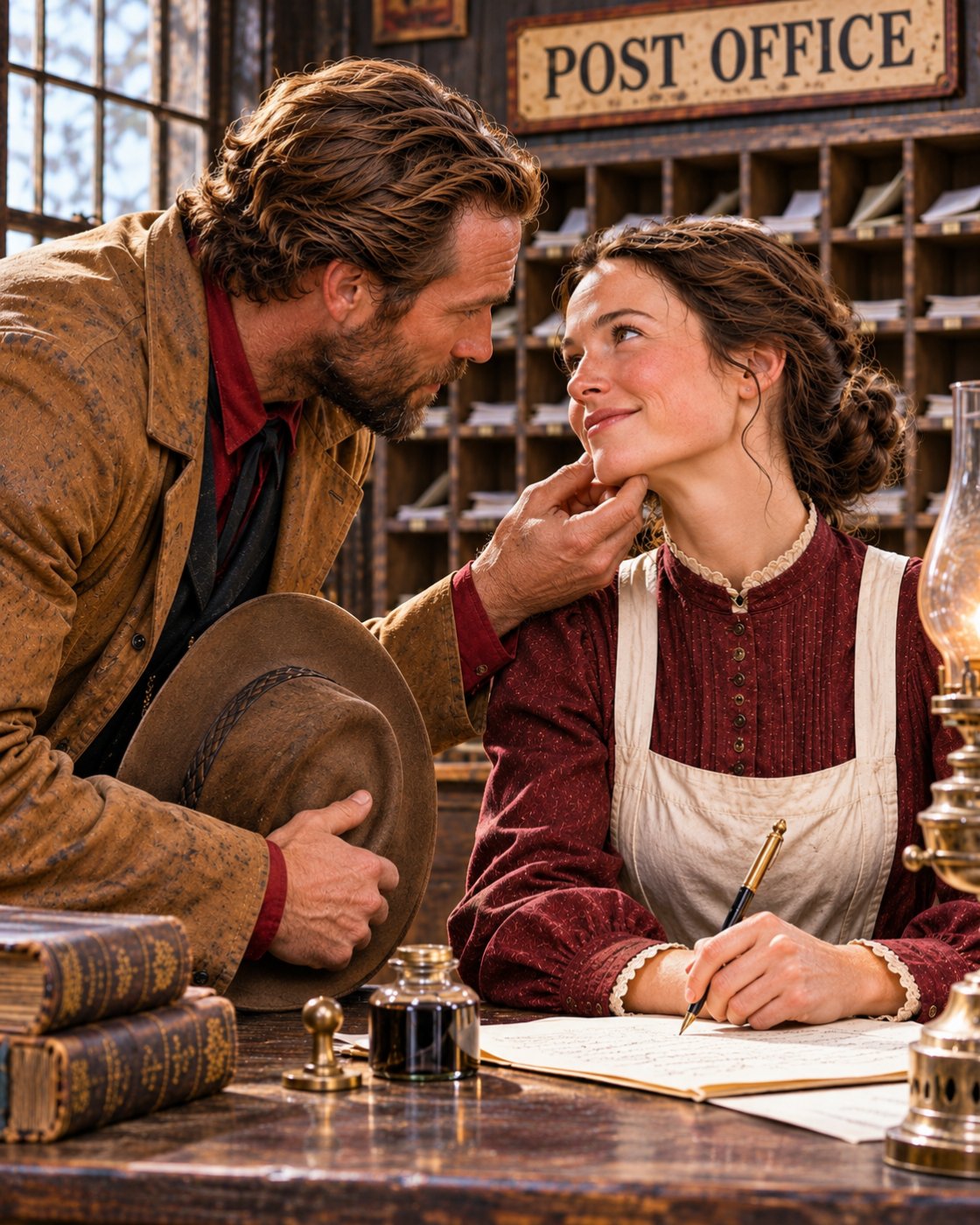
PART 3
For the first time in four years, Tobias Garrity couldn't find a single word.
He stood in the middle of the Methodist church, holding the matrimonial advertisement Odessa had written for him months earlier.
Around them, the people of Kingfisher had fallen silent.
Odessa's fingers tightened around her handbag.
She had come to surrender her post office keys and leave quietly.
Instead, the man she loved was standing before her with a piece of paper that had nearly broken her heart.
“Dessa,” Tobias began, “I need to tell you something.”
She glanced toward Louisa Pennywhistle.
The woman who was supposed to marry him sat calmly in the second pew.
She smiled.
Tobias followed Odessa's gaze.
“Louisa and I aren't getting married.”
A ripple of astonishment traveled through the congregation.
Granny Oleander Pruitt nearly dropped her plate of peach cobbler.
“What happened?” Odessa whispered.
Tobias looked down at the advertisement.
“I made a mistake.”
Odessa's heart sank.
She had spent years imagining him declaring his love.
But she had never imagined hearing those words.
“You didn't make a mistake choosing Louisa,” she said softly. “She's a wonderful woman.”
“She is,” Tobias agreed. “That's why she deserves a man who loves her the way I love you.”
Odessa stopped breathing.
The words seemed to hang between them.
Tobias stepped closer.
“Four years ago, I came into your post office because I couldn't write a decent letter.”
A few people smiled.
“You helped me without ever making me feel foolish. You read my sister's letters aloud when I couldn't make sense of the handwriting. You remembered my birthday when even I forgot it.”
His voice grew rough.
“You taught Pearl to read. You brought apples for Deacon. And every Saturday, I rode eleven miles into town even when I didn't have any mail.”
Odessa's eyes filled.
“Why?”
He gave a helpless little laugh.
“Because you were there.”
A woman near the back pressed a handkerchief to her eyes.
Tobias unfolded the advertisement.
“When I asked you to help me find a wife, I told you I wanted someone kind, someone who laughed with her whole face, someone who understood me.”
He looked at the paper, then back at her.
“I described you, Dessa. Every single word.”
She could barely speak.
“Then why didn't you ask me?”
The question was quiet.
But it carried four years of longing.
Tobias swallowed.
“Because I was afraid.”
“You?”
“I can face a blizzard. I can handle a wild horse. But the thought of asking you to love me and hearing you say no…”
He shook his head.
“I couldn't bear losing the best friend I ever had.”
Odessa stared at him.
All those Saturdays.
All those letters.
All those evenings when he lingered beside the stove.
She had mistaken his fear for indifference.
And he had mistaken her silence for friendship.
“Then why the advertisement?” she asked.
Tobias smiled ruefully.
“Because a stranger could refuse me without breaking my heart.”
A soft laugh moved through the room.
He took another step toward her.
“I asked you to help me find a wife, Dessa.”
He held out his hand.
“Will you help me one last time?”
Odessa looked at him.
Then she began to laugh.
Not the careful, polite laugh she used with customers.
A real laugh.
The kind that made her eyes shine and her cheeks lift.
The kind Tobias had described in the very first sentence of his advertisement.
“Tobias Garrity,” she said, loud enough for the entire church to hear, “you're looking at her.”
For one heartbeat, nobody moved.
Then the church erupted.
Granny Pruitt shouted so loudly that Reverend Teague nearly dropped his Bible.
The cowboys from the Cimarron ranches cheered.
Someone threw a hat into the air.
And Pearl Garrity came running down the aisle.
“I knew it!” she screamed.
She flung herself between them and wrapped her arms around their waists.
“I told Uncle Toby he was supposed to marry you!”
Tobias laughed.
“You did, sweetheart.”
Pearl looked up at Odessa.
“Does this mean you won't get on the train?”
Odessa knelt.
“No, darling.”
“Ever?”
“Not unless I'm coming back.”
Pearl considered that answer.
Then she hugged Odessa so tightly that the woman's hat slipped sideways.
“Good,” she whispered. “Because I already picked out where your books can go.”
Later that evening, after the church supper had ended and the last of the peach cobbler had disappeared, Tobias found Odessa standing outside beneath the stars.
The Oklahoma prairie stretched beyond the town, dark and peaceful.
He approached quietly.
“May I walk you home?”
She smiled.
“You've been walking me home for four years.”
“Then I reckon I ought to keep doing it.”
They walked along Main Street, past the mercantile and the blacksmith's shop.
For once, neither seemed afraid of the silence.
At the post office, Odessa stopped.
“I need to ask you something.”
“Anything.”
“Did you truly mean what you said in church?”
Tobias looked wounded.
“Every word.”
“Even about loving me?”
He reached for her hand.
“Especially that.”
She looked down at their joined fingers.
“I've loved you for four years, Toby.”
He closed his eyes.
“Four years?”
“Since the autumn you brought me a basket of apples because you heard I'd been sick.”
“I remember.”
“You said Deacon had knocked them out of the tree.”
Tobias chuckled.
“He did knock down two.”
“And the other dozen?”
“I picked those myself.”
Odessa laughed.
Then her expression softened.
“I thought you were simply being kind.”
“I was trying to be brave.”
She moved closer.
“You should have told me.”
“I know.”
“So should I.”
He brushed a loose strand of hair away from her cheek.
“Perhaps we can stop wasting time now.”
Odessa smiled.
“I'd like that.”
Their first kiss was gentle.
There was no cheering crowd, no preacher, no music.
Only two people who had spent years standing inches from happiness without realizing how close they were.
When Tobias drew back, he rested his forehead against hers.
“I've wanted to do that for a very long time.”
“So have I.”
“Then we really have been fools.”
“Terrible fools,” Odessa agreed.
And they kissed again.
Their engagement lasted only three weeks.
Granny Pruitt insisted that a wedding delayed was a wedding endangered.
Reverend Teague politely disagreed.
Pearl announced that both adults were wrong and that the wedding should happen immediately because she had already chosen her dress.
Tobias wisely remained silent.
Odessa, who had managed the post office through dust storms, late trains, and angry ranchers, discovered that organizing her own wedding was considerably more difficult.
Everyone wanted to help.
The mercantile owner's wife offered ribbons.
The schoolteacher offered flowers.
The blacksmith offered to repair the church bell.
And Granny Pruitt offered opinions about everything.
But one person remained uncertain about attending.
Louisa Pennywhistle.
Odessa visited her at the boardinghouse on a warm June afternoon.
Louisa was sitting by the window, reviewing figures in a ledger.
When Odessa entered, she stood immediately.
“Miss Whitlow.”
“Please call me Dessa.”
Louisa smiled.
“Then you must call me Louisa.”
Odessa sat opposite her.
“I came to thank you.”
“For what?”
“For being braver than either of us.”
Louisa closed the ledger.
“I didn't do anything extraordinary.”
“You could have married him.”
Louisa shook her head.
“I could have married a man who was trying very hard to convince himself he loved me.”
Her expression softened.
“But that isn't the same thing.”
Odessa reached across the table.
“I'm sorry you were hurt.”
“I was disappointed,” Louisa admitted. “But disappointment is easier to recover from than a lifetime of being loved halfway.”
For a moment, neither spoke.
Then Odessa smiled.
“Will you come to our wedding?”
Louisa looked surprised.
“You want me there?”
“Very much.”
Louisa considered it.
Then she laughed.
“Well, someone ought to make sure Tobias doesn't forget his vows.”
They both laughed.
And an unexpected friendship began.
The wedding took place on the last Sunday of June.
The little church was decorated with prairie roses and blue ribbons.
Odessa wore a simple ivory dress with her mother's lace collar.
Tobias wore a new dark coat that made him look so handsome she nearly forgot how to walk down the aisle.
Pearl scattered flower petals with great seriousness.
Unfortunately, she used most of them before Odessa reached the front.
Reverend Teague began the ceremony.
Tobias held Odessa's hands.
His palms were damp.
She smiled.
“Nervous?”
“More than the day I broke my first horse.”
“I'm not going to throw you.”
“That is a comfort.”
When the reverend asked whether Tobias took Odessa to be his wife, the cowboy answered before the question was finished.
“I do.”
The congregation laughed.
When Odessa answered, her voice was steady.
“I do.”
Tobias looked at her as though the entire world had suddenly become a place he understood.
The reverend pronounced them husband and wife.
And before he could invite the groom to kiss his bride, Pearl shouted, “Finally!”
The laughter shook the church.
Tobias kissed Odessa.
And this time, neither had to wonder what the other was feeling.
Their first evening at the Circle G ranch was quiet.
Pearl fell asleep in the buggy before they reached the house.
Tobias carried her upstairs while Odessa stood on the wide wooden porch.
The prairie smelled of warm grass and distant rain.
She could hear Deacon moving around in the stable.
Inside the house, a lamp glowed through the kitchen window.
Odessa looked at the place she had visited so many times as a guest.
Now it was her home.
Tobias returned and stood beside her.
“Are you happy?”
She turned toward him.
“Very.”
He looked relieved.
“I was afraid you'd miss town.”
“I will.”
“You can keep working at the post office.”
“I intend to.”
“Good.”
She smiled.
“You thought I'd give it up?”
“I didn't know.”
“Tobias, I love you. But I also love my work.”
He nodded.
“Then we'll make room for both.”
It was such a simple answer.
And perhaps that was why she loved him.
He didn't ask her to become someone different.
He only wanted to share the life she already had.
She slipped her arm through his.
“There's one thing you should know.”
“What?”
“I intend to keep feeding apples to your mule.”
Tobias groaned.
“Dessa, that animal already thinks he owns the ranch.”
“Perhaps he does.”
“He's impossible.”
“So are you.”
Tobias laughed and pulled her close.
Then he kissed her beneath the porch light.
Marriage did not transform Tobias into a perfect man.
He still struggled with letters.
He still forgot where he left his hat.
And his attempts at cooking remained disastrous.
Odessa soon discovered that he could repair a broken wagon wheel in an hour but could not produce a respectable pie in an entire afternoon.
Yet he kept trying.
Every May, on the anniversary of the rainy night when he had brought her that dreadful chicken pie, he baked another.
The crust was always too thick.
The filling was usually too salty.
And every year, Odessa ate a generous slice.
“Best pie I've ever tasted,” she would announce.
Tobias would narrow his eyes.
“You're a terrible liar, Mrs. Garrity.”
“Only about pie.”
He would kiss her forehead.
“Then I suppose I can forgive you.”
Pearl grew up surrounded by books, horses, and laughter.
Odessa taught her to write letters in beautiful, careful handwriting.
Tobias taught her to ride before she was tall enough to climb into the saddle alone.
Together, they taught her that love was not something a child had to earn by being quiet, useful, or obedient.
It was something she could trust.
When Pearl was sixteen, she asked Odessa a question one evening.
“Did you really write forty-one letters to other women because you loved Uncle Toby?”
Odessa smiled.
“I did.”
“That seems terribly foolish.”
“It was.”
“Why didn't you just tell him?”
Odessa looked toward the porch, where Tobias was repairing a saddle.
“Because sometimes the truth feels more frightening than losing what you want.”
Pearl thought about that.
“Was it worth waiting?”
Odessa watched her husband glance toward the kitchen window.
When he saw her, he smiled.
The same slow, wonderful smile that had stolen her heart years earlier.
“Yes,” she whispered. “But I wouldn't recommend waiting so long.”
Years passed.
Kingfisher grew.
New shops appeared along Main Street.
The railroad brought families, newspapers, and news from places Odessa had never seen.
She continued working at the post office, and Tobias continued riding into town on Saturdays.
Sometimes he helped sort the mail.
Sometimes he simply sat nearby, pretending to read the newspaper while waiting for her to finish.
Their marriage became one of those ordinary miracles that rarely attracted attention.
They argued occasionally.
They worried about money.
They endured dry summers and difficult winters.
But they never again allowed fear to keep important words unspoken.
When Odessa was unhappy, she told him.
When Tobias was worried, he told her.
And every evening, they found their way back to the same kitchen table.
One autumn, many years after their wedding, Tobias brought an old newspaper clipping into the post office.
“Found this in a drawer.”
Odessa unfolded it.
There, faded but still readable, was the advertisement she had written all those years earlier.
Honest cattleman, thirty-four, seeks kind and sensible woman of good humor to share a home and raise a child. Must be fond of mules.
Odessa laughed.
“I can't believe you kept this.”
“Of course I did.”
“Why?”
Tobias took a pen from the counter.
Beneath the advertisement, he slowly wrote one word.
Found.
Then he handed it back.
“Because it reminds me of the best mistake I ever made.”
Odessa looked at the clipping.
“You mean asking me to find you another woman?”
“No.”
He smiled.
“Taking four years to realize the woman I wanted was standing right in front of me.”
She reached for his hand.
“You found me eventually.”
Tobias squeezed her fingers.
“No, Dessa.”
He looked around the little post office where their story had begun.
“You were never lost.”
She smiled.
“Neither were you.”
And when he kissed her across the counter, the brass clock above the stamp drawer continued ticking, just as it had on the morning he first asked her to help him find a wife.
Only now, there was no heartbreak in the silence between its ticks.
There was a lifetime of love.
And on the wall behind the counter hung a framed advertisement with one handwritten word beneath it.
Found.