They Called Her the Plain Unmarried Sister—Then the Mountain Man Asked Her to Supper
PART 1
“She’s thirty-one, built like a workhorse, and no man in Montana would marry her unless she came with a hundred acres of land.”
The laughter spread through the mercantile, but Abigail Miller didn't turn around. She simply tightened her grip on the fifty-pound sack of flour and carried it toward the counter. Her younger sister, Clementine, stood among the laughing women in a pale yellow dress, her beautiful face flushed with embarrassment. Yet she said nothing to defend Abigail. She never did.
For six years, Abigail had cooked, cleaned, chopped firewood, and kept their family home standing after their parents died. At thirty-one, she was considered hopelessly unmarried. Clementine, twenty-two, had golden curls, delicate hands, and half the eligible men in Bitter Creek fighting for her attention. Abigail had calluses, aching shoulders, and a heart she'd trained herself to keep quiet.
Then the mercantile door opened, and the laughter stopped.
Elias Boon stood in the doorway, a towering mountain man with a dark beard, broad shoulders, and pale gray eyes. He lived alone somewhere beyond the northern ridge. People whispered that he'd survived blizzards that killed entire hunting parties, and that the last man who threatened him had left town before sunrise.
Clementine immediately straightened her dress and offered him her prettiest smile. Boon barely glanced at her. Instead, he watched Abigail struggling with the flour.
“That's a heavy load for one woman,” he said.
“It's heavy for anyone,” Abigail replied sharply. “But somebody has to carry it.”
Something almost like a smile touched his mouth. Without another word, he lifted the second sack and carried it to her wagon.
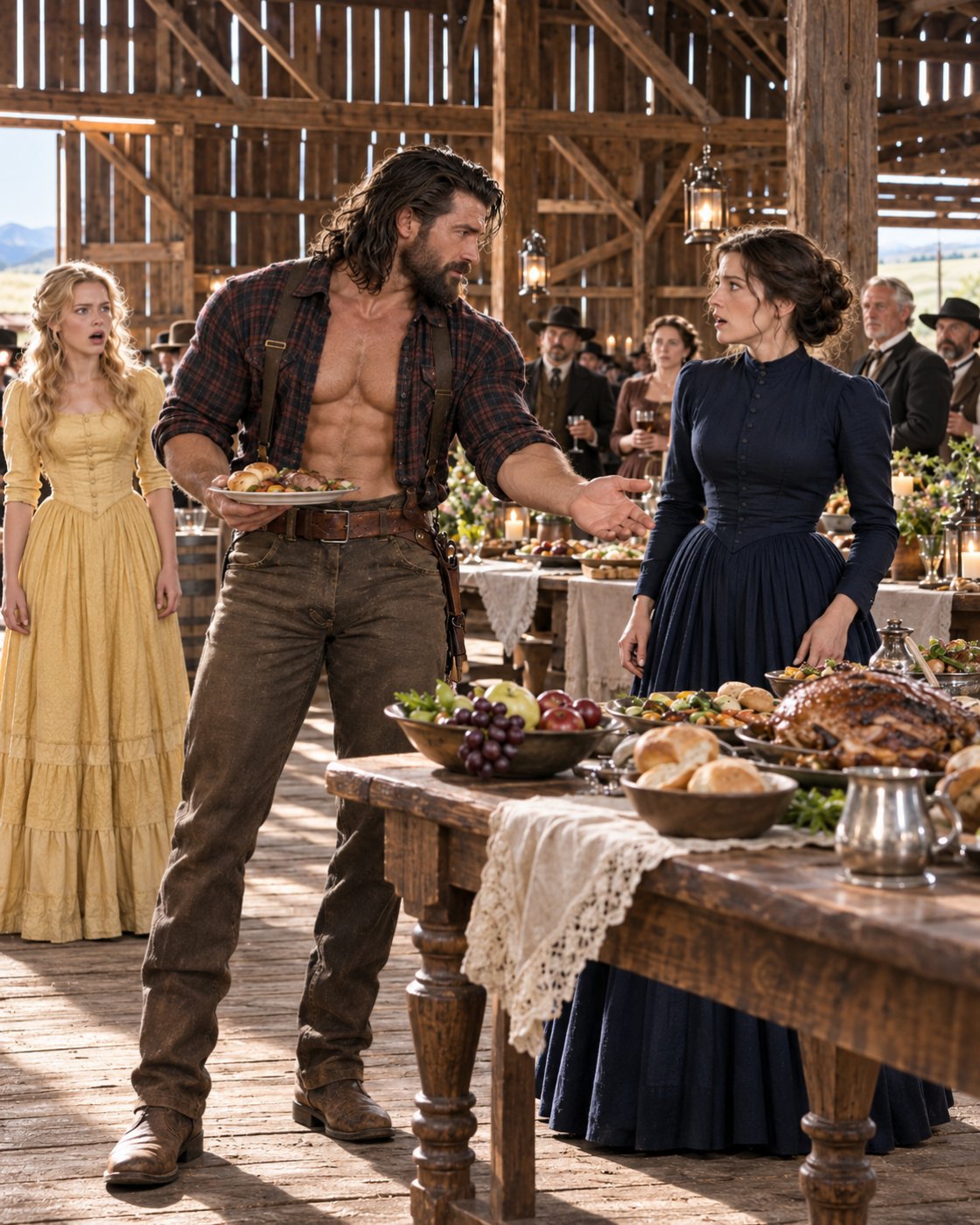
Three nights later, at the Founders' Day supper, Abigail stood behind the food table serving roast pork while Clementine danced with the mayor's son. When Boon entered the crowded barn, the musicians faltered. He walked past every unmarried beauty in Bitter Creek and stopped directly in front of Abigail.
“Miss Miller,” he said, removing his hat. “Would you have supper with me?”
Abigail stared. “You mean Clementine?”
“No, ma'am. I mean you.”
The barn fell silent. Abigail's cheeks burned as she slowly untied her apron. For the first time in years, she left the serving table while someone else finished her work.
But as Boon offered his arm, Clementine hurried forward and caught Abigail's wrist.
“Abby, wait.” Her voice trembled. “There's something you need to know about him.”
Abigail frowned. “What?”
Clementine glanced at Boon, suddenly pale.
“He came to our house yesterday while you were working. He asked me something about you, and when I answered, he said he'd been waiting ten years.”
Abigail turned toward the mountain man.
“Ten years?”
Boon's expression changed.
And for the first time that evening, the man who feared nothing in the mountains looked afraid.
Why had Elias Boon waited ten years to approach a woman who believed no man had ever wanted her? And what had Clementine told him that made him afraid Abigail would discover the truth?
Would you accept supper with a stranger who seemed to know more about your past than you did?
The answer begins with something Abigail finds inside her late mother's sewing chest. Read PART 2 in the first comment. 👇
PART 2
And for the first time that evening, the man who feared nothing in the mountains looked afraid.
Abigail withdrew her hand from Clementine's grasp. “What does she mean, Elias?” Boon glanced at the crowd gathering around them, then lowered his voice. “Your mother knew me, Abigail. Years ago, when I was twenty-four and half-frozen on the northern trail, she helped save my life.” Abigail stared at him. “Mother never mentioned you.” “I asked her not to. I was ashamed of what had happened to me.” He hesitated. “But she talked about you. Said you were the one who kept the family together, even when nobody noticed.” Abigail felt something tighten inside her chest. “Then you didn't come here because you wanted me. You came because you owed my mother.” Boon shook his head. “That's how I first learned your name. It isn't why I asked you to supper.”
But Abigail couldn't believe him. She returned to the food table, leaving Boon standing alone beneath the lanterns. The next morning, searching her mother's old sewing chest, she discovered a faded envelope addressed to Elias Boon. Inside was a letter written ten years earlier. Dear Elias, you have nothing to repay. But if you ever find yourself passing through Bitter Creek again, I hope you'll meet my eldest daughter. She is stronger than anyone knows, yet sometimes I fear the world will never see the woman beneath all that responsibility. Abigail pressed the letter against her chest and cried. Her mother had understood her loneliness long before Abigail could admit it herself.
Two days later, Boon appeared with a wagonload of firewood. Abigail met him at the gate. “Did Mother ask you to marry me?” His eyes widened. “Good Lord, no.” “Then why me? You could have any woman in this valley.” He looked at her workworn hands. “Because I watched you carry what everyone else was too comfortable to lift. Because you spoke to me like a man instead of some mountain monster. And because when you smiled at supper, I realized I wanted to spend a lifetime giving you reasons to smile again.” Abigail's eyes filled, but before she could answer, Clementine appeared on the porch. “Abby, don't be foolish. Men like him don't stay. They come down from the mountains, take what they want, and disappear.”
Boon said nothing. He simply finished stacking the firewood and left. Over the following weeks, however, he returned again and again. He repaired Abigail's broken smokehouse, brought venison for winter, and sat beside her on the porch while she spoke about the dreams she'd abandoned. Slowly, she began to believe him. Then, one bitter November morning, Boon arrived with his horse packed for the mountains. “Snow's coming,” he said. “I have to go before the pass closes.” Abigail swallowed her tears. “Will you come back?” He looked at her for a long moment. “I don't know if the mountain will let me.”
Five days passed. The first snow began falling. Abigail was chopping firewood when a familiar roan horse appeared on the northern road, pulling a wagon dangerously fast through the freezing mud. Boon jumped down, his face pale with cold. “I reached my cabin,” he gasped. “Lit the fire. Sat down. And realized I couldn't bear another winter without you.” He took her hands. “Marry me, Abigail. Come home with me.”
But before she could answer, Clementine rushed from the house, crying, “You can't take her! If Abigail leaves, what happens to me?”
Abigail stood between the sister who had depended on her for six years and the man offering her the love she'd waited thirty-one years to find.
If choosing happiness meant leaving someone she loved behind, did Abigail have the courage to do it?
Would you choose LOVE or DUTY? Comment one word—“LOVE” or “DUTY”—for PART 3, where Abigail must make the hardest decision of her life.
PART 3
Abigail stood between the sister who had depended on her for six years and the man offering her the love she'd waited thirty-one years to find.
The November wind swept across the Miller yard, carrying the first hard flakes of snow. Elias Boon's enormous roan gelding stood trembling beside the wagon, steam rising from its nostrils. The mountain man himself looked as though he'd ridden through hell to reach her. His dark hair was damp beneath his hat, his beard flecked with ice, and his gray eyes held a desperation Abigail had never imagined seeing in such a formidable man.
“Marry me, Abigail,” he repeated quietly. “I don't have much to offer beyond a cabin, a good horse, and two hands that know how to work. But whatever I have, I'd share it with you.”
Behind her, Clementine began crying.
“You can't leave me, Abby. You know I can't manage this house alone.”
Abigail turned toward her younger sister. Clementine stood on the porch in a thin wool shawl, her beautiful golden hair blowing loose around her frightened face. For six years, Abigail had been the person who made sure Clementine never had to be afraid. She had cooked every meal, paid every bill, repaired every broken hinge, and gone without new dresses so her sister could attend dances in pretty ribbons.
And now Clementine was asking her to continue doing those things forever.
“Clem,” Abigail said gently, “you're twenty-two years old.”
“I know how old I am!”
“Then you know you're old enough to take care of yourself.”
Clementine stared at her. “You make it sound so simple.”
“It isn't simple. It never was.”
Abigail looked down at her hands. The knuckles were cracked from cold water and lye soap. There was a small scar across her left palm from the winter she'd repaired the barn roof after their father died. Her hands carried six years of work that nobody else had thought to do.
“I was frightened when Mother and Father died,” she continued. “I didn't know how we'd survive. I learned because I had to. And somewhere along the way, I made the mistake of thinking you should never have to learn.”
Clementine's lips trembled.
“You're saying it's my fault?”
“No. I'm saying I love you. But loving you doesn't mean I must give up every chance of having a life of my own.”
Boon stood silently beside the wagon. He didn't interrupt or try to hurry her. Abigail noticed that his horse was shivering, and that the snow was beginning to settle on the canvas covering his supplies.
She turned back to him.
“Elias, if I say yes, I won't leave tonight.”
His expression changed.
“Abigail, the pass—”
“I know about the pass. But I won't run away from my home in the middle of a snowstorm. And I won't marry a man I've known only a few weeks without understanding what kind of life we're choosing.”
Boon looked at her for a long moment. Then, slowly, he nodded.
“Fair enough.”
She took a breath.
“If you truly mean to marry me, you'll have to wait until we can do it properly.”
The wind whistled through the bare cottonwood branches.
Boon glanced toward the northern mountains. The clouds were gathering fast, dark and heavy over the ridge.
Then he looked back at Abigail.
“I've lived alone ten years,” he said. “Reckon I can wait one more winter if I know you're waiting at the other end.”
Something inside her softened.
“But where will you go?” she asked.
“Back to the cabin, if I leave now.”
Abigail studied the exhausted horse.
“You won't make it before dark.”
Boon looked toward the mountains again.
He knew she was right.
The storm had arrived faster than he'd expected, and the roan had already traveled too far.
“There's room in the barn,” Abigail said. “And a bedroll by the kitchen stove.”
A slow smile spread across his face.
“You offering me shelter, Miss Miller?”
“I'm offering your horse shelter. You may come along if you behave yourself.”
For the first time that day, Boon laughed.
It was a deep, warm sound, so unexpected that Abigail found herself smiling too.
Behind them, Clementine wiped her eyes and turned toward the house.
She didn't say another word.
But Abigail knew the argument was far from finished.
The storm lasted four days.
By the second morning, Bitter Creek lay beneath nearly two feet of snow. The roads disappeared beneath white drifts, and the wind rattled the Miller farmhouse so fiercely that Clementine feared the windows would break.
Boon remained in the barn loft at night and worked around the property during the day. He repaired a loose section of roof, cleared the path to the well, and reinforced the stable doors before the worst of the storm arrived.
Abigail watched him through the kitchen window as he worked.
She had known strong men before. Bitter Creek was full of ranchers, freight drivers, and lumbermen who could lift heavy loads and break wild horses. But Boon's strength was different. He never seemed interested in proving it. He simply noticed what needed doing and did it.
On the third evening, he came into the kitchen carrying an armload of split firewood. Snow melted from his beard onto his shirt collar.
Abigail stood at the stove, stirring a pot of rabbit stew.
“Put those beside the hearth,” she said.
He obeyed.
Then he stood awkwardly near the table, looking at the empty chair.
“You can sit down, Elias.”
He removed his hat.
“Didn't want to presume.”
Abigail smiled.
“You've repaired half my property. I think you've earned supper.”
He sat.
Clementine appeared from the parlor wearing a pale blue dress and a carefully arranged expression of indifference. She had spent the afternoon sulking, but the smell of stew had finally brought her into the kitchen.
Boon stood when she entered.
“Evening, Miss Clementine.”
She glanced at him.
“Mr. Boon.”
The silence was uncomfortable.
Abigail placed three bowls on the table.
They ate quietly until Clementine finally spoke.
“Is it true you live entirely alone up there?”
Boon nodded.
“Most of the year.”
“And you expect Abigail to live that way?”
“No.”
Clementine frowned.
“What do you mean?”
Boon set down his spoon.
“I expect Abigail to decide what sort of life she wants. If she wants to spend winters in Bitter Creek, we'll find a way. If she wants to keep this house, that's her business. I haven't asked her to disappear into the mountains.”
Clementine looked surprised.
Abigail was surprised too.
Boon continued.
“I asked her to marry me. I didn't ask her to stop being herself.”
For a moment, the only sound was the wind against the windows.
Then Clementine looked down at her stew.
“She's never had much of a chance to be herself,” she said quietly.
Abigail stared.
It was the first time her sister had acknowledged such a thing.
Boon said nothing.
He didn't need to.
That night, after Clementine had gone upstairs, Abigail found Boon sitting beside the kitchen stove, repairing a torn leather glove.
She poured two cups of coffee and sat across from him.
“Tell me something,” she said.
He looked up.
“Anything.”
“Why did you live alone for ten years?”
Boon lowered his eyes to the glove.
For a long time, he said nothing.
Then he placed the leather on his knee.
“I came home from the war a different man.”
Abigail frowned.
“What war?”
“The last fighting against the tribes, years ago. I was young. Thought wearing a uniform made a man important.”
His voice grew quiet.
“I saw things I wish I hadn't. Men frightened enough to do terrible things. Other men pretending those things were necessary.”
He looked toward the fire.
“When I left the Army, I couldn't bear crowds. Couldn't bear the sound of men laughing about suffering. So I went into the mountains.”
Abigail listened without interrupting.
“At first, I thought I'd stay one winter. Then another. After a while, it became easier to be alone than to explain why I wasn't like other men.”
He rubbed his thumb over a scar on his knuckle.
“Your mother found me during that first winter. I'd fallen through river ice and injured my leg. She was traveling with a neighbor who knew the lower trail. They brought me blankets and food, and she made certain someone came back for me.”
Abigail remembered her mother disappearing for two days during a terrible storm when Abigail was twenty-one. Eleanor had returned exhausted, with a torn skirt and a story about helping a stranded traveler.
She had never mentioned his name.
“She told me about you,” Boon continued. “Said you were stubborn, capable, and always looking after everyone else.”
Abigail smiled faintly.
“That sounds like Mother.”
“She said something else.”
“What?”
Boon looked directly at her.
“She said she hoped someday someone would look after you.”
Abigail's throat tightened.
For a long moment, she couldn't speak.
Then she whispered, “I wish she'd told me.”
Boon shook his head.
“Maybe she knew you wouldn't have believed her.”
Abigail laughed softly through her tears.
“Probably not.”
He reached across the table and offered his hand.
She placed hers in it.
His fingers were rough and warm.
Neither spoke for a long time.
Outside, the storm continued.
But inside the kitchen, Abigail felt something she hadn't felt since her parents were alive.
She felt safe.
Not because someone had promised to protect her from everything.
But because, for once, she wasn't carrying everything alone.
When the storm finally cleared, Boon prepared to return to the mountains.
The northern pass would be difficult, but the weather had settled enough for him to travel.
Abigail stood beside his horse while he tightened the saddle.
“Will you write?” she asked.
Boon looked embarrassed.
“My handwriting isn't much.”
“Neither is Clementine's cooking, but she keeps trying.”
He laughed.
“I'll write.”
Abigail hesitated.
“Elias?”
He turned.
“I meant what I said. About waiting until spring.”
“So did I.”
She looked up at him.
“I want to know you. Not just the man who carried my flour or asked me to supper. I want to know the man who lives alone in the mountains. The things that frighten him. The things that make him happy.”
Boon's expression softened.
“And I want to know the woman who keeps pretending she doesn't need anything.”
Abigail smiled.
“Then we both have work to do.”
He reached for her hand.
“May I kiss you goodbye?”
The question startled her.
No man had ever asked her that before.
For a moment, she felt painfully aware of her plain wool dress, her rough hands, and the loose strands of brown hair escaping her pins.
Then she looked into his eyes.
And saw no disappointment.
Only hope.
“Yes,” she whispered.
Boon leaned down and kissed her gently.
It wasn't a desperate embrace or a dramatic declaration.
It was warm, careful, and full of promise.
When he drew back, Abigail was smiling.
“Spring,” she said.
“Spring,” he answered.
Then he mounted the roan and rode toward the mountains.
Abigail watched until he disappeared beyond the northern ridge.
The first letter arrived three weeks later.
It was written on rough paper in a large, uneven hand.
Dear Abigail,
Snow's deep. Horse is well. Cabin roof held through the storm.
I made coffee this morning and caught myself setting out two cups.
Don't know why I did that.
Reckon I was thinking about you.
Abigail read it three times.
Then she laughed.
She carried the letter upstairs and placed it inside her mother's sewing chest.
The second letter arrived in January.
Dear Abigail,
Saw a mountain lion near the ridge yesterday. Beautiful creature. Mean disposition.
Reminded me of you when you were angry with me about the firewood.
I mean that kindly.
Abigail laughed so hard that Clementine came running from the kitchen.
“What's so funny?”
“Nothing.”
Clementine eyed the letter.
“From him?”
Abigail nodded.
Her sister hesitated.
“Does he write nicely?”
Abigail smiled.
“Not particularly.”
Clementine looked confused.
“Then why are you laughing?”
“Because he's funny.”
Clementine stared at her.
Then, unexpectedly, she smiled.
“Perhaps I misjudged him.”
Abigail looked up.
It wasn't an apology.
Not yet.
But it was a beginning.
Winter changed the Miller household in ways Abigail hadn't expected.
At first, Clementine resisted every new responsibility.
She burned the biscuits.
Forgot to bring in the washing before a snowfall.
Miscounted the money at the mercantile.
And complained bitterly when Abigail refused to take over.
But slowly, something began to happen.
Clementine learned.
She discovered that she could make bread without Abigail standing beside her.
She learned to mend her own dresses.
She even began helping Mr. Henderson keep the mercantile accounts, discovering a surprising talent for arithmetic.
One evening in February, Abigail returned from visiting a sick neighbor to find the kitchen clean, supper cooking, and Clementine sitting at the table with a ledger.
Abigail stopped in the doorway.
“What's all this?”
Clementine looked up.
“Supper.”
“I can see that.”
“And I paid the coal bill.”
Abigail stared.
“You did?”
Clementine nodded proudly.
“Mr. Henderson said my figures were correct.”
Abigail smiled.
“I'm proud of you, Clem.”
Her sister looked down.
Then, quietly, she said, “I didn't realize how much you did.”
Abigail's smile faded.
Clementine continued.
“I thought the house simply worked. The bread was always there. The fire was always lit. The bills were always paid.”
Her voice trembled.
“I never thought about who made it happen.”
Abigail sat beside her.
For a moment, neither spoke.
Then Clementine whispered, “I'm sorry, Abby.”
Abigail took her sister's hand.
“I know.”
Clementine began crying.
“I was afraid you'd leave me.”
Abigail squeezed her fingers.
“I know that too.”
Her sister looked up.
“But I was wrong to make you feel guilty for wanting someone to love you.”
Abigail felt tears gather.
Clementine smiled through her tears.
“And for what it's worth, I don't think you're plain.”
Abigail laughed.
“That's kind of you.”
“No. I mean it.”
Clementine studied her sister's face.
“I think I was so used to everyone looking at me that I never noticed how much I liked having you beside me. And when he looked at you instead, I was jealous.”
Abigail stared.
Clementine wiped her eyes.
“I'm ashamed of that.”
Abigail pulled her into an embrace.
For the first time in years, the sisters held each other without the weight of duty standing between them.
March brought the first thaw.
Snow began slipping from the lower hills.
The creek behind the Miller house ran fast and muddy.
And Abigail received a letter that made her heart pound.
Dear Abigail,
The lower trail is opening.
I've been working on something all winter.
Don't want to tell you what it is yet.
But if the weather holds, I'll be in Bitter Creek by the first Sunday in April.
I hope you'll let me take you to supper again.
Yours,
Elias.
Abigail pressed the letter to her chest.
Then she looked toward the calendar.
Three weeks.
She had three weeks to wait.
For the first time in her life, waiting felt wonderful.
On the first Sunday in April, Bitter Creek gathered for church beneath a clear blue sky.
Abigail wore her navy dress.
But this time, she'd sewn a small white lace collar around the neckline.
Clementine had helped her arrange her hair.
“You look beautiful,” her sister said.
Abigail smiled.
“Thank you.”
She walked into church feeling nervous but hopeful.
Boon had not yet arrived.
She told herself he might be delayed by the trails.
Then the church doors opened.
A familiar figure stood in the entrance.
Elias Boon.
He wore a clean dark coat, polished boots, and a freshly trimmed beard.
His gray eyes searched the room.
When they found Abigail, his entire face changed.
He smiled.
Not the small, guarded smile she'd seen before.
A real smile.
Warm and unmistakably happy.
He walked down the aisle.
The congregation fell silent.
Abigail stood.
“Miss Miller,” he said softly.
“Mr. Boon.”
He looked at her dress.
“You look beautiful.”
Her cheeks warmed.
“Thank you.”
Then he reached into his coat.
And Abigail's heart nearly stopped.
He withdrew a small wooden box.
For one terrible moment, she thought he intended to propose in front of the entire congregation.
But Boon simply placed the box in her hands.
“Something I made for you.”
Abigail opened it.
Inside lay a small silver brooch shaped like a mountain flower.
The petals were delicate and carefully carved.
At the center was a tiny blue stone.
Abigail stared.
“Elias…”
He looked embarrassed.
“Found the stone near the creek. Had a silversmith in Helena help me with the setting.”
She touched the brooch.
“It's beautiful.”
Boon smiled.
“Reminded me of you.”
Abigail looked up.
“Why?”
He glanced toward the mountains visible through the church window.
“Because it grew in a place where nobody expected anything beautiful to survive.”
Abigail's eyes filled.
And for the first time in her life, she didn't try to hide her tears.
That afternoon, Boon took her to supper.
Not at a grand celebration.
Not before a hundred staring townspeople.
Just the two of them, sitting at a small table near the window of Mrs. Harper's boarding house.
They ate roast chicken and warm biscuits.
They talked about winter.
About Clementine.
About the mountains.
About the things they wanted from life.
And when the sun began to set, Boon asked Abigail to walk with him.
They followed the creek beyond town, where the grass was beginning to turn green.
At a quiet bend in the water, Boon stopped.
“There's something I want to show you.”
He reached into his coat and unfolded a piece of paper.
It was a drawing.
A rough sketch of his mountain cabin.
Abigail studied it.
There was a new room on the eastern side.
A larger kitchen.
A covered porch.
And a small garden behind the house.
She looked up.
“What's this?”
Boon swallowed.
“What I've been working on all winter.”
Abigail stared.
“You built an addition?”
“Started one. Didn't finish it.”
“Why?”
He looked at her.
“Because I wanted to know what you thought before I went any further.”
Abigail studied the drawing again.
The kitchen was larger than the one in the Miller house.
There were shelves for preserves.
A proper pantry.
And a window above the sink overlooking the valley.
“You remembered,” she whispered.
Boon nodded.
“You said you liked to see the morning light when you worked.”
Abigail felt tears gather.
For years, she'd built her life around everyone else's needs.
Now someone had spent an entire winter imagining a home where her needs mattered too.
She looked up.
“Elias, it's wonderful.”
He smiled.
“But there's one thing missing.”
“What?”
He reached into his pocket.
And this time, he withdrew a ring.
It was simple silver, with a narrow band and a tiny mountain flower engraved along the edge.
Abigail covered her mouth.
Boon lowered himself onto one knee in the soft spring grass.
“Abigail Miller,” he said, his voice rough with emotion, “I've lived through winters that nearly killed me. I've crossed mountains in storms when I couldn't see my own horse's ears. I've spent ten years believing I was better off alone.”
He swallowed.
“Then I met a woman who carried a sack of flour like the whole world depended on her.”
Abigail laughed through her tears.
“And I realized I'd been wrong about what makes a man strong.”
He took her hand.
“Strength isn't surviving alone. It's having someone worth coming home to.”
His gray eyes shone.
“I don't want you because you're useful. I don't want you because your mother once helped me. And I don't want you because I think you need saving.”
He paused.
“I want you because I love the woman you are.”
Abigail was crying openly now.
Boon continued.
“Will you marry me, Abigail? Will you build a life with me, not because you have to, but because you want to?”
For a moment, she couldn't speak.
She thought of every cruel joke she'd endured.
Every dance where nobody asked her to join.
Every wedding dress she'd sewn for someone else.
Every night she'd lain awake wondering whether she'd spend her whole life being useful and invisible.
Then she looked at the man kneeling before her.
And smiled.
“Yes,” she whispered.
Boon closed his eyes.
She laughed.
“Yes, Elias. I'll marry you.”
He rose and gathered her into his arms.
And when he kissed her beneath the budding cottonwoods, Abigail felt something she'd never known before.
Not relief.
Not gratitude.
Not the desperate happiness of a woman who'd finally been chosen.
She felt the quiet certainty of a woman who had chosen for herself.
They married in June.
The ceremony was held in the small white church at the edge of Bitter Creek.
Abigail wore a dress she'd sewn herself, made of soft ivory cotton with delicate lace at the collar.
Clementine stood beside her as bridesmaid.
And when Abigail walked down the aisle, every person in town turned to look.
Some of the women who'd once mocked her now whispered about how beautiful she looked.
But Abigail barely noticed.
She saw only Elias.
He stood at the altar wearing his best dark suit, his broad shoulders looking almost too large for the little church.
When he saw her, his eyes filled.
And Abigail smiled.
Because she knew exactly what he was thinking.
He had found his way home.
They didn't leave Bitter Creek forever.
Instead, they built a life between the valley and the mountains.
During the warmer months, they lived at Boon's cabin, where Abigail planted a garden, expanded the smokehouse, and learned to recognize the wildflowers that bloomed along the high trails.
During the harshest winter weeks, they stayed in a small house near Bitter Creek, close enough to friends and supplies that Abigail never felt isolated.
Clementine remained in the old Miller farmhouse.
She managed the household herself, continued helping at the mercantile, and eventually opened a small dressmaking business.
The sisters visited often.
And though they sometimes argued, their relationship became something healthier than it had ever been before.
They were no longer a mother and child pretending to be sisters.
They were two grown women who loved each other.
One autumn evening, several years later, Abigail sat beside the stone fireplace in the mountain cabin.
Rain tapped softly against the windows.
Elias sat across from her, repairing a leather harness.
Their little daughter slept in a cradle nearby.
Abigail looked down at her hands.
They were still rough.
Still calloused.
Still marked by years of work.
She smiled.
“Elias?”
He looked up.
“Yes, sweetheart?”
“Do you remember what you said the first time we met?”
He frowned thoughtfully.
“Something about flour?”
She laughed.
“You said it was a heavy load for one woman.”
Boon smiled.
“And you told me it was heavy for anyone.”
Abigail nodded.
“I was so angry with you.”
“I noticed.”
She looked toward the sleeping child.
“Do you know what I think now?”
“What?”
She held out her hand.
Boon took it.
“I think I was tired of carrying everything alone.”
He brought her fingers to his lips.
“Then it's a good thing you don't have to anymore.”
Abigail leaned back in her chair.
Outside, the wind moved gently through the pines.
Inside, the fire burned warm and steady.
And for the first time in her life, Abigail Miller was not the plain unmarried sister.
She was not the woman everyone overlooked.
She was not the person who existed only to make other people's lives easier.
She was Abigail Boon.
A wife.
A mother.
A woman who had learned that love was not a reward for being beautiful, young, or easy to admire.
It was the gift of being seen completely—and being cherished anyway.
And every spring, when the first mountain wildflowers appeared beside the cabin, Elias picked a small purple blossom and left it on Abigail's pillow.
Not because she needed reminding that she was beautiful.
But because he never wanted her to forget that she was loved.
Would you have trusted Elias when he first approached Abigail, or would his connection to her mother have made you suspicious? And do you believe true love begins when someone finally recognizes your worth—or when you learn to recognize it yourself?