PART 3
“There's something I've been afraid to tell you,” Wesley said. “And if you hear it from Pike first, you may never forgive me.”
Adelaide stood motionless on the porch. Beyond the yard, Pike's wagon disappeared into the dust, leaving the silence of Ravenwood Ranch heavier than it had been before.
Wesley removed his hat.
“Six years ago, after the freight inquiry destroyed my reputation, Harlon Voss sent me a letter. He admitted that Orson Pike had ordered the shipment diverted. He offered me money to leave Wyoming permanently and never speak about what happened.”
Adelaide's expression changed.
“You had a confession?”
“Not a full confession. Enough to connect Pike to the shipment, but not enough to prove everything. Voss claimed he'd deny writing it if I ever produced it.”
“Where is the letter?”
Wesley looked away.
“I burned it.”
For several seconds, Adelaide couldn't speak.
“You burned the only evidence that might have cleared your name?”
“I was twenty-six, Addie. I'd already lost my contract, my savings, and nearly every friend I had. Pike had men watching me. Voss said if I tried to fight, he'd make certain my younger brother lost his job with the railway. My brother had a wife and a newborn child.”
He swallowed.
“I was frightened. And I made a coward's decision.”
Adelaide stepped back.
The distance between them was barely three feet, but Wesley felt it like a hundred miles.
“You told me there was nothing else.”
“I know.”
“You looked me in the eyes and told me everything.”
“I know.”
Her voice trembled for the first time.
“I could have understood fear, Wesley. I understand it better than most people. But you let me believe I knew the whole truth.”
He made no attempt to defend himself.
“You're right.”
Adelaide turned toward the house. At the doorway, she stopped.
“My father spent twelve years hiding evidence because he was afraid. You burned evidence because you were afraid. And now I'm expected to stand in front of an entire town and trust that fear won't silence us again.”
“Adelaide—”
“I need to think.”
She went inside.
Wesley remained on the porch until the last dust from Pike's wagon had settled.
That evening, they ate supper at opposite ends of the kitchen table.
For the first time since their marriage, the silence felt like it had on the day they arrived at Ravenwood: two strangers sharing a house because circumstances had placed them there.
Wesley hated it.
But he didn't ask Adelaide to forgive him.
He had learned enough about her to know that forgiveness demanded honesty, not persuasion.
The next morning, Inspector Ezra Bard arrived from Laramie.
He was a small, serious man with silver hair, sharp eyes, and the habit of examining every document as though someone had deliberately hidden a lie inside it.
Adelaide had prepared everything.
The original freight manifest. Her father's ledger. Pike's instructions to Voss. The disputed property deed. Every date and signature had been carefully cross-referenced.
Bard studied the papers for nearly an hour.
Then he looked up.
“Mrs. Callahan, whoever organized this evidence understood exactly what a legal investigation requires.”
“I did,” Adelaide answered.
Bard examined her with renewed interest.
“You have a remarkable mind.”
Adelaide simply nodded.
Praise was still something she didn't quite know how to receive.
Then Wesley spoke.
“There's another matter you need to know.”
He told Bard about the burned letter.
Adelaide watched him carefully.
He omitted nothing.
Not the threat against his brother. Not his fear. Not his decision to destroy the evidence.
When he finished, Bard folded his hands.
“That letter might have been valuable,” the inspector said. “But destroying it doesn't establish your guilt in the original theft. And the documents Mrs. Callahan recovered are stronger than your recollection of a letter.”
Wesley nodded.
Bard turned toward Adelaide.
“Your father's original records may be enough to reopen the freight inquiry and challenge Pike's deed.”
Adelaide looked down at the papers.
“Then we proceed.”
There was no triumph in her voice.
Only determination.
Over the next two days, they prepared for the hearing.
Wesley worked in the barn and checked the road for Pike's men. Adelaide reviewed documents with Bard, rehearsed answers to difficult questions, and prepared to explain every inconsistency Pike's lawyer might exploit.
They remained polite to one another.
But Wesley noticed that Adelaide no longer lingered beside him after supper.
She no longer left a second coffee cup waiting for him in the morning.
And when they sat on the porch, she chose the chair rather than the place beside him.
He understood.
He had damaged something precious.
And he couldn't repair it with a hammer.
On the evening before the hearing, Wesley found Adelaide standing in the orchard, watching the last sunlight catch the leaves.
“May I speak to you?” he asked.
She nodded.
“I've spent years telling myself I was an honest man because I never stole that shipment,” he began. “But I wasn't honest with you. I kept the worst part of my past hidden because I wanted you to keep looking at me the way you did.”
Adelaide turned.
“How did I look at you?”
“Like I was someone worth trusting.”
Her eyes softened, but she said nothing.
“I don't expect you to forgive me tonight,” Wesley continued. “I only want you to know that tomorrow, whatever Pike says, I'll tell the truth. Even if it costs me everything.”
“Even if it costs you me?”
He met her gaze.
“Even then.”
Adelaide looked toward the distant hills.
For a long time, she said nothing.
Then she spoke quietly.
“My father taught me that courage meant doing the right thing while you were afraid. I used to think he was courageous because he kept those records. But I've spent weeks wondering why he never brought them forward.”
She paused.
“Now I understand how fear can make decent people do terrible things.”
Wesley waited.
“I don't know if I can forget what you hid from me.”
“I wouldn't ask you to.”
“But I can see that you're telling the truth now.”
He nodded.
Adelaide stepped closer.
“Tomorrow, we finish what my father started.”
Together, they returned to the house.
The following morning, Brier Hollow gathered at the courthouse once again.
The same steps where Adelaide had been mocked two months earlier were crowded with people eager to witness another public spectacle.
But this time, she wasn't carrying a traveling bag against her chest like a shield.
She carried a leather case filled with evidence.
Wesley walked beside her.
Inside, Orson Pike sat with his attorney, Garrett, looking confident enough to make Adelaide's stomach tighten.
The hearing began shortly after ten.
Inspector Bard presented the original freight documents, explaining how the missing shipment had been deliberately misrepresented as ordinary ranch supplies.
The cargo had actually contained surveying equipment and private land assessments connected to property Pike wanted to acquire.
Then Bard introduced the letter between Pike and Voss.
It described how the shipment would be diverted and how the blame would fall upon the contracted driver whose signature appeared on the receipt.
Wesley Callahan.
A murmur spread through the room.
Pike's attorney stood immediately.
“These documents are years old. Their origin is questionable.”
“Then let us examine their origin,” Adelaide said.
She rose before anyone could dismiss her.
The commissioner looked at her.
“Mrs. Callahan?”
“My father recorded every freight transfer through Brier Hollow for more than twenty years. The documents are numbered, dated, and matched against the surviving railway archives. Inspector Bard has authenticated the corresponding entries.”
She opened her father's ledger.
Her hands were steady.
Her voice was clear.
She explained each document, each date, each connection between Pike, Voss, and the missing shipment.
When Garrett tried to interrupt, she waited until he finished.
Then she answered his objection with a single page from the ledger.
The room grew quieter.
For the first time, people were listening to Adelaide Fenwick Callahan not because she was someone's wife, but because she knew more about the case than anyone else in the building.
Then came the forged deed.
Pike claimed Adelaide's father had transferred the signal house property to him in April 1878.
Adelaide placed the document beside the county notary registry.
“The seal belongs to Richard Crane,” she said. “But Mr. Crane wasn't commissioned as a notary until February 1880.”
The commissioner frowned.
“You're saying this deed was notarized almost two years before the notary had legal authority?”
“Yes.”
Garrett stood.
“There may have been an administrative error.”
“Then perhaps you can explain why my father's journal records him bedridden with fever on the exact date he supposedly signed it.”
Adelaide opened another book.
The commissioner read the entry.
He read it again.
Then he looked directly at Pike.
“Mr. Pike, this commission has serious concerns about the authenticity of your claim.”
Pike's face hardened.
The hearing continued for another hour.
Wesley testified about the missing shipment, his former employer, and the letter he'd burned.
He admitted his decision without excuse.
When Garrett suggested that destroying the letter proved Wesley had something to hide, Wesley answered plainly.
“I did have something to hide. I was ashamed of being frightened. But I didn't steal that shipment, and I won't lie about what I did afterward.”
Adelaide looked at him.
There was no practiced defense in his voice.
Only the truth.
By afternoon, the commissioners announced their findings.
Pike's property claim would be suspended pending territorial court review. The forged deed would be referred for investigation. And the original freight inquiry against Wesley would be reopened, with the newly discovered documents entered into the official record.
It wasn't a final judgment.
But it was the first real justice either of them had seen in years.
Adelaide reached beneath the table and took Wesley's hand.
He looked at her in surprise.
She squeezed it once.
Then Pike stood.
“Congratulations, Callahan,” he said loudly. “Your old maid wife finally found a way to make herself useful.”
The room fell silent.
Adelaide went pale.
Not because she believed him.
Because some wounds remained tender long after a person learned to live with them.
Wesley rose.
He removed his hat.
Then he turned toward Adelaide and held out his hand.
She placed hers in it.
He lifted her fingers and kissed her knuckles.
Just as he had on their wedding day.
But this time, when he faced the crowd, his voice carried something deeper than anger.
“You keep calling her an old maid,” he told Pike, “as though a woman who spends her life caring for her father and building a business has somehow failed because no man married her.”
Nobody moved.
“This woman preserved evidence your money couldn't erase. She stood before this commission and defended the truth while men with twice her influence tried to bury it.”
Wesley's voice grew rough.
“You think I did her a favor by marrying her?”
He shook his head.
“She did me the greatest honor of my life when she agreed to become my wife.”
Adelaide's eyes filled.
Wesley turned toward her.
“I married you because we were cornered, Addie. But if you let me, I'd marry you again tomorrow without a single person forcing either of us.”
A tear slipped down her cheek.
He stepped closer.
“I love you. Not because you cleared my name. Not because you saved my ranch accounts. I love you because you're Adelaide. And I wish I'd been wise enough to see you years ago.”
For a moment, she couldn't answer.
Then she whispered, “I love you too.”
She moved into his arms.
Wesley held her in the middle of the hearing room, with every person in Brier Hollow watching.
An elderly rancher's wife began to clap.
Others joined.
Soon the room filled with applause.
Pike walked out without another word.
Outside, Adelaide stood on the courthouse steps, looking at the town that had made her feel unwanted for so many years.
Wesley approached quietly.
“What do you need?” he asked.
She took a breath.
“I want to go home.”
The word struck him.
Home.
Not his ranch.
Theirs.
“Then let's go home,” he said.
On the ride back, Adelaide finally spoke about the secret he'd kept.
“I was angry because I thought you trusted me enough to tell me everything.”
“I should have.”
“Yes,” she said. “You should have.”
She looked at him.
“But today you stood in that room and admitted what you did, knowing everyone might judge you for it.”
Wesley waited.
“I think that's the man I married. Not a man who's never been afraid. A man who's learning not to let fear make his decisions.”
He reached for her hand.
She gave it willingly.
And when they reached Ravenwood Ranch, she didn't go upstairs to her separate bedroom immediately after supper.
She stayed beside him on the porch.
The night was warm.
The stars were bright.
And when Wesley asked whether she'd like to dance, she smiled.
“There's still no music.”
“There's still wind.”
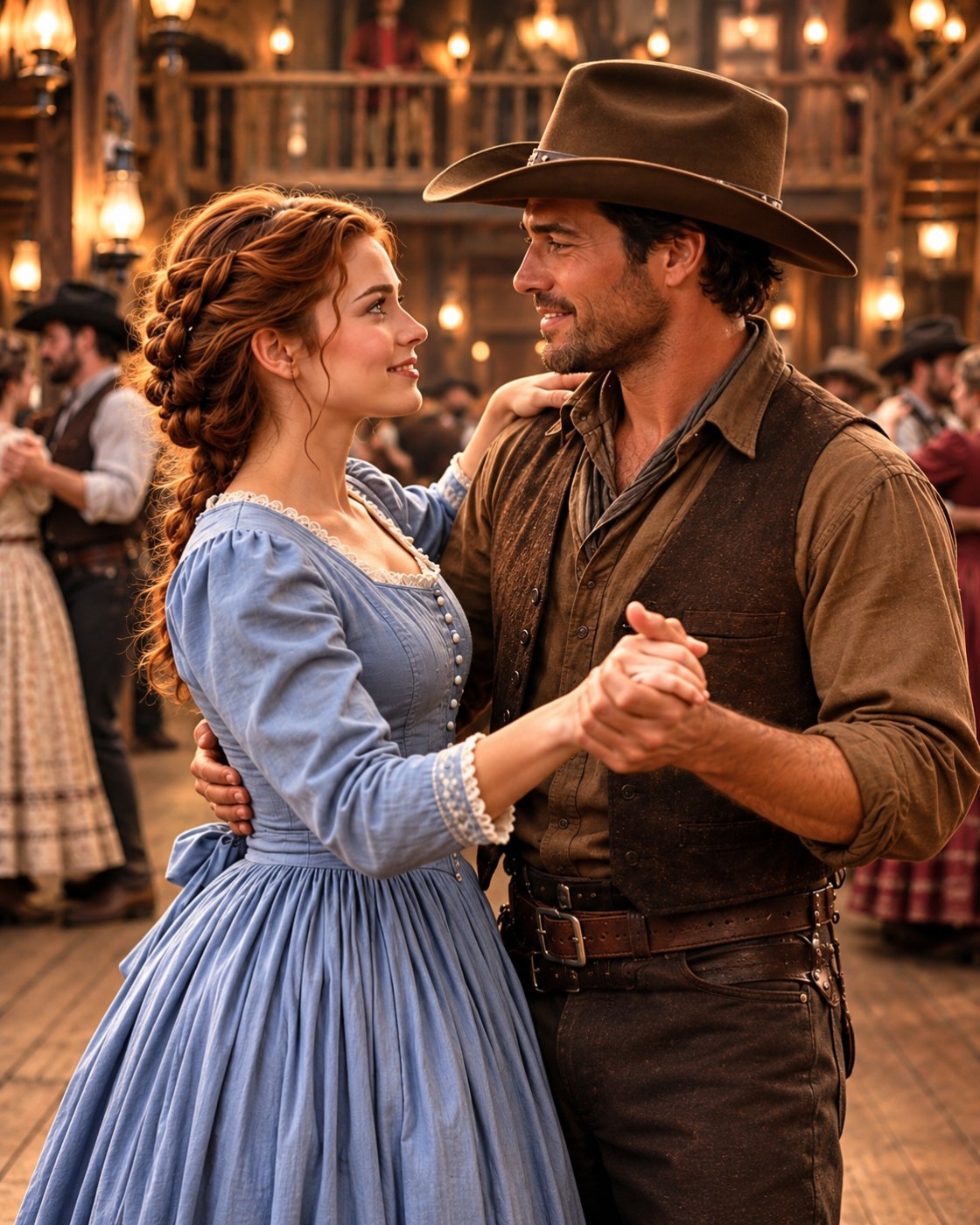
They danced slowly beneath the cottonwoods.
This time, when the dance ended, Adelaide rose onto her toes and kissed him.
There was no audience.
No courthouse.
No bargain.
Only a woman choosing the man who had finally learned to trust her with his whole heart.
Over the following weeks, life changed in ways neither had expected.
The territorial investigation continued, but Pike's influence diminished as his property dealings came under scrutiny. Eventually, the railway authority formally corrected Wesley's record, clearing him of responsibility for the missing shipment.
Adelaide began planning a new business.
She wanted to restore the abandoned signal house and open a freight correspondence office where local ranchers could bring contracts, billing disputes, and commercial records.
Wesley listened to her plans one evening over supper.
“You'll need a new roof,” he said.
“I know.”
“And proper shelves.”
“I know.”
“And a desk.”
Adelaide smiled.
“Wesley, I am perfectly capable of making a list.”
“I know,” he said. “But I'm capable of building a desk.”
For the next several Saturdays, he worked at the signal house.
He repaired the roof, replaced damaged boards, and built shelves along the walls.
Then he made a desk.
It wasn't elegant.
The corners weren't perfectly symmetrical.
But he sanded the surface until it was smooth enough for Adelaide's careful handwriting.
When she discovered what he'd done, she stood in the doorway without speaking.
“It's not quite finished,” he said.
She walked to the desk and placed both hands upon it.
Her eyes filled.
“My father always said a person's work was the truest thing about them.”
Wesley stepped beside her.
“He was right.”
She turned toward him.
“Do you know what you've given me?”
“A desk?”
She laughed through her tears.
“A place where I can build something of my own.”
Wesley brushed a tear from her cheek.
“Then we'd better put your name on the door.”
The sign was painted the following week.
ADELAIDE FENWICK CALLAHAN
FREIGHT CORRESPONDENCE & COMMERCIAL RECORDS
Adelaide stood beneath it for a long time.
She had kept her father's name.
She had chosen her husband's.
And for the first time, both felt entirely hers.
The business opened in October.
Four ranchers became her first clients. By November, she had nine. By Christmas, she was considering hiring an assistant.
One evening, Wesley found her examining the plain wedding band on her finger.
“Something wrong?” he asked.
“No,” she said. “I love this ring.”
He sat beside her.
“But?”
She looked at him.
“Sometimes I wish our marriage hadn't begun with people laughing at us.”
Wesley considered that.
“Then perhaps we ought to give it another beginning.”
She frowned.
“What do you mean?”
He took both her hands.
“Adelaide Fenwick Callahan, will you marry me again? Not because Pike threatened us. Not because either of us needed protection. Because I love you, and I want to spend every ordinary morning of the rest of my life with you.”
She stared at him.
Then she smiled through tears.
“Yes.”
The following Saturday, they returned to Brier Hollow.
But not to the courthouse.
To the little white church at the end of Main Street.
There were flowers this time.
There were friends.
Inspector Bard had traveled from Laramie. The Hartleys and Drummonds filled the front pews. Two ranch hands stood beside Wesley like brothers.
Adelaide wore the same pale blue dress.
Only this time, she walked toward the man she loved without fear.
When Reverend Hail asked Wesley for his vows, he took her hands.
“I promise to stand beside you,” he said. “Not ahead of you, not behind you. Beside you. I promise to tell you the truth even when it's difficult, and to remind you every day that you never had to become someone else to be worthy of love.”
Adelaide's voice trembled as she answered.
“I promise to stop believing that needing someone makes me weak. I promise to let myself be loved. And I promise never to forget that you chose me when I was still learning how to choose happiness for myself.”
When the reverend pronounced them husband and wife, Wesley kissed her.
Then he lifted her hand.
For the third time, he pressed his lips against her knuckles.
The first kiss had silenced cruelty.
The second had defended her dignity.
The third was simply love.
Adelaide smiled.
“Three times,” she whispered.
Wesley grinned.
“And I intend to make it a thousand.”
Years later, on a warm September evening, Adelaide sat on Ravenwood's porch with her head against Wesley's shoulder.
Her freight office had grown beyond anything she'd imagined. She employed two clerks, handled correspondence for ranchers across three counties, and had become one of the most respected businesswomen in the region.
Wesley had never stopped teasing her about correcting his cattle routes.
She had never stopped correcting them.
“Do you ever wish we'd met differently?” she asked.
He thought for a moment.
“I wish you'd never been hurt on those courthouse steps.”
“So do I.”
“But if I could change one thing,” he continued, “I'd walk into your telegraph office years earlier, remove my hat, and ask whether you'd care to have supper with me.”
Adelaide laughed softly.
“I probably would have told you I was busy.”
“I'd have come back the next day.”
“And the next?”
“As many times as it took.”
She smiled and rested her head against his shoulder again.
The crickets sang.
The last sunlight disappeared behind the hills.
And Wesley held the woman a town had once called unwanted, knowing that the greatest gift of his life had been the chance to love someone who had always been worthy of love.
They had forced him to marry her once.
But when he had the freedom to choose, he chose her again.
And he kept choosing her, every morning, for the rest of their lives.
Would you have forgiven Wesley for hiding the truth, or would his secret have broken your trust forever?