PART 3
Cora stopped so suddenly that the packhorse behind her nearly walked into her shoulder.
The moon hung above the Wyoming mountains, turning the snow silver. Ahead, Harlan Rourke was tightening the strap on his saddle when he noticed she was no longer following.
“Something wrong?”
Cora pointed toward his coat.
“That paper.”
Harlan glanced down.
A folded document protruded from his inside pocket, its corner exposed where he'd reached for his gloves.
“What about it?”
“I saw Thomas's name.”
The mountain man's expression changed.
For three days, Cora had watched him face down the richest man in Red Ridge without the slightest hesitation. She had seen him stand against two hired enforcers as calmly as a man waiting for morning coffee.
Now, for the first time, he looked uncertain.
“Cora…”
“Why do you have something with my husband's name on it?”
Harlan slowly withdrew the document.
It was old, creased along the folds, and stained with water.
Across the top were the words Red Ridge Silver Mining Company.
Below them appeared Thomas Harding's signature.
Cora reached for it.
“Where did you get this?”
“From a man who worked the mine before it closed.”
“Who?”
“Elias Voss. He was the timber foreman.”
Cora stared at him.
She remembered Elias. He had attended Thomas's funeral, standing near the back of the church with his hat in his hands.
He had left town the following week.
“Why would he give you this?”
Harlan looked toward the dark timber.
“Because he knew I was coming down to Red Ridge.”
Her throat tightened.
“You knew about Thomas before you sat beside me?”
“Yes.”
The answer struck harder than she expected.
For a moment, the only sound was the restless movement of the horses.
“Was any of it real?” she asked.
Harlan turned toward her.
“What?”
“The dinner. The firewood. The money you spent. Did you do those things because you wanted to help me, or because you were carrying some secret about my husband?”
He stepped closer.
“Everything I did for you was because I wanted to.”
“Then why didn't you tell me?”
“Because I didn't know whether the paper meant anything.”
Cora unfolded it with trembling fingers.
The document was a copy of a mine inspection report, dated eleven days before Thomas died.
She read the first paragraph.
Then the second.
Her breath caught.
The report warned that the supports in the eastern shaft were failing.
It recommended that work stop immediately until the timbering could be replaced.
At the bottom was a notation in Gideon Holt's handwriting.
Repairs deferred pending next shipment.
Cora felt the mountains tilt beneath her.
“Thomas told me the mine was safe.”
Harlan said nothing.
“He said the company had inspected the supports.”
Her voice broke.
“Gideon told me it was an accident.”
“It may still have been an accident,” Harlan answered carefully. “But that report suggests they knew there was danger.”
Cora stared at the paper.
For eight months, she had believed her husband died because a mountain had been cruel.
Now she was looking at evidence that men had ignored a warning.
“Why didn't Elias bring this to me?”
“He was afraid. Holt threatened to ruin him if he spoke. He gave me the copy when I passed through his camp last month.”
“And you kept it?”
“I was trying to find out whether it was genuine.”
Cora looked up.
“Without asking me?”
Harlan lowered his eyes.
“That was wrong.”
She hadn't expected him to admit it so readily.
He continued, “I thought bringing you an accusation I couldn't prove would only cause more pain. But it was your decision to make, not mine.”
Cora folded the paper.
For the first time since meeting him, she stepped away.
“I need a moment.”
Harlan nodded.
He didn't follow her.
Cora walked to the edge of the clearing, where the snow sloped toward the distant lights of Red Ridge.
She could barely see the town through the trees.
Somewhere below stood the bank that had taken her home.
Somewhere nearby lay the grave of the man she had loved for twelve years.
Thomas Harding had been gentle, hardworking, and hopeless with money. He could repair a wagon wheel with almost nothing, but he trusted contracts he barely understood.
She remembered the morning he left for his final shift.
He had kissed her forehead while she stirred oatmeal.
“Don't wait supper for me, sweetheart. They're paying extra for the eastern shaft.”
She had laughed.
“Then perhaps you'll finally buy me those blue curtains.”
He had smiled.
“Blue curtains. I promise.”
He never came home.
Cora pressed the document against her chest.
She had spent months believing that grief was the worst thing a person could endure.
But there was something almost as terrible.
Discovering that someone might have profited from the danger that killed the person you loved.
Behind her, footsteps approached.
Harlan stopped several feet away.
“We don't have to go north tonight.”
Cora turned.
“What?”
“I can take you back to town.”
She stared at him.
“You said Red Ridge would destroy me.”
“I said the town had decided what you were worth. That doesn't mean it gets the last word.”
She looked at the document.
“Can this prove anything?”
“Not by itself. It's a copy. We'd need the original records or someone willing to testify.”
“Elias?”
“He's living near the northern railhead. I know where to find him.”
Cora considered the horses.
Then the dark road beyond the ridge.
“Would you take me to him?”
Harlan's answer came without hesitation.
“Yes.”
“And afterward?”
“Afterward, you decide what happens next.”
She studied his face.
“You'd give up your journey for this?”
He looked almost puzzled.
“Cora, I wasn't asking you to come north because I needed another pair of hands.”
Her heart began beating faster.
“Then why?”
He glanced away, uncomfortable with the words.
“Because the first night I saw you, you were sitting alone in a room full of people who should've been ashamed of themselves.”
He paused.
“And I wanted to know the woman who could sit there with her head held high.”
Cora's eyes filled.
Harlan gently took the document from her shaking hands and tucked it safely inside her satchel.
“We'll ride at first light,” he said. “There's a sheltered camp a mile ahead.”
This time, when he offered his hand to help her mount, she took it.
The journey north took four days.
Harlan knew every sheltered valley, every frozen creek crossing, and every stand of timber where the horses could rest.
Cora discovered that the silent mountain man possessed an unexpectedly gentle patience.
He never hurried her when the trail became difficult.
He taught her how to judge snow depth by the shape of the drifts, how to build a fire in damp weather, and how to keep her feet warm without wasting precious blankets.
At night, they slept beneath separate canvas shelters beside a shared fire.
On the second evening, Cora watched him repairing a broken saddle strap.
“Do you ever get lonely up here?”
Harlan continued working.
“Sometimes.”
“Then why live so far from everyone?”
He pulled the leather through the buckle.
“People are easier to understand when there's fewer of them.”
Cora smiled.
“That sounds like something a man says after being disappointed.”
He looked up.
“Probably is.”
She waited.
After a moment, he set the strap aside.
“I was married once.”
Cora's smile faded.
“I didn't know.”
“Most people don't.”
“What happened?”
Harlan stared into the fire.
“Her name was Ruth. She hated the mountains. I loved them.”
He rubbed his scarred knuckles.
“I thought if I worked hard enough, built a good cabin, and kept food on the table, she'd eventually be happy.”
“Was she?”
“No.”
His voice remained steady, but Cora heard the regret beneath it.
“She left for Denver. Wrote me a letter saying she wanted music, neighbors, and children who could grow up around other children.”
Cora looked at him.
“Did you have children?”
“No.”
He shook his head.
“We wanted them. Never happened.”
The fire cracked softly.
“I was angry for a long time,” Harlan admitted. “Then I realized she hadn't been wrong to want a different life.”
“Did you ever see her again?”
“Once. She was remarried. Had a little boy.”
Cora waited.
“She looked happy,” he said.
“And you?”
Harlan gave a faint smile.
“I went back to the mountains.”
Cora studied him.
“Perhaps you deserved happiness too.”
He looked across the fire.
“Perhaps.”
Neither spoke for a while.
Then Harlan reached for the coffee pot.
“More?”
Cora held out her cup.
“Yes, please.”
Their fingers brushed.
Neither pulled away immediately.
They found Elias Voss in a small settlement near the railhead.
He was older than Cora remembered, with a graying beard and hands permanently bent from years of handling timber.
When she introduced herself, his face crumpled.
“Mrs. Harding.”
“Please,” she said. “Call me Cora.”
Elias invited them inside.
His wife brought coffee while Harlan explained the document.
The old foreman listened without interrupting.
When Cora finished, he stared at his hands.
“I should've told you sooner.”
“Then tell me now.”
Elias swallowed.
“The eastern supports were rotten. I reported them twice. Thomas knew there were problems, but Holt's superintendent told the men the repairs had been approved.”
Cora gripped her cup.
“Did Gideon know?”
“I saw the report delivered to his office.”
“Can you prove it?”
Elias rose and walked to a wooden chest.
He returned with a leather folder.
Inside were copies of his original inspection notes and a receipt acknowledging that the company's office had received them.
“I kept these because I was afraid they'd blame me.”
Harlan examined the papers.
Cora looked at Elias.
“Will you testify?”
The old man closed his eyes.
“My wife and I have little enough. Holt could still make trouble.”
“I know.”
She leaned forward.
“But Thomas is dead. Other men could die if nobody speaks.”
Elias looked toward his wife.
She nodded.
Then he turned back to Cora.
“Yes,” he said quietly. “I'll tell what I know.”
Cora began to cry.
Not because everything had been made right.
It hadn't.
But because, for the first time since Thomas died, someone who knew what happened was willing to stand beside her.
They returned to Red Ridge six days later.
Gideon Holt was furious.
He had expected Cora to disappear into the mountains, leaving behind an abandoned shack and a town that would quickly forget her.
Instead, she walked into the county clerk's office carrying documents and accompanied by two men prepared to give statements.
The clerk examined the papers.
“This warrants review,” he said carefully. “But I can't promise what a court will decide.”
“I understand,” Cora replied.
She did not ask for promises.
She asked that the evidence be recorded.
Within a week, word spread through Red Ridge.
The mine inspection reports became the subject of conversations in the saloon, the mercantile, and the churchyard.
Several miners came forward to describe the condition of the eastern shaft.
One remembered Thomas arguing with the superintendent about the timber supports.
Another recalled being ordered back underground after a warning.
Gideon denied wrongdoing.
He claimed the reports were preliminary and that the collapse had been unforeseeable.
His lawyers challenged the documents and questioned Elias's memory.
The investigation dragged through the remainder of winter.
Cora learned that truth could be slow, expensive, and exhausting.
But she also discovered something unexpected.
She was no longer alone.
The blacksmith offered to repair her stove without charge.
A miner's widow brought her bread.
Miller, the mercantile owner, admitted he had been afraid of Gideon for years.
And when Mrs. Gable approached Cora outside the church one Sunday, her voice was unusually quiet.
“I owe you an apology.”
Cora looked at her.
“For the banquet?”
“For that, and more.”
Mrs. Gable swallowed.
“We treated you shamefully.”
“Yes,” Cora answered. “You did.”
The woman nodded.
Cora did not rush to comfort her.
Some apologies deserved to be heard without immediately erasing the harm that made them necessary.
By early spring, the investigation had produced a settlement.
The mining company did not admit deliberate wrongdoing, but it agreed to compensate several families affected by the collapse, including Cora.
Separately, questions about Gideon's foreclosure practices led to a review of the debts he had claimed against the Harding property.
The process did not restore everything Thomas had lost.
No amount of money could bring him back.
But Cora recovered enough to purchase a modest house and establish a small laundry business of her own.
For the first time in nearly a year, she possessed something Gideon Holt could not take away with a cruel remark.
A future she had chosen.
Yet the victory carried an unexpected ache.
Harlan was preparing to leave.
He had stayed through the investigation, repairing her stove, delivering firewood, and walking beside her whenever she needed company.
But the mountain trails were opening.
His horses were ready.
And Cora knew he belonged to the high country.
One evening, she found him beside the stable, checking the straps on his pack saddle.
“Leaving tomorrow?”
He nodded.
“Before sunrise.”
She folded her arms.
“You might have told me.”
“Was going to.”
“When?”
He looked at her.
“Tonight.”
Cora tried to smile.
“Then I suppose I should thank you.”
“For what?”
“For everything.”
Harlan shook his head.
“You don't owe me thanks.”
“I know.”
She stepped closer.
“That's what makes me want to give them.”
He smiled faintly.
The silence stretched between them.
Finally, Cora asked, “Will you come back?”
Harlan looked toward the mountains.
“I don't know.”
The answer hurt more than she expected.
She nodded.
“Then I wish you a safe journey.”
She turned away.
“Cora.”
She stopped.
Harlan walked toward her.
“I've been trying to figure out what to say.”
She looked up.
“Then say it badly.”
He gave a quiet laugh.
“I'm good at that.”
He took her hands.
“I've spent years believing I was better off alone.”
“And now?”
“Now every time I look at my cabin, I wonder what it would sound like with you laughing inside it.”
Cora's breath caught.
Harlan continued, “I don't want you to leave behind the life you've fought to rebuild. And I won't ask you to live somewhere that makes you unhappy.”
He paused.
“But I love you, Cora Harding. And I needed you to know before I rode away.”
Tears filled her eyes.
“You stubborn mountain man.”
He looked alarmed.
“Was that the wrong thing to say?”
She laughed through her tears.
“No.”
Then she stepped into his arms.
“I love you too.”
Harlan held her carefully, as though she were something precious he had never expected to find.
When he kissed her, it was slow and tender, without the urgency of a man afraid of being refused.
For the first time in years, Cora felt no need to prove she was worthy of being loved.
She simply was.
They did not rush into marriage.
Instead, they spent the summer learning how to share two very different worlds.
Harlan helped Cora establish her laundry business, building sturdy washing benches and repairing a shed behind her new house.
Cora traveled into the mountains with him when the weather was kind.
She learned to recognize the scent of rain before it reached the valley and to distinguish elk tracks from deer.
Harlan learned that a home could contain music, neighbors, and conversation without becoming a prison.
He even attended a church social.
Calmly.
Although he refused to dance until Cora took his hand.
“You're frightening the musicians,” she whispered.
“I'm frightened of the musicians.”
She laughed.
“Then we're even.”
They danced badly.
Neither cared.
By autumn, Harlan had made his decision.
He would keep his mountain cabin for trapping season, but they would make their home together on a small property between Red Ridge and the foothills.
Close enough to town for Cora's business.
Close enough to the wilderness for Harlan to breathe.
It was not a sacrifice demanded by either.
It was a life they built together.
Their wedding took place in October, almost a year after the night of the founders' banquet.
Cora wore a deep blue dress, with her hair pinned neatly beneath a small hat decorated with autumn leaves.
Harlan wore a clean dark coat.
His beard had been trimmed.
His boots, however, remained stubbornly mountain-worn.
The ceremony was held in a little clearing beneath the pines.
Elias Voss attended with his wife.
Miller brought a basket of food.
Several miners and their families came.
Even Mrs. Gable appeared, standing quietly near the back.
When the minister asked Harlan whether he would love and honor Cora, the mountain man answered so firmly that everyone heard him.
“I will.”
Cora smiled.
And when she promised to love him in return, her voice did not tremble.
Afterward, they shared a meal beneath the trees.
There were no fine white linens.
No assigned seats.
No banker deciding who belonged near the fire.
Only wooden tables, warm food, and people who had come because they wanted to celebrate.
At one point, Cora noticed an empty chair beside the cooking fire.
She turned to Harlan.
“Do you remember what I told you the night we met?”
He smiled.
“They seat me by the kitchen.”
“And what did you say?”
Harlan reached for his plate.
“Then I'll bring my plate to you.”
Cora laughed.
He pulled out the empty chair.
“Still room for me?”
She took his hand.
“Always.”
Years later, people in Red Ridge would remember the story differently.
Some spoke of the mining investigation.
Others remembered the banker who lost his influence.
A few recalled the winter night when a mountain man walked into a banquet and refused the finest seat in the room.
But Cora remembered something simpler.
She remembered being cold.
She remembered being hungry.
She remembered sitting alone while people who had once called themselves her friends pretended not to see her.
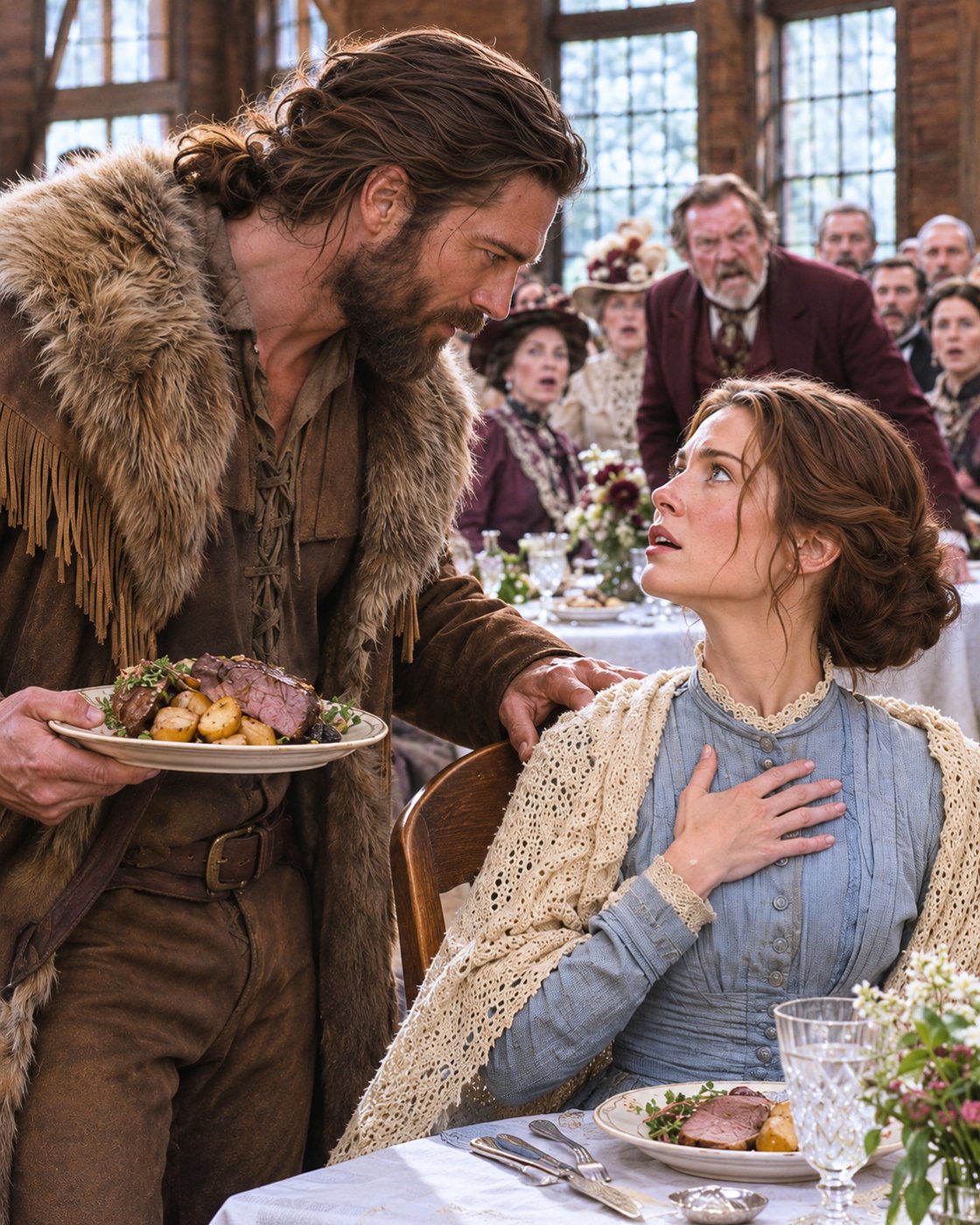
And she remembered the sound of heavy boots crossing the wooden floor.
A man had approached her table.
Not to rescue her.
Not to purchase her gratitude.
Not to tell her how she ought to live.
He had simply asked whether the chair was taken.
In the years that followed, Harlan and Cora endured difficult winters, failed harvests, illness, and the ordinary disagreements of two strong-willed people learning to share a life.
Sometimes they argued.
Sometimes they needed silence.
But neither ever used love as a debt the other was required to repay.
And whenever the mountain wind rattled their windows, Harlan made certain the woodbox was full.
One snowy evening, Cora found him sitting beside the stove, repairing a leather strap.
She brought him coffee and settled into the chair opposite.
“Comfortable?” she asked.
He looked up.
“Very.”
“Not too crowded down here in the valley?”
He glanced around their warm little home.
At the shelves of books.
At the curtains Cora had sewn.
At the woman sitting across from him.
“Wouldn't change a thing.”
She smiled.
Then Harlan reached across the table and took her hand.
Outside, snow covered the mountains.
Inside, the fire burned steadily.
And Cora Harding Rourke understood that dignity had never depended on where the town chose to seat her.
It had always belonged to her.
The mountain man had simply been the first person in a long time to pull up a chair and treat her as though everyone else should have known it too.