PART 3
In case you missed it: forty-five years after Gideon Marsh left Josephine Whitcomb at the altar, he stepped off a train in Winslow and back into her life. Her brother Henry, now a respected territorial judge, went white at the sight of him and warned her that Gideon was wanted in Missouri for murder. And on the hotel porch, Gideon told her a man had died the night before their wedding, but that he would sooner hang than say who killed him.
Jo took her hand out of his.
She did it slowly, the way you take your hand off a stove you’ve only just realized is hot. Gideon let her go. He didn’t try to hold on.
“You’d sooner hang,” she repeated.
“Yes.”
“Than tell me.”
“Yes, Josie.”
“Don’t call me that.” But there was no heat in it now. She stood up and smoothed her skirt with both hands, because her hands needed something to do. “I won’t sit here and listen to riddles from a man who couldn’t even send a letter in forty-five years.”
Something moved across his face then. She saw it even in the moonlight, a flinch, quick and deep, as though she’d struck an old bruise.
“Good night, Mrs. Whitcomb,” he said quietly.
She went inside. She climbed the stairs to the second floor and walked down the hall past her brother’s door. Light still showed under it. She could hear him moving on the other side, the creak of the floorboards, back and forth, back and forth, like a man in a cell.
She raised her hand to knock. She held it there in the air for a long moment.
Then she lowered it, went on to her own room, and shut the door.
She didn’t sleep.
She lay in the dark in the big walnut bed she’d shared with Tom for eighteen years, before the fever took him, and she let herself do the thing she had refused to do for almost half a century. She let herself remember.
The church in Lexington, Missouri, on the fourteenth of June, 1857. Hot. The smell of lilies and candle wax and three hundred people in their Sunday wool. Her mother’s dress, taken in at the waist, the lace yellowed at the edges. Her father beside her at the back of the church, checking his watch. Checking it again.
Eleven o’clock. Half past. Noon.
The whispers starting at the back pews and rolling forward like a grass fire.
She remembered standing at the front of the church because the minister had told her to wait there, that the groom was surely only delayed, and she remembered how long she stood there. Over an hour. Until her father came up the aisle with a face like stone and took her by the elbow and walked her out past every one of those three hundred faces.
She had not cried. That was the day she learned how not to.
But now, lying in the dark in Arizona, she made herself remember other things. Things she had pushed aside at eighteen because the shame had been so loud it drowned out everything else.
Henry.
Henry had been at the church that morning. Of course he had. He was her big brother, twenty-five years old, studying law with old Judge Pemberton. But he had come late, and he had stood at the very back, and he had been gray in the face, gray as ashes. His right hand had been wrapped in a bandage.
“Cut it on a fence,” he’d said, when Mama asked.
She remembered that he never touched liquor again after that day. Mama had called it a miracle. Henry, who had been the wild one, who had come home from the river taverns smelling of whiskey half the nights of the week, had simply stopped.
She remembered that within a month, Papa had sold the farm at a loss and moved them all to Kansas, as though something were chasing him. She remembered that for weeks after the wedding, Papa had burned the newspaper every morning before she could read it. “There’s nothing in it you need to see, Josie,” he’d said, and she had thought he was protecting her from the gossip about the jilted Whitcomb girl.
She remembered that Henry had never once, in forty-five years, spoken Gideon’s name. Not in anger. Not at all. Every other person who loved her had cursed Gideon Marsh at one time or another. Henry never had.
Jo sat up in bed in the dark with her heart pounding.
No, she told herself. No.
She lay back down. She did not sleep until the eastbound freight came through at five, shaking the windows, and even then she only dozed.
By morning she had decided she was a foolish old woman inventing stories in the dark. Henry was a judge. Henry was a deacon of the Methodist church in Prescott. Henry had lent her eight hundred dollars, after Tom died, so she could buy this hotel and keep her independence. Henry was the best man she knew.
She went down to breakfast with her back as straight as it had ever been. Henry did not come down. Gideon had eaten before dawn and gone out.
At three o’clock that afternoon, she poured a cup of tea, put a slice of orange on the saucer without quite knowing why, and carried it out to the barn.
She told herself she was going to thank him for the door. That was all. A woman paid her debts, even to a man like Gideon Marsh.
She heard the voices before she reached the barn door, and she stopped where she stood, in the shade of the big cottonwood, with the teacup in her hand.
“You’ll be on that train tomorrow,” Henry was saying. His voice was low and shaking. “The six-fifteen. Do you hear me? You’ll get on it and you’ll go to California and you’ll never set foot in this territory again.”
“I’ve got a hearing tomorrow morning, Henry.” Gideon’s voice was calm. Tired. “In your court. You may have noticed.”
“I’ll rule against you. I’ll give your water to the land company, and you’ll have nothing to stay for.”
“Maybe you will.”
“And if that isn’t enough,” Henry said, and his voice cracked in the middle of the sentence, “I’ll wire the sheriff of Lafayette County, Missouri, that Gideon Marsh is alive and living on Clear Creek in Arizona Territory. The warrant never expired, Gideon. Murder doesn’t expire. They’ll take you back in irons.”
There was a long silence in the barn.
Jo stood motionless under the cottonwood. The tea in the cup had begun to tremble.
“You’d do that?” Gideon said at last. “After what I did for you?”
“I have a name. A career. I have a granddaughter in Prescott who thinks I hung the moon.” Henry was almost sobbing now. “Forty-five years, Gideon. Forty-five years I’ve built a life. You can’t come walking back into it now.”
“I didn’t come back for you, Henry. I didn’t even know you were here.”
“Nobody would believe you anyway. You understand that? A territorial judge against a fugitive stage driver. Who do you think they’d believe?”
“I know who they’d believe.” Gideon’s voice was very quiet now. “They’ve believed you for forty-five years. I never asked them not to.”
“Then go.”
“I’ll go,” Gideon said. “I’ll get on your train. I’ll go wherever you like. But you listen to me, Henry Whitcomb. You leave her out of it. You’ve let her think for forty-five years that she wasn’t worth showing up for. You let her stand at the front of that church. I did it so she wouldn’t be the sister of a man they hanged in the square at Lexington, and you let her carry it alone her whole life.” He drew a breath that Jo could hear from where she stood. “Whatever else you do, you don’t ever tell her. You hear me? It’d break her worse than I ever did.”
The teacup slipped out of Jo’s hand.
It struck the hard-packed dirt and shattered, and the orange slice rolled away into the dust.
Inside the barn, both men went silent.
Jo didn’t wait for them to come out. She turned and walked back to the hotel. She did not run. She had never run from anything in her life. She walked through the kitchen past the startled cook, and up the back stairs, and into her own room, and she shut the door behind her and stood with her back against it and her hands flat against the wood.
It was Henry. It had always been Henry.
Gideon found her an hour later.
She had not answered Henry’s knock. She had heard her brother outside the door, saying her name over and over, “Jo, please, Jo, let me explain,” until his voice broke, and then she had heard him go away down the hall. She had not answered the cook, or the maid.
But when the soft knock came, three times, the way someone had knocked on her father’s kitchen door when she was seventeen, she opened it.
Gideon stood in the hall with his hat in his hands.
“I’m sorry,” he said. “I’m sorry you had to hear it that way.”
“Come in,” Jo said. “Shut the door. And tell me. All of it. Every word, Gideon. You owe me that much.”
He came in and shut the door. She sat down in the chair by the window. He didn’t sit. He stood by the dresser, turning his hat, and looked at the floor, and then he began.
“The night before the wedding, Henry was at Pruett’s tavern down by the river landing. You remember Pruett’s.”
“I remember.”
“I went to fetch him home. Your mother asked me to. She said, ‘Gideon, he’ll listen to you, he always does,’ and she was worried, because he had to stand up with us in the morning.” He shook his head slowly. “When I got there, he was in the back room at a card table with a river gambler named Silas Rourke. Henry was drunk. Drunker than I’d ever seen him. And Rourke was cheating him. Everybody in the room could see it but Henry.”
Jo closed her eyes.
“Henry caught him at it. He stood up and called him a cheat, and Rourke laughed in his face and reached for something in his coat. Might have been a gun. Might have been his billfold. I never knew, and neither did Henry. Henry had his hunting knife on his belt. He just... he had it out before I could get across the room.” Gideon’s voice was very quiet. “Rourke was dead before he hit the floor.”
The clock on the dresser ticked. Outside, a switch engine whistled in the yard.
“The barkeep had gone for the sheriff. There was nobody else in the back room but the three of us. I got Henry out the back door and down to the river. He was covered in blood. His hand was cut where the knife had slipped. He was on his knees in the mud, and he was crying, Josie. Crying like a little boy. He kept saying, ‘Papa will die of it. Mama will die of it. And Josie. Josie’s getting married tomorrow. They’ll hang me in the square, and she’ll be the sister of a hanged man the rest of her life. Nobody will ever look at her again without thinking of it.’”
Jo pressed her gloved hand over her mouth.
“He was right,” Gideon said simply. “I knew he was right. I’d lived in that county my whole life. I knew what folks were like. If Henry hanged, your father’s name was finished, and you with it. You’d have married me, and every time anybody looked at us they’d have whispered, ‘That’s the Whitcomb girl. Her brother was hanged for murder.’ Every child we had would’ve heard it in the schoolyard.”
“So you took it.”
“The barkeep had seen a tall young man go into the back room. Henry and I were the same height then. Same coloring, near enough, in that light.” He shrugged. “I told Henry to go home, wash, and burn his shirt. I took the knife. I threw it in the river. And I rode west that same night, so they’d chase me instead of looking at anyone else.”
“Gideon.” Her voice came out a whisper. “We were going to be married in the morning.”
“I know.”
“You could have taken me with you.”
“To where? To live on the run with a man wanted for murder? Changing names in every town? Sleeping in barns?” He looked up at her for the first time. His eyes were wet. “You were eighteen, Josie. You had a family, a home, a good name. I couldn’t give you anything but a life of looking over your shoulder. And if they ever caught me with you, they’d have hanged me and called you my accomplice.” He swallowed. “Jilted was better. People forget a jilting. They don’t forget a hanging.”
“I never forgot it,” Jo said. “Not for one single day.”
“I know. I’m sorry.”
“Why didn’t you write? Once. One word. In forty-five years, Gideon, you couldn’t send one word to tell me it wasn’t my fault?”
He was quiet for a long moment.
“I did write,” he said. “Once. From Fort Kearny, the spring after. I couldn’t send it to you directly. Your father would’ve burned it, and if the sheriff saw a letter from me with a postmark on it, they’d have known where to look. So I sent it to the only person who knew the truth. I sent it to Henry, and asked him to give it to you when it was safe.”
Jo went completely still.
“He never gave it to you,” Gideon said. It wasn’t a question.
“No.”
“I thought not. When I never heard back, I figured you’d read it and decided I wasn’t worth answering. I couldn’t blame you.” He turned the hat in his hands. “I didn’t write again. I didn’t think I had the right.”
Jo stood up. She walked to the window and looked down at the tracks shining in the late sun, the long silver lines running east toward Missouri and everything she had left behind there.
“Forty-five years,” she said. “I married a good man at thirty because I was tired of being the girl nobody wanted. I loved him, Gideon. I did. But I never once told him I took my tea with orange. Did you know that? I stopped taking it that way after you left. Not in front of anyone. I’d only do it alone, in the kitchen, late at night, when nobody could see.” Her voice cracked for the first time. “I’ve been ashamed of a slice of orange for forty-five years.”
“Josie.”
“And all that time,” she went on, very low, “Henry sat at my table at Christmas. He held my babies at their christenings. He stood beside me at Tom’s grave and held my arm. He lent me the money for this hotel. And he knew. Every single day of it, he knew.”
She turned from the window. Her eyes were dry. Her face was terrible.
“What are you going to do?” Gideon asked quietly.
“I don’t know yet,” Jo said. “Go away now. Please. I need to think.”
He went.
That night, Jo sat alone in the hotel office until after midnight, with one lamp burning and a ledger open in front of her that she did not read.
She thought about Henry at nine years old, carrying her on his shoulders through the apple orchard so she could pick the highest fruit. Henry teaching her to ride bareback on the old plow horse, running alongside with his hand on her back. Henry at twenty, wild and laughing, sneaking her a sip of cider from the barrel. Henry at Tom’s funeral, gray-haired and steady, his arm under her elbow.
She thought about Henry’s granddaughter Clara in Prescott, sixteen years old, who wrote Aunt Jo a letter every month and wanted to be a schoolteacher.
She thought about what would happen if she told the truth. Henry would lose everything. His seat on the bench. His name. Possibly his freedom, even at seventy. They could still try him for it. Murder did not expire. Clara would grow up as the granddaughter of a judge who had let another man take the blame for a killing. The whispers would follow her the way they would have followed Jo.
That was the choice Gideon had made for her at twenty-one. He had decided that the whispers were too heavy for a girl to carry. And he had carried them himself instead, for forty-five years.
And what would happen if she said nothing?
Gideon would get on the six-fifteen tomorrow. Or Henry would rule against him and take his water, and he would lose the only home he’d had since he was twenty-one. Or Henry, in his fear, would send that wire to Missouri, and an old man who had done nothing but love her would be taken back to Lexington in irons to answer for a crime that wasn’t his. And Henry would go on sitting on the bench, passing judgment on other men.
Jo put her head down on the ledger.
She had spent forty-five years being the woman who never cried. She had built herself up board by board, like this hotel, so nobody could ever again look at her and see the girl standing alone at the front of that church. She’d been so proud of that. So proud of never needing anyone, never trusting anyone, never letting anyone close enough to leave.
And all of it, every board, had been built on Henry’s lie.
Sometime after one o’clock, she heard a soft step in the hall. The office door opened a few inches. Gideon stood there in his shirtsleeves, his silver hair rumpled.
“Saw the light,” he said. “Couldn’t sleep either.”
“Come in.”
He came in and sat down in the chair across the desk from her. For a while neither of them spoke.
“Don’t do it, Josie,” he said finally.
“Do what?”
“Whatever you’re thinking of doing. To Henry.” He leaned forward with his elbows on his knees. “I’ve carried this for forty-five years. I’m used to the weight. I can carry it a few more. I’ll get on that train in the morning, and you’ll keep your brother, and that’ll be the end of it.”
“You’d do that. Again.”
“I’d do it a hundred times.” His gray eyes met hers. “I didn’t take the blame for Henry, Josie. I never gave a damn about Henry. I took it for you. That hasn’t changed. It’s never going to change. Don’t you throw away your only family on my account. I’m not worth it.”
Jo looked at him across the lamplight. At the stoop of his shoulders and the lines in his face and the hands, scarred and knotted from forty years of reins and ropes and weather, that had fixed her barn door without being asked.
“Yes, you are,” she said. “You’re worth it. You always were. That’s the whole trouble, Gideon. You decided a long time ago what I could stand and what I couldn’t. You decided it for me, at a riverbank in the middle of the night, without asking me once.” Her voice was steady now. “You don’t get to decide it for me again.”
He opened his mouth and closed it.
“Go to bed,” Jo said gently. “The hearing’s at ten. You’ll want to be rested.”
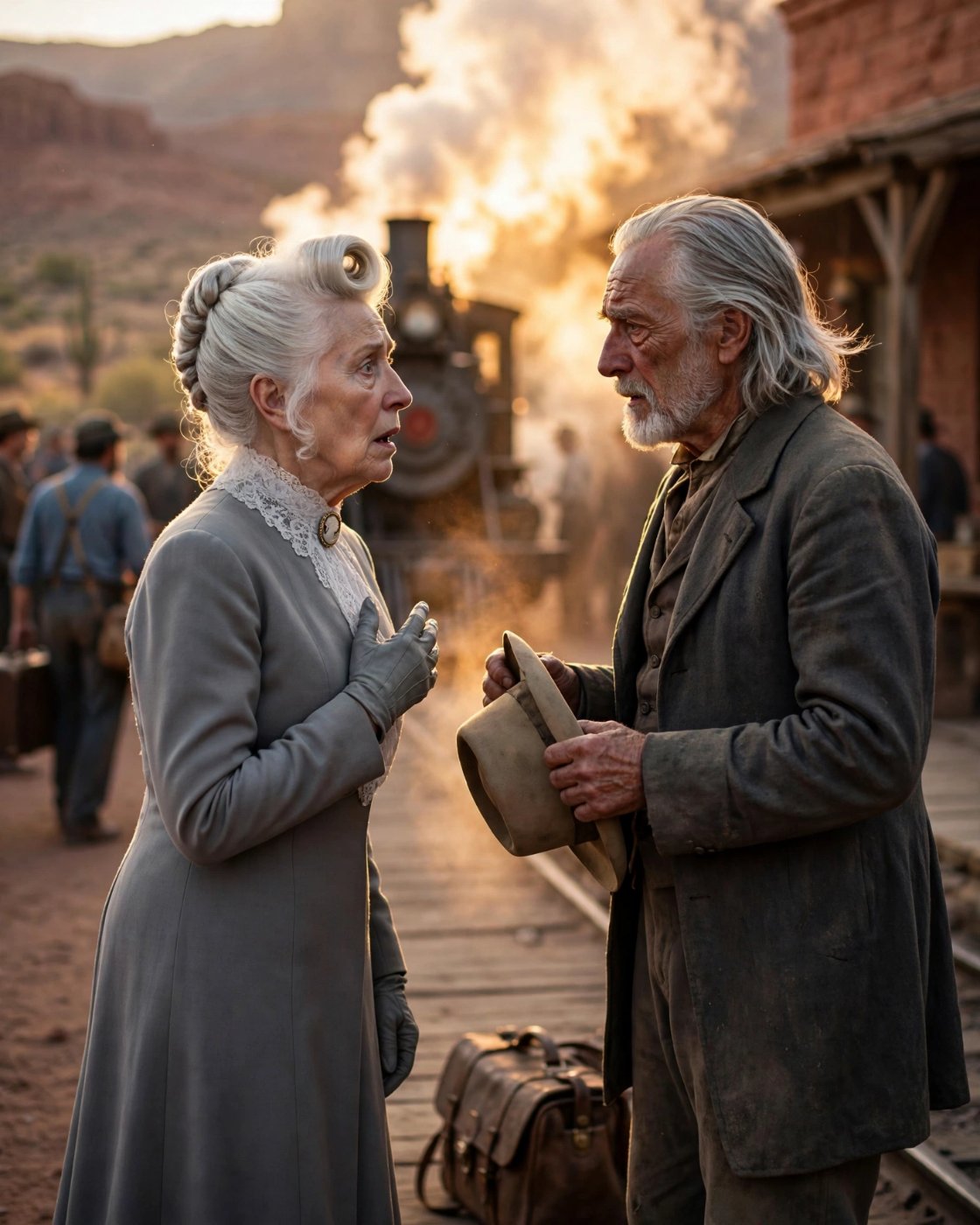
At seven o’clock the next morning, Josephine Whitcomb put on her good gray dress, the one with the jet buttons she wore to church. She pinned up her white hair. She went down to the private dining room at the back of the hotel, the small one with the window onto the cottonwoods, where she served railroad officials and visiting senators.
She set the table herself. Three places. Three cups. A pot of tea. A small dish of orange slices.
Then she sent the maid up with two notes.
Henry came down first. He was dressed for court in his black frock coat, his white beard neatly trimmed, and from a distance he looked exactly like what he was, the most respected judge in the Territory. Up close, his eyes were red and swollen, and his hands shook.
He stopped in the doorway when he saw the table set for three.
“Jo—”
“Sit down, Henry.”
“Jo, please. If you’d just let me—”
“Sit down.”
He sat.
Gideon came in a minute later, in his only good coat, with his hat in his hand. He looked at Henry. Henry looked at the tablecloth.
“Sit down, Gideon,” Jo said. “Across from him.”
Gideon sat.
Jo poured three cups of tea. She took a slice of orange and laid it on her own saucer, deliberately, where both men could see it. Then she sat down at the head of the table with her hands folded in front of her.
“I heard you both in the barn yesterday,” she said. “Every word. And last night Gideon told me the rest. About Silas Rourke. About the river. About the knife.” She looked at her brother. “And about the letter from Fort Kearny.”
Henry made a small sound, like a man who has been struck.
“So I know, Henry. I know all of it. But I want to hear it from you. Not from Gideon. Not from a barn door. From you. Sitting at my table. Looking at me.” Her voice did not rise. “You’ve had forty-five years to tell me. You can take five minutes now.”
Henry Whitcomb looked at his sister. Then he looked across the table at Gideon Marsh. And all at once the judge was gone, the black coat and the white beard and the dignity of the bench, and there was only an old man, shaking, at a breakfast table.
“I killed him,” Henry said.
He said it so quietly it was barely a whisper. Then he said it again, louder, as though it were a stone he had to push out of his chest.
“I killed Silas Rourke. In the back room of Pruett’s tavern, on the night of the thirteenth of June, 1857. With my own knife. I was drunk, and I was angry, and I didn’t even know if he was reaching for a gun.” He was crying now, openly, tears running down into his beard. “And Gideon took it on himself. Because I begged him to. I got down in the mud on my knees and I begged him. I said it’d kill Papa. I said it’d ruin you. And he looked at me for a long time, and then he said, ‘All right, Henry. For Josie.’ And he rode away.”
He wiped his face with a shaking hand.
“I told myself I’d tell the truth when Papa died. Then I told myself I’d tell when I passed the bar. Then when I was married. Then when I was appointed to the bench. Every year it got harder, Jo. Every year there was more to lose. And after a while I almost... I almost started to believe it. That it was Gideon. That he’d done it, and run off, and that was why he left you.” He bowed his head. “God forgive me. Some years I believed it.”
“And the letter?” Jo asked.
Henry shut his eyes.
“It came in the spring of ‘58. To me, care of Judge Pemberton’s office. Addressed to you inside. I read it.” His voice dropped to almost nothing. “He said he loved you. He said it wasn’t your fault, never, not for one moment. He said he’d come back for you if he ever could. And he said he could never tell you why he’d gone, because it wasn’t his secret to tell.”
“What did you do with it, Henry?”
“I burned it.” He was sobbing. “In the stove in Pemberton’s office. Because if you’d read it, you’d have asked questions. And if you’d asked questions, sooner or later you’d have found the answer. And the answer was me.”
The room was very quiet. Outside, a mockingbird sang in the cottonwoods.
Across the table, Gideon had gone very still. He was staring at his own scarred hands on the white tablecloth.
“He said he’d come back for me,” Jo said slowly.
“Yes.”
“And I never knew.”
“No.”
Jo stood up. She walked to the window and stood with her back to both men, looking out at the cottonwoods, and her shoulders were as straight as they had ever been.
Then they began to shake.
It started very small, a tremor at the back of her neck. Then it moved down her spine and into her hands, and she reached out and gripped the windowsill, and a sound came out of her that neither man at that table had ever heard. A sound she had kept locked inside since she was eighteen years old, standing at the front of a church in Lexington, Missouri, in her mother’s yellowed lace.
Josephine Whitcomb, who had never once been seen to cry, put her face in her gloved hands and wept.
Gideon was out of his chair before he knew he’d moved. He crossed the room in three steps, and stopped just behind her, his hands raised and not touching her, as if he didn’t think he had the right.
She turned around and put her forehead against his chest.
He closed his arms around her, carefully, the way you’d hold something you’d dropped once and were terrified of dropping again. Over her bowed white head, his eyes met Henry’s across the room.
Henry was sitting at the table with his face in his hands.
It was a long time before anyone spoke. When Jo finally lifted her head, her face was wet and blotched and she didn’t care. She stepped back from Gideon, wiped her eyes with the back of her glove, and turned to her brother.
“Henry.”
He looked up.
“You’ll write it down,” Jo said. “Everything you just said. Sign it. Date it. Today. Before the hearing.”
“Jo—”
“You’ll recuse yourself from Gideon’s case. And then you’ll do whatever an honest judge would do with a sworn confession to murder, if it came across his bench from some other man.”
“They’ll take my seat,” Henry whispered. “They may put me on trial. At my age. Clara...”
“Clara will survive it.” Jo’s voice was gentler now, but no less steady. “She’s a Whitcomb. We survive things. I survived standing alone in front of three hundred people when I was eighteen. She’ll survive knowing her grandfather is a man who finally told the truth.” She looked at him for a long moment. “That’s better than what she has now, Henry. Now she has a grandfather who’s lying.”
Henry stared at her. Then, slowly, he nodded.
“Bring me paper,” he said hoarsely. “And a pen.”
Jo brought him hotel stationery from the office, and a pen and ink. She set them on the white tablecloth in front of him, beside his untouched cup of tea. Then she sat down again at the head of the table, and Gideon sat across from Henry, and the two of them waited while the judge wrote out his confession in a slow, shaking hand.
It took him nearly an hour. Four pages. When he was done, he signed it, Henry Asa Whitcomb, Associate Justice, Territory of Arizona, and dated it. Then he sat back and looked at it for a long time.
“I’ll wire Prescott this morning,” he said. “And the governor. And the prosecuting attorney in Lafayette County. I’ll ask them to withdraw the warrant against Gideon Marsh, and I’ll go back to Missouri on the eastbound train and present myself to the court in Lexington.” He looked up at Gideon. “It’s forty-five years too late. I know that. But it’s what I have.”
Gideon didn’t answer for a long moment.
“You were a scared boy, Henry,” he said finally. “On your knees in the mud. I remember. I was scared too.” He shook his head slowly. “The night I can’t forgive is the night you burned that letter. You weren’t a scared boy then. You were a grown man, and you knew exactly what you were doing to her.”
“I know,” Henry whispered. “I know it.”
“But I’ll tell you something.” Gideon turned his hat around once in his hands. “I’ve spent forty-five years hating you, Henry Whitcomb. Every mile of every stage road between Prescott and Fort Apache. It never did me one bit of good. I don’t intend to spend whatever years I’ve got left doing the same.” He stood up. “I’ll see you at the hearing.”
The hearing did not happen that morning.
At ten o’clock, in the Winslow schoolhouse that served as a courtroom when the circuit came through, Judge Henry Whitcomb took his seat on the bench before a room full of lawyers, land company men, and curious townsfolk. He announced, in a voice that carried to the back wall, that he was recusing himself from the matter of Marsh against the Painted Desert Land Company, and that a new judge would be sent from Prescott within the week.
Then he took off his spectacles, folded them, laid them on the bench, and said that he had a further announcement to make. And he told them.
Not everything. Not the letter. That, he said afterward, was between him and his sister and God. But all the rest. Silas Rourke. The knife. Pruett’s tavern. The young man who had taken the blame and the warrant and forty-five years of exile so that a family could keep its good name.
He named Gideon Marsh, who was sitting in the third row with his hat in his lap.
The schoolroom was so silent that Jo, sitting beside Gideon, could hear the clock on the wall.
When Henry was finished, he stood up, took off his black robe, folded it, and laid it on the bench beside his spectacles. Then he walked down the center aisle and out the door into the bright October morning, and nobody tried to stop him.
That night he took the eastbound train for Missouri.
Jo went to see him off. She hadn’t decided until the last moment whether she would. But at six o’clock she found herself on the platform in her gray dress, with her shawl around her shoulders, watching the porter load her brother’s trunk into the baggage car.
Henry stood by the step of the Pullman, looking old and small without his robe.
“You didn’t have to come,” he said.
“I know.”
“I don’t expect you to forgive me, Jo.”
“I don’t know if I can, Henry. Not yet.” She looked at him for a long time. “But you’re my brother. You carried me through the orchard on your shoulders. You held my babies. That was real too. I’m not going to pretend it wasn’t, just because the rest was a lie.”
His face crumpled.
She reached out and took his hand. His right hand, the one with the old white scar across the palm from the night the knife had slipped. She held it, the way he had held her arm at Tom’s grave.
“Go tell the truth, Henry,” she said. “Then write to me. And this time, I’ll read every word.”
The conductor called. Henry climbed aboard. Jo stood on the platform and watched the train pull out, east, toward Missouri, until it was nothing but a smudge of smoke against the purple evening sky.
When she turned around, Gideon was standing at the end of the platform, waiting. He hadn’t come close. He’d just waited, in case she needed him.
The California train came through the next evening at six-fifteen, right on schedule.
Gideon Marsh was not on it.
He stayed on at the Whitcomb House in the back room by the kitchen, although nobody had asked him to and nobody asked him to leave. He fixed the squeaking hinge on the pantry door, and the loose board on the back step, and the leaking pipe under the laundry tub. He drove out to Clear Creek every morning to see to his stock and came back every evening in time for supper, which he now ate in the dining room, at the small corner table by the window.
On the fourth evening, Jo came and sat down across from him with her own plate.
On the fifth, she brought two cups of tea. Both with orange.
On the sixth, the new judge came up from Prescott, heard the matter of Marsh against the Painted Desert Land Company in the Winslow schoolhouse, and ruled in fifteen minutes that Gideon Marsh held clear and lawful title to his water. The land company men went back to Holbrook on the next train.
And on the seventh day, a telegram came for Gideon from the prosecuting attorney of Lafayette County, Missouri.
WARRANT IN MATTER OF STATE VS GIDEON MARSH 1857 WITHDRAWN AND VACATED THIS DATE. WITH THE COURT’S APOLOGIES.
Gideon read it standing in the hotel lobby. Then he handed it to Jo without a word, and went out the front door, and walked down to the depot platform, and stood there for a long time looking east along the tracks.
She gave him an hour. Then she put on her shawl and went to find him.
It was the same platform, the same hour of the evening, almost exactly a week since he’d stepped off the train with his hat in his hand. The sun was going down red over the San Francisco Peaks, and the long shadows of the water tower and the telegraph poles stretched across the tracks.
He heard her step on the boards and turned around.
“Forty-five years,” he said. His voice wasn’t quite steady. “I’ve been a wanted man since I was twenty-one, Josie. I’ve never once in all that time walked into a town without checking the post office wall for my own face. And now...” He held up the telegram. “Now I don’t know what to do with myself.”
“I suppose you’ll have to learn.”
“I suppose I will.” He folded the telegram carefully and put it in his breast pocket. Then he took off his hat.
She knew what he was going to say before he said it. She saw it in his face. Forty-five years she had dreamed of this moment, and in every dream she had turned her back on him and walked away, so he would know how it felt.
She didn’t move.
“I’m forty-five years late,” Gideon said. “Is the offer still open?”
The wind came up off the desert and tugged at her shawl. Somewhere down the line, a freight whistle blew, long and lonely.
Jo stepped forward. She reached up and straightened his collar, which had been crooked all day, and she noticed with some surprise that her hand was trembling. She left it there a moment, on the worn cloth over his heart.
“This time, Mr. Marsh,” she said, “you walk down that aisle first. I’m not waiting at the front ever again.”
Gideon Marsh laughed. It burst out of him, startled and young, a sound she had not heard since a summer evening on her father’s porch in 1857, and it went through her like sunlight. He put his arms around her right there on the platform, in front of the station agent and two porters and the whole of Winslow, Arizona Territory, and she let him.
“I’ll be there first,” he said into her white hair. “I’ll be there so early the preacher’ll think I’m the janitor. I’ll be standing at the front of that church before the sun comes up.”
“See that you are,” said Josephine Whitcomb, and for the second time in a week, she wept in public. She found she didn’t mind at all.
They were married on the first Saturday in November, in the little Methodist church on Kinsley Avenue.
There were not three hundred people. There were about forty: the cook and the maids from the Whitcomb House, the station agent, a few old friends of Tom’s, and a handful of grizzled stage drivers who had ridden in from as far as Holbrook and Payson to see Gideon Marsh, who had never stayed anywhere longer than a season, finally stand still.
Henry’s granddaughter Clara came up from Prescott on the train and sat in the front pew in a blue dress, holding a letter from her grandfather in Missouri. He had stood before the court in Lexington and pleaded guilty to manslaughter. The judge, who had been a boy of six in 1857, heard the testimony of the last living witness from Pruett’s tavern, an old man who swore that Silas Rourke had carried a derringer in his coat that night. Given the defendant’s age and his voluntary confession, the court suspended the sentence. Henry would live out his days in a rented room in Lexington, not far from the old church. He had written to Jo every week since he left. She had read every word.
At the bottom of the letter Clara carried, Henry had written: Tell him I’m sorry. Tell her I love her. Tell them both I’ll be thinking of them at eleven o’clock.
Eleven o’clock was the hour the wedding was set to begin.
Gideon was at the church by half past seven. The minister found him sitting alone in the front pew in the gray light, his hat on his knee, waiting.
“You’re very early, Mr. Marsh,” the minister said.
“I’ve been late enough for one lifetime,” said Gideon.
At eleven o’clock exactly, the doors at the back of the church opened, and Josephine Whitcomb stood there in a dress of dove-gray silk, with a spray of orange blossoms in her white hair.
She looked down the aisle. And there, at the front of the church, where she had once stood alone for over an hour while three hundred people whispered behind her back, was Gideon Marsh. Standing straight, or as straight as sixty-six years and forty years of stage roads would let him. Waiting for her. His gray eyes fixed on her face as if nothing else in the world existed.
Josephine took a breath. Then she walked down the aisle toward him, slow and steady and unafraid, and every step of it felt like setting down something heavy she had been carrying since she was eighteen years old.
When she reached the front, he took her hand. His was shaking. So was hers.
“You came,” she whispered.
“I was always going to,” said Gideon. “It just took me a while to get here.”
That evening, after the wedding supper, after the stage drivers had gone singing off to the saloon and the cook had cried into the dishwater and Clara had gone up to bed, the two of them sat on the front porch of the Whitcomb House in the cool November dark.
Down by the depot, the westbound train came through, its lamps glowing, and slowed, and stopped. A few passengers stepped off onto the platform. A few more got on. Then the whistle blew, and it pulled away again, west toward California, and the platform was empty.
Neither of them got up. Neither of them so much as turned their heads.
On the little table between their two rocking chairs sat a teapot and two cups. In each saucer lay a single slice of orange, bright as a coin in the lamplight. Gideon reached over without looking and took his wife’s hand, the bare hand now, no glove, and Jo laced her fingers through his and held on.
Forty-five years late, Josephine Whitcomb took her tea the way she liked it, out in the open, where anyone in the world could see.
Jo had to choose between protecting the brother who raised her and freeing the man who gave up everything for her. If you were in her place, could you have forgiven Henry, after he burned that letter? Tell me what you think in the comments.