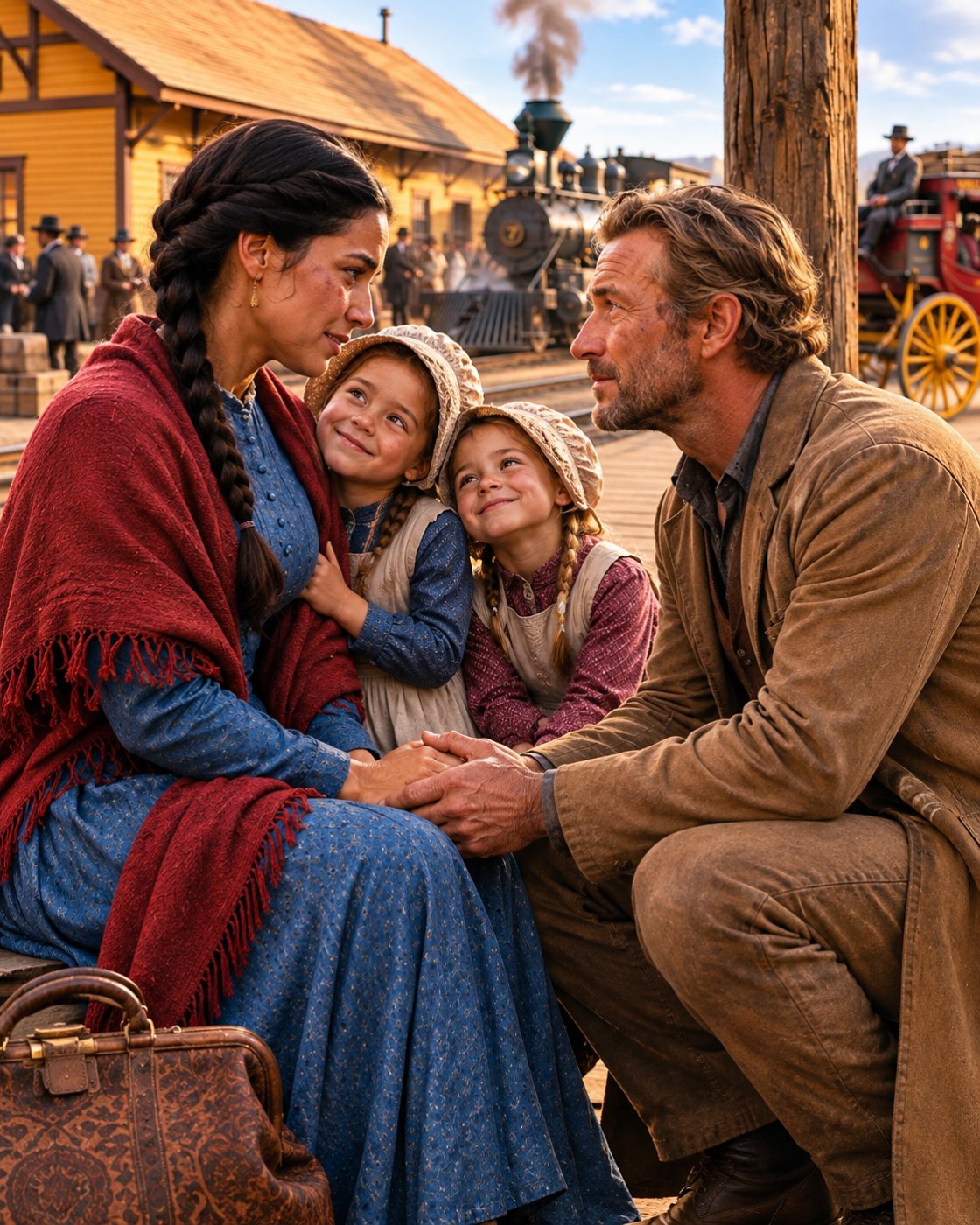
PART 3
In case you missed it: Abigail Hale traveled six hundred miles to marry a rancher named Garrett Shaw, who rejected her in front of a crowded train platform because of the smallpox scars on her face.
Widower Caleb Turner, raising six-year-old twins Emma and Lily alone, offered her a home and work and slept in his own barn to protect her name.
Over the winter, Abigail brought his silent cabin back to life and nursed little Lily through a dangerous fever.
Then Garrett Shaw drove into the yard and asked her to come back with him.
Abigail stood on the porch with a dish towel in her hands and didn't say anything at all.
She had imagined this moment more than once, lying awake in the narrow bed in the little back room of Caleb's cabin, in those first weeks when the humiliation still burned.
She had imagined Garrett Shaw coming back.
In her imagination, she always had something sharp and clever to say.
Something that would make him feel exactly as small as he had made her feel on that platform.
Now he was really here, standing in the yard in his fine wool coat with his hat in his hands, and she found she didn't want to say anything sharp at all.
She only felt tired.
"I said come back with me, Abigail," said Garrett.
Behind her, the swing on the big cottonwood had stopped creaking.
Emma and Lily had gone very quiet.
Abigail could feel them watching from across the yard.
"Girls," she said, without turning around.
"Go inside, please.
Wash up for dinner".
"But Mama Abigail.
.
".
It was Emma.
She had begun calling her that since Lily's fever.
Mama Abigail.
Not quite Mama.
Not yet.
Close enough to make Abigail's heart ache every time.
"Inside, Emma.
Take your sister".
The screen door creaked and banged shut.
Abigail heard small feet run across the kitchen floor, then stop.
They would be at the window.
They always were.
Garrett stepped closer to the porch.
"I've thought about it a great deal these past months," he said.
"I behaved badly at the depot.
I know that.
I was.
.
.
surprised.
I'd pictured someone different.
I let that get the better of me".
He turned his hat in his hands.
"But I've been hearing things in town.
About you.
How you keep this place.
How you nursed the Turner girl when the doctor said she wouldn't last the night.
Mrs. Pruett at the mercantile says there isn't a woman in this valley who could have done what you did".
Abigail said nothing.
"I've got six hundred acres on the North Fork," Garrett went on.
"A frame house with glass windows in every room.
A hired girl to do the washing.
You'd never have to scrub a floor again.
I'll buy you dresses from Denver.
Silk ones".
He glanced at the cabin, at the patched roof and the woodpile, and his mouth tightened.
"You'd have a bigger ranch, nicer clothes, an easier life.
Better than this.
Better than being hired help in another man's kitchen".
"I'm not hired help," said Abigail quietly.
"Aren't you? He pays you wages.
You keep his house and raise his children and he sleeps out in his barn".
Garrett's voice hardened, just a little.
"You know what people in Silver Creek are saying about that, Abigail?"
She did know.
She had heard it whispered behind hands at the mercantile and outside the church.
A young woman alone in a widower's house.
What kind of arrangement is that? Nobody had said it to her face.
They didn't need to.
"I know what people say," said Abigail.
"People said a great many things at the depot too".
Garrett flushed.
"I'm offering to make it right," he said.
"To marry you, proper.
Today, if you want.
The preacher's in town".
Abigail looked at him for a long moment.
She looked at his good coat and his fine boots and his handsome, impatient face.
She thought about six hundred acres and glass windows and silk dresses from Denver.
She thought about never scrubbing a floor again.
Then she thought about the platform.
About the way he had looked at her cheeks.
About the laughter.
And she thought about the moment, three weeks ago, when Lily had opened her eyes after four days of fever and whispered, "May we call you Mama? Someday?"
Abigail smiled.
It was a gentle smile, and it surprised her as much as it surprised him.
"Mr. Shaw," she said.
"The day I stepped off that train, you only saw my face.
You wrote me for five months, and I told you the truth about myself in every letter.
And when you finally saw me, you looked at these scars and decided you'd been cheated".
She shook her head slowly.
"Caleb Turner looked at me for one minute, across a train platform, and he saw my heart".
"Abigail.
.
".
"I'm not angry with you anymore," she said.
"I was, for a long time.
But I'm not now.
I suppose I ought to thank you, really.
If you hadn't left me standing there, I'd never have found this".
She looked around her.
At the garden, just beginning to come up green in the March sun.
At the swing on the cottonwood.
At the two small faces pressed against the kitchen window.
"No, thank you, Mr. Shaw.
I won't be coming with you".
Garrett stared at her.
For a moment, she thought he would argue.
Then something passed over his face.
She saw him look at the window, at the two little girls, and then back at her.
And she saw him understand, finally, what he had thrown away on the platform at Silver Creek.
He lowered his head.
"I'm sorry," he said.
And this time, she thought he meant it.
"For what I said at the depot.
You didn't deserve it".
"No," said Abigail.
"I didn't.
But I forgive you".
He put his hat back on and climbed into his wagon.
He drove out of the yard slowly, without looking back, the way he had driven away from the depot six months before.
Only this time, he was the one leaving something behind.
Abigail stood on the porch and watched him go.
Then she heard boots on the gravel behind her, and she turned.
Caleb was standing at the corner of the barn.
He had a coil of rope over one shoulder and a look on his face she couldn't read.
She didn't know how long he had been standing there.
Long enough, she thought.
He came slowly across the yard and stopped at the foot of the porch steps.
"That was Shaw," he said.
"Yes".
"He came for you".
"He did".
Caleb looked down at the rope in his hands.
He was quiet for so long that Abigail began to worry.
"I heard some of it," he said finally.
"Not all.
I didn't mean to listen".
He swallowed.
"He's right about one thing, Abigail.
He's got more than I do.
A lot more.
Glass windows.
A hired girl.
You'd have an easier life".
"I didn't want an easier life".
"I know.
I heard".
He still didn't look up.
"But I need you to know something.
I never wanted you to feel obligated to stay here.
Not because of anything I did at the depot.
Not because of the girls.
Not because you've got nowhere else to go".
His voice roughened.
"If you ever want to go, you go.
I'll drive you to the depot myself and buy your ticket anywhere in the country, and I won't say one word against it".
Abigail came down the porch steps until she was standing on the bottom one, eye to eye with him.
She took the coil of rope out of his hands and set it on the step.
Then she took his hand.
His rough, scarred, careful hand.
"Caleb," she said.
"I didn't stay because I felt obligated.
I stayed because this is the first place in my whole life where I've been loved for who I truly am.
Not for what my face looks like.
Not for how much work I can do.
Just for me".
Caleb looked up at her then.
Before he could say anything, the screen door banged open behind them and Emma and Lily came flying out across the porch.
They hurled themselves at Abigail from behind, both of them at once, and wrapped their thin arms around her waist so hard she nearly toppled down the step into Caleb.
"You didn't go!" Emma cried.
"You didn't go with that man!"
"We saw him!" said Lily.
"We saw him from the window! We thought you'd go!"
"I'm not going anywhere," Abigail said, laughing and crying at the same time, trying to hug both girls at once.
And then Lily, the shy one, who hardly ever spoke above a whisper, pressed her face against Abigail's apron and said, loud and clear, for the first time:
"Mama".
Abigail went completely still.
Then Emma said it too.
"Mama".
Caleb's eyes filled with tears.
He didn't try to hide them.
He stepped forward and put his arms around all three of them, his daughters and the woman holding them, and held on.
They stood there in the March sunshine, the four of them, for a long time.
But the valley wasn't finished talking.
Garrett Shaw didn't spread the rumors.
In fairness to him, Abigail heard later, he told anyone who asked that he'd been a fool at the depot and that Miss Hale was a better woman than he deserved.
But the rumors didn't need Garrett.
They had been growing quietly all winter, the way rumors do in a small town with long evenings and not much else to talk about.
A young woman alone in a widower's house.
On the first Sunday in April, Caleb drove Abigail and the girls to church in Silver Creek, as he had every Sunday since she came.
When they walked up the aisle to their usual pew, two women in the row in front of it got up, without a word, and moved to the other side of the church.
Abigail felt her face go hot.
She kept her eyes on her hymnbook and her back very straight.
She had been stared at her whole life.
She knew how to sit still and pretend not to notice.
Lily noticed.
"Mama," she whispered, tugging Abigail's sleeve.
"Why did those ladies move?"
"Hush, sweetheart.
Sing".
After the service, on the church steps, Mrs. Pruett from the mercantile stopped beside Caleb with a tight little smile.
"Mr. Turner.
A word.
Some of us have been concerned.
About the arrangement at your place.
With the girls being so young, and impressionable.
It isn't quite.
.
".
She glanced at Abigail.
"Fitting.
I'm sure you understand".
Caleb looked at her for a long moment.
"No, ma'am," he said.
"I don't believe I do".
He took Abigail's arm and the girls' hands and walked them to the wagon.
He didn't say anything the whole drive home.
His jaw was tight, and his hands were tight on the reins.
That night, after the twins were asleep, Abigail found him sitting on the porch steps in the dark.
She sat down beside him.
She didn't say anything.
She'd learned that about him.
Caleb needed silence before he could find his words.
"I'm sorry about today," he said at last.
"It wasn't your fault".
"It was my fault".
He stared out at the dark pasture.
"I brought you here and I gave you a place to stay and I told myself that was enough.
I told myself I was protecting your name, sleeping in the barn.
But I wasn't thinking about what it would be like for you.
Sitting in that church with people moving away from you".
He shook his head.
"You had enough of that at the depot.
You shouldn't have to have it every Sunday".
"I've had it my whole life, Caleb," said Abigail quietly.
"Ever since I was eleven".
He turned to look at her.
She had never told him.
Not all of it.
She looked down at her hands in her lap.
"My mother and father died in the smallpox when I was eleven.
I had it too.
I lived.
They didn't.
My aunt in Missouri took me in.
She had a boarding house in Hannibal, and she needed a girl to scrub the floors and empty the slop pails and do the washing, and I was cheaper than a hired one".
She smiled a little.
"She never once let me forget what I looked like.
When guests came, she'd send me to the kitchen so they wouldn't have to see my face.
She said it would put them off their supper".
Caleb said nothing.
But his hand had found hers on the step between them.
"When I was fifteen, the smallpox came through Hannibal again.
Half the town took sick.
Nobody would nurse them.
Everybody was afraid.
Except me.
I'd already had it, so I couldn't catch it again.
So I went from house to house for two months, nursing strangers.
Children, mostly".
She swallowed.
"Some of them lived because of me.
Some of them didn't.
Afterward, the mothers of the ones who lived would cross the street when they saw me coming.
Not because they were ungrateful.
Because I reminded them".
"Abigail".
"I stayed with my aunt until I was twenty-four.
Then I saw Garrett Shaw's advertisement in the Hannibal paper.
A rancher in Colorado seeking an honest, hardworking wife.
I thought, here's someone who doesn't need pretty.
He needs honest.
I can give him honest".
She laughed softly.
"So I wrote him the truth.
Every word.
I told him about my face.
I told him in the very first letter, so he'd never feel cheated.
He wrote back that he didn't care about looks.
That he only cared about character".
She shook her head.
"I believed him.
I believed him so much that I spent the last of my wages on a train ticket and came six hundred miles".
"And he left you on the platform".