Three weeks after Japan’s surrendered, in a stone-walled prison in Tokyo, an American investigator asked Admiral Soemu Toyoda a simple question. “Why did Japan lose the war?” Toyoda did not say the atomic bomb. He did not say the Marines on the beaches.
He did not say the aircraft carriers. He said one sentence that no Japanese admiral had ever said aloud before. “You repaired your ships faster than we could damage them.” The investigator wrote it down. He did not fully understand what he had just been told.
Almost no one in America did, then or now. But that one sentence describes the greatest untold story of the war in the Pacific. A story that began 4 years earlier in a place you have seen a thousand times in old newsreels, a harbor called Pearl.
A morning in December and an old repair ship that everyone forgot. Her name was USS Vestal. Captain Commander Cassin Young was in his cabin aboard her that morning. 47 years old, 25 years in the Navy. The captain of a ship built in 1908, older than most of his crew, a floating
workshop of iron and steel that everyone in Pearl Harbor called the tugboat with a machine shop. Vestal was not a warship. She carried a few guns for show. Her real weapons were lathes, welders, foundries, and the 1,400 hands that made her run.
She was moored 23 m from the USS Arizona. At 8:00 in the morning, the first bombs fell. Young heard the drone before he understood it. Then the whistle. Then the world stopped making sense. He looked out the porthole and saw a Japanese torpedo plane skim across the water, so close he could see
the pilot’s face. And then at 8:06, the Arizona exploded. 23 m, that is nothing. That is the length of a swimming pool. When a battleship’s forward magazines detonate, releasing the force of a million pounds of explosives in a single instant, 23 m is not a distance.
It is a suggestion. The shockwave lifted the Vestal out of the water and slammed her back down. Debris rained across her decks. Burning fuel oil coated her waterline. Sailors were thrown overboard by the concussion, some of them into a harbor that was already on fire.
Behind her, the Arizona was gone, not sinking, gone. 1,217 men were dying in a fire that would burn for 2 and 1/2 days. Cassidy Young was on the bridge. He was covered in oil and glass. His crew was already at their stations, wounded, some dying, but at their stations.
Two bombs had punched through Vestal’s decks. She was listing. She was burning. She was taking on water in three compartments. And her captain, dripping fuel oil, walked onto the bridge and gave three orders in a voice that did not shake.
“Cut the mooring lines. Get us clear of the Arizona. Beach the ship before she sinks.” Vestal moved, slow, wounded, on fire, but she moved. Her crew ran her aground on a shoal before her hole filled. She would not sink that day. She would not sink any day.
Cassidy Young would receive the Medal of Honor for what he did in those minutes. He would also die 11 months later in a different ship, in a different battle, in a chain of events set in motion by that morning. But he did not know this yet. He knew only that his ship was alive, his men were alive, and the world had just
changed. That was the twist no one saw, not the American admirals watching Pearl Harbor burn, not the Japanese pilots flying home to celebrate. Not the newspapers that would call this the greatest naval catastrophe in American history. The oldest, ugliest, most forgotten ship in the harbor had
just survived. And in 3 years, she would help end the war. Christmas Day, 1941, a Navy PB2Y flying boat had landed at Pearl Harbor carrying a 56-year-old admiral in a rumpled uniform. His name was Chester William Nimitz. He was from Fredericksburg, Texas. He spoke fluent German. He was quiet by nature,
patient with his men, and known for chess, not fire. President Roosevelt had just given him command of what remained of the United States Pacific Fleet. He waited 6 days. On New Year’s Eve, he took command. The harbor still stank of burned oil. Divers were pulling bodies from the water.
Arizona’s tomb sat in the mud, her superstructure a black tangle above the waterline. Oklahoma had rolled over. West Virginia and California were on the bottom. Nevada was beached. Nimitz took the oath of command on the deck of a submarine, the USS Grayling tied up at the sub base.
There was no other ship dignified enough that was not damaged. He looked around. He said very little. His staff waited for the words that would define his era. He said them the next morning to a group of officers who expected a speech about revenge. The Japanese, Nimitz told them, had made three mistakes.
They had attacked on a Sunday when most of the crews were ashore, not aboard. They had bombed ships, but not the fuel farm. 4 and 1/2 million barrels of oil sat in tanks that a single incendiary round could have destroyed. Without that oil, the the American fleet would have retreated to California and stayed there
for a year. And they had not touched the machine shops. The machine shops, the dry docks, the repair basins, the cranes, the submarine base. The power plant. Every piece of infrastructure that made Pearl Harbor a base, rather than a puddle. The Japanese had come to sink ships and had ignored the tools that built ships.
Nimitz understood something the Japanese did not. The war would not be won by battleships, it would be won by whoever could put damaged ships back into the fight faster. He walked out to look at the Vestal. She was beached, black with fire, holed, listing, and her captain was already directing repairs on his own ship.
Nimitz stood on the shore and watched Cassin Young for a long time. He did not speak. He turned and walked back to his headquarters. That night, he wrote a single order. Every repair ship in the Pacific Fleet was to be placed under a new priority.
Every damaged vessel was to be assessed not for salvage, but for rebuilding. The Vestal was to be refloated, refitted, and returned to service. The old ships would fight the new war. 6,000 km to the west, in a stateroom aboard the flagship Nagato, a man in a rumpled kimono sat reading the after-action reports from Pearl Harbor.
His name was Isoroku Yamamoto, 57 years old, commander-in-chief of the Combined Fleet, the architect of the attack that had just crippled the American battle line. His staff brought him a glass of sake to celebrate. He did not drink it. Yamamoto had been to America.
He had been sent to Harvard from 1919 to 1921 as a language officer, studying English and America itself. He had served as naval attaché in Washington from 1926 to 1928. He had driven across the United from the East Coast to Texas, from Detroit to Los Angeles. He had seen the automobile
plants. He had seen the steel mills. He had seen the oil fields of the Southwest, endless as an ocean. He had told his junior officers again and again in the years before the war, “You do not understand America. You have not seen it. You think of it as a country. It is not a country. It is a continent of factories.”
They had listened, and they had ignored him. Now, on the day of his greatest victory, he read the reports and calculated the time he had bought. Six months, perhaps a year. That was the window before American industry recovered its balance and began to turn its full weight against Japan.
Yamamoto had told the prime minister exactly this, “Months before the attack, I can run wild for 6 months. After that, I have no confidence.” 6 months was not enough. He wrote in his journal that night a sentence that his biographers would later find.
“I fear we have awakened a sleeping giant and filled him with a terrible resolve.” He was wrong, not about the giant, about the sleep. The giant had not been asleep. The giant had been preparing quietly for years for exactly this war.
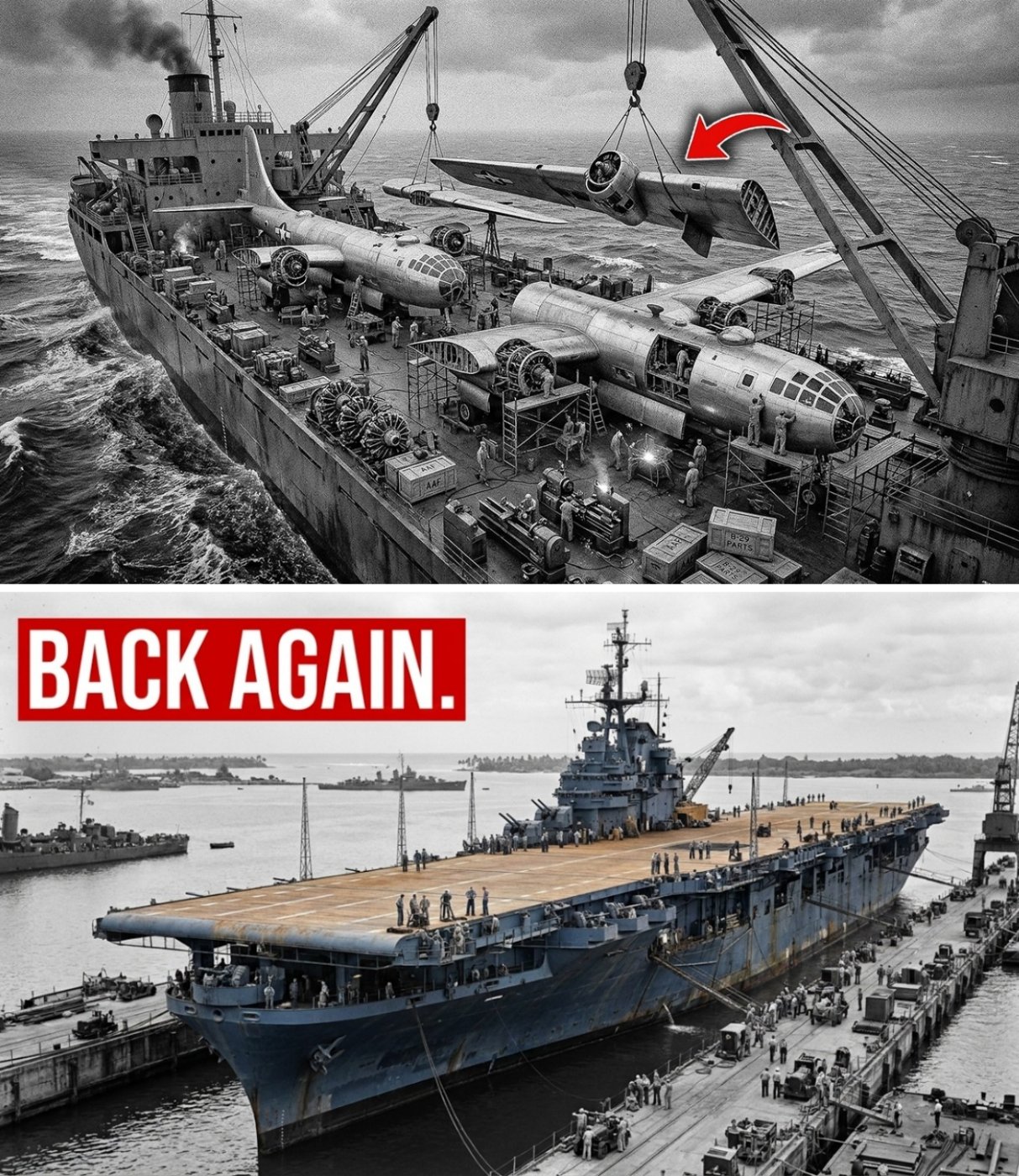
And the preparations had nothing to do with battleships. In 1938, 3 years before Pearl Harbor, the United States Navy Bureau of Ships had begun drawing up plans for a new kind of vessel. Not a warship, not a supply ship, something no navy in history had ever built, a floating machine shop. The idea
came from a hard question. If the next war was fought across the Pacific, ships would be damaged thousands of miles from the American coast. Sending them home to Mare Island or Puget Sound would take weeks each way. A damaged carrier could be out of the war for 4 to 6 months.
In that time, the enemy could win. Unless Unless you brought the shipyard to the ship. The Bureau of Ships specified something without precedent. A vessel 16,000 tons in displacement, 625 ft long, filled not with cargo but with machine tools.
Lathes long enough to turn a propeller shaft, presses heavy enough to forge anchor chains, foundries that could pour molten steel at sea. Electrical shops that could rewind the massive motors of an aircraft carrier’s elevator, and crewed not by sailors but by 1,400 craftsmen.
Machinists from Detroit, welders from Pittsburgh, metallurgists from Bethlehem Steel, electrical engineers from Westinghouse, foundry workers from Buffalo, men who had spent their lives making things put into uniform and sent to sea.
The first ship of this new class was laid down at New York Shipbuilding Corporation in Camden, New Jersey in December 1939. She was launched in December 1940. She was commissioned on June 16th in 1941 and her name was USS Vulcan. She was the god of the forge.
In the same month that Vulcan was being built, the Japanese Naval General Staff in Tokyo was running its own calculations. They were led by Admiral Osami Nagano, the chief of the Naval General Staff, and by a younger officer named Minoru Genda, the 37-year-old commander who had designed the tactical plan for the Pearl
Harbor attack. Genda was brilliant. Genda was thorough. Genda had studied every American naval facility with the patience of a chess player. His intelligence files described them in detail. Mare Island Naval Shipyard in California, two carrier slips, full overhaul capability. Puget Sound in
Washington, three carrier slips, best facility on the West Coast. Pearl Harbor, emergency repair only, four carriers maximum. Genda calculated the American repair capacity down to the day. If Japanese carriers and submarines could damage six American carriers in the first year of war, the repair
bottleneck would paralyze American naval aviation for months. Ships would have to steam 3,000 miles back to the West Coast, be repaired for 4 to 6 months, then steam 3,000 miles back. Total 8 to 10 months out of the war per carrier per repair. The math was elegant. The math was correct.
The math assumed one thing, that the Americans would repair their ships where the shipyards were. Genda could not imagine an alternative. No one could. In 3,000 years of naval history, ships had always come home to be repaired. Rome repaired her galleys at Ostia.
Britain repaired her fleet at Portsmouth. Japan repaired her carriers at Kure. The idea of building a shipyard, putting it on a hull, and sailing it across an ocean to the war was not a bad idea. It was a category of thought that did not exist in any naval academy on Earth.
Yamamoto knew about American industry. He had seen it. He had warned about it, but he had not seen the Bureau of Ships blueprints. He had not seen the Vulcan under construction. He had not read the memos passing between Admiral Harold Stark and the Chief of the Bureau of Ships in early 1941 discussing the need for what they
called an industrial base. He knew America had shipyards. He assumed America would use them the way every navy in history had used them. He could not calculate what he did not know existed, and this was the deepest twist of the war that had just begun.
Not that America was strong, Yamamoto knew that. Not that America’s was rich, Yamamoto knew that. But that America had spent the years before Pearl Harbor asking a question no other naval power had thought to ask. What if the shipyard could move? What if a wounded carrier did not have to come home? What if home came to her?
By early February 1942, two ships were at sea that would decide the war in the Pacific. The first was the USS Yorktown, a fleet carrier of nearly 20,000 tons standard displacement steaming south through the Coral Sea toward a Japanese fleet that had never been beaten.
She carried more than 70 aircraft. She carried 2,000 men. She carried the hopes of a wounded nation. The second was the USS Vestal, refloated from I Ain Sho, patched, welded, her fires long cold. She was steaming toward the New Hebrides, where she would spend the next year quietly rebuilding whatever the
Japanese damaged. Her crew was tired. Her hull was scarred. Her captain, Cassin Young, was gone to a new command, a heavy cruiser called the San Francisco. Neither ship knew about the other. Neither crew imagined that their fates would meet twice in the year to come.
First, in a repair anchorage at Nouméa, where Vestal would save a carrier that Cassin Young was fighting alongside. And then in a battle off Guadalcanal, where the man who had saved Vestal would die inside a ship she had helped keep alive.
The two ships were sailing toward the same story. And in Tokyo, Yamamoto was still doing his arithmetic, still counting American carriers and American repair times, still calculating a war he was already losing without knowing it. The war of the machine shops had begun.
He would not live to understand who had won it, May 8th, 1942. The Coral Sea, USS Yorktown was fighting a battle no aircraft carrier had ever fought before. There were no ships in sight. The enemy was over the horizon. The battle was between two flights of aircraft launched from decks that would
never see each other, and the men flying them were dying at a rate that would have made Nelson weep. At 11:27 in the morning, a Japanese 550-lb bomb punched through Yorktown’s flight deck. It did not detonate on impact.
It fell through the flight deck, through the hangar deck, through the third deck, and in a compartment four levels down, it exploded. 40 men died in that instant. 26 more would die from the wounds and the smoke before the day ended.
The rest kept fighting. Yorktown launched her aircraft. Yorktown recovered her aircraft. Yorktown steamed at 24 knots through smoke and fire, and turned the Japanese fleet back at the edge of Australia. When the battle ended, the Japanese carrier Shokaku was drifting north with three bombs in her belly.
The Japanese carrier Zuikaku was steaming home with an air group cut to pieces. And Yorktown was steaming toward Pearl Harbor, wounded, listing, trailing oil. The Navy engineers came aboard on May 27th. They walked the compartments with clipboards and flashlights.
They measured, they calculated, they looked at each other with the expressions of men about to deliver bad news. They told Admiral Nimitz she would take 3 months to repair. 3 months meant she would miss the next battle, and Nimitz [music] knew there was a next battle. American code breakers at Station Hypo in a basement
in Pearl Harbor had cracked the Japanese naval code. They knew the Japanese fleet was steaming toward a small atoll called Midway. They knew the attack would come in the first week of June. 3 months was not acceptable. Nimitz walked down to drydock number one. He put on rubber boots. He climbed into the
dock. He walked under the belly of the Yorktown looking up at the twisted steel where the bomb had gone through. He came back up. He looked at the yard superintendent, a civilian engineer named Wallin. He said one thing, “You have 3 days.”
3 days, 72 hours, to repair damage that any peacetime naval yard would have called a total loss. 1,400 workers descended on the Yorktown. They worked in shifts around the clock, welders and ship fitters and pipe men, the arc lamps burning day and night.
Steel was cut, hauled, welded into place. Compartments were not fully rebuilt, they were made functional. The kind of repair no shipyard would sign off on in peacetime. The kind of repair that happens only when a nation is losing a war. On the morning of May 30, Yorktown steamed out of Pearl Harbor.
She had been in the yard for 3 days. She sailed to Midway. 4 days later, on June 4th, 1942, Yorktown launched her Dauntless dive bombers against the Japanese carrier Soryu. The bombs went in. Soryu burned, then Hiryu. The Imperial Japanese Navy lost four aircraft carriers in a single afternoon.
It was the day the empire began to die. Yorktown was hit again during the battle. She was hit a third time. Late that day, she was abandoned. Two days later, on June 7, she rolled over and sank in 3,000 fathoms. She had been given 3 months to live. She had been given 72 hours instead. She had
used them to help kill four Japanese carriers. But there was another number, and it mattered more than the 72 hours. There was another ship on the other side of the Pacific in a yard called Kure. Her name was Shokaku. She had come back from the Coral Sea with three bombs in her belly. She was moored in the same
waters where Japan had built the battleship Yamato. The best repair yard in the empire, thousands of skilled workers, every material she needed. She sat there from mid-May until early July. Nearly 2 months, not 72 hours, not 3 days, 2 months. And her sister carrier Zuikaku, who had come out of the Coral
Sea untouched, could not sail either. She had lost too many pilots. There were no replacements ready. Japan could not produce trained air crew fast enough. So, when the Combined Fleet steamed toward Midway, it steamed with four aircraft carriers instead of six.
Two ships were missing, not because they had been sunk, because Japan could not repair one and could not man the other. This was the arithmetic of the war. This was what Yamamoto had feared, not battles, not tactics, time. The clock that had ticked at different speeds in Pearl Harbor and Kure.
The Americans had bought 72 hours with 1,400 workers. The Japanese had paid 2 months with the finest shipyard in the empire. The difference was Midway. 6,000 km to the south in a lonely anchorage in the New Hebrides, the USS Vestal sat at her mooring like a patient waiting for the
wounded. She was 34 years old now. She had been rebuilt after Pearl Harbor. Her fires were cold. Her machine shops were running 12 hours a day. Her new commanding officer was a career naval engineer, a quiet man who trusted his craftsmen and stayed out of their way.
The craftsmen were doing something the Japanese did not believe was possible. They were rebuilding warships in an open harbor in a war zone with no dry dock, no conch or gantry cranes, no permanent supply of steel. They were building what they needed on board. Their lathes turned propeller shafts. Their foundries poured bearings.
Their electrical shops rewound the enormous motors that drove aircraft carrier elevators. They were, in effect, a small city of makers floating in a lagoon waiting for the war to bring them work. The work came on October 27th, 1942. USS Enterprise limped into the anchorage.
She had been in the Battle of the Santa Cruz Islands. She had been hit by two bombs and a near miss. Her forward elevator was jammed. Her forward hangar deck was warped. Her flight deck was cratered. If she had gone home to Pearl Harbor, she would have been out of the war for 4 months, maybe 6.
And she was the last operational American carrier in the Pacific. There were no others. The Japanese knew this. Their pilots reported Enterprise as damaged, probably sunk. Tokyo issued official announcements that the American carrier fleet had been eliminated. Vestal’s men looked at Enterprise for 1 hour.
They started to work. They fabricated new elevator machinery from raw steel they had brought from California. They rebuilt the hangar deck section by section. They rewound the motors. They welded plates over the flight deck cratering.
They did all this in an open anchorage with anti-aircraft guns manned around the clock in a lagoon that Japanese submarines were probing every night. 12 days. On November 11th, Enterprise steamed out of Noumea and turned north. She was going back to Guadalcanal.
November 13th, 1942. Off the north coast of Guadalcanal, 2:00 in the morning, the USS San Francisco, a heavy cruiser, was leading an American task force into a night battle against a Japanese force that included two battleships and 11 destroyers.
The Americans were outgunned. They knew it. They went in anyway because there was no other way to stop the Japanese from shelling the Marines on the beach. The captain of the San Francisco was Cassin Young, the same man who had stood on the burning bridge of the Vestal at Pearl Harbor 11 months earlier.
The same man who had saved her on the morning the war began. He had been given a heavy cruiser to command. He was 48 years old. He had a wife at home in Coronado, California. The battle began at 1:50 in the morning.
It was fought at ranges under 3,000 m in the dark with searchlights slashing across the water to ant star shells hanging in the sky like broken chandeliers. Ships fired at other ships they could not see at ranges where a 15-year-old could not have missed. The Japanese battleship Hiei found the San Francisco
in her searchlight. She opened fire with her 14-in guns. A shell hit the San Francisco’s bridge. Cassin Young died there standing at his post still giving orders. So did most of the men around him. The bridge was gone. The forward superstructure was gone, but the ship kept fighting.
She turned into the Japanese line. She rammed her guns into the flagship at point-blank range. She helped the Hiei so badly the Japanese aircraft would scuttle her the next day. She helped save Guadalcanal. Overhead in the pre-dawn hours, the American air cover was arriving from Enterprise, which was 200 mi south steaming north as
fast as her rebuilt engines would let her. She had been rebuilt 12 days before by the Vestal. She was providing the air support that was helping the San Francisco survive. She was fighting alongside the ghost of the man who had saved the ship that had saved her. The man who cut the Vestal’s mooring lines at Pearl Harbor died in a
battle the Vestal had made possible. Enterprise’s aircraft, launching from a deck that Vestal had rebuilt, flew over the sinking Japanese flagship that had killed Cassin Young. None of them knew. The Japanese did not know either. Their reports insisted that Enterprise had been sunk at Santa Cruz.
When American planes appeared over Guadalcanal, Japanese intelligence assumed these were aircraft from a different ship. They started counting American carriers that did not exist. They convinced themselves that the American fleet was larger than it was, that new carriers were pouring out of American yards, that they were losing
not to skill, but to overwhelming numbers. They were losing to 1,400 men in a lagoon with a lathe. By the summer of 1944, the war had turned. The Americans had taken the Marshalls. The Americans had taken Saipan. The Americans had destroyed the Japanese carrier air arm at the Battle of the
Philippine Sea. The combined fleet had a new commander, Admiral Soemu Toyoda, 59 years old, a man who had spent the war watching the arithmetic go wrong. Yamamoto was dead. He had been shot down over Bougainville on April 18th, 1943 by American P-38 fighters flying an
intercept based on decoded Japanese messages. He had died knowing what he had warned about. He had not lived to see how deep the warning went. Genda was still alive. He was writing reports that fewer and fewer people read, and a new kind of ship, or rather a new kind of anchorage, was being built in the middle of the Pacific.
Its name was Ulithi. Ulithi Atoll is a ring of coral in the Caroline Islands, 1,000 miles east of the Philippines. Before the war, it had a population of 400 people. It had no port. It had no runway, it had no strategic value.
It had, however, a lagoon. The lagoon was 22 miles long and 12 miles wide. It was deep enough to anchor a battleship. It was ringed by coral that broke the ocean swell. It was, in the language of the Bureau of Ships, a natural roadstead.
American Marines seized Ulithi on September 23rd, 1944. They found the islands abandoned. The Japanese had never garrisoned it. They had considered it useless. On October 1st, 1944, Service Squadron 10 arrived. Service Squadron 10 was the strangest fleet in the world. It had no
battleships. It had no carriers. It had no cruisers. It had 100 repair ships, tenders, tugs, floating dry docks, refrigerator ships, oilers, ammunition ships, hospital ships, and barges. It carried in its holds enough food to feed 100,000 men for 2 months, enough fuel to keep an entire task force at sea
for 6 weeks, and enough spare parts to rebuild any ship in the fleet. Its commander was Rear Admiral Worrall Reed Carter. Carter was 60 years old. He had graduated from the Naval Academy in 1904. He was a quiet man, a religious man, a man who kept a daily journal in a small
leather book. Every night he wrote down the number of ships in the lagoon, the tons of supplies delivered, the men treated in the hospital ships, the repairs in progress. He did not speak at press conferences. He did not appear in news reels. He did his work. In 180 days, he turned Ulithi
into the largest naval base in the world. On some days, 600 ships lay at anchor. Aircraft carriers, battleships, cruisers, destroyers, submarines, supply ships. The daily line of fleet carriers moored together for replenishment became known to every sailor in the Pacific as Murderer’s Row.
Photographs of it were classified. And underneath the surface of the lagoon, the real war was being fought. The advanced base sectional docks were an American invention that had no counterpart in the Japanese Navy. They were dry docks that could be broken into sections. Each section was towed across the Pacific thousands of miles by
tugboats. They were assembled at forward bases. Once joined, they could lift a warship completely out of the water for repair. The largest of them, ABSD-2, could lift a fully loaded battleship 90,000 tons of displacement, enough for an Iowa-class.
Seven of them were built during the war. They were, engineer for engineer, the strangest ships in the American Navy. They had no bow. They had no stern. They had no purpose except to raise other ships out of the water and let men climb underneath and work.
They did this for 4 years in lagoons and atolls across the Pacific, and they gave the American fleet a capability that no other navy in history had possessed. Rear Admiral Carter walked the dry docks every morning. He talked to the metallurgists. He talked to the welders.
He talked to the men rewinding the motors. His journal recorded their names. Some of those names had come from Detroit, some from Chicago, some from small towns in Pennsylvania. They were the same men who had built America. They were now rebuilding her fleet in a lagoon most Americans had never heard of on an atoll that did not
exist on the maps of the enemy who was losing to them. The Japanese did know about Ulithi. Not at first, not for months, but by November of 1944, aerial reconnaissance had confirmed the scale of what the Americans had built.
Tokyo received the photographs. Tokyo did not believe them at first. Then Tokyo believed them, and Tokyo panicked. The Combined Fleet was almost gone. There were few carriers left. There were few battleships worth risking. There were fuel shortages that made major operations impossible.
Japan reached for a weapon of last resort, the Kaiten, a human torpedo, a one-man submarine, essentially a long lance torpedo with a cockpit welded on that a pilot rode into an enemy ship and detonated at close range. It was a suicide weapon. It was the naval version of the Kamikaze, developed in parallel with it, born of the same
desperation. On the night of November 20th, 1944, the Japanese submarines I-36 and I-47 launched five Kaitens against Ulithi Lagoon. The pilots had been in training for 6 months. They had been given ceremonial funerals before leaving. Their names had already been written on memorial rolls. Five men
rode five torpedoes into the greatest naval anchorage in the world. They found 600 ships. They hit one. The fleet oiler USS Mississinewa exploded and burned. 63 men died. She sank at her mooring. Four of the five Kaiten pilots missed entirely and detonated in the coral or malfunctioned. The fifth achieved the
only success of the mission and died with his target. Tokyo received the after-action report. The commanders read it in silence. Six months of preparation, five pilots dead, hundreds of engineers. Two submarines committed, every ounce of ingenuity Japan could spare, one oil tanker. At the same moment, Service
Squadron 10 was repairing 30 warships in the same lagoon. Rear Admiral Carter walked past the site of the Mississinewa’s sinking the next morning. He recorded it in his journal. 63 men dead, one tanker lost. He did not write anything else about it. There was too much other work to do.
In Tokyo, the Combined Fleet Staff was doing new arithmetic. They had counted American carriers throughout the war. Every intelligence report from every submarine, every pilot, every diplomatic dispatch had been logged. The count kept going up. They knew the American shipyards were building fast.
They had estimated the production rate. They had planned around it. The count was still going up faster than the production rate. Ships they thought they had sunk kept reappearing. Ships damaged in one battle appeared undamaged in the next.
Carriers that pilots reported as burning wrecks were seen operating aircraft 2 weeks later. The intelligence officers began writing memos suggesting that American production must be much higher than estimated. That the Americans must be building carriers in secret yards. That the numbers did not add up. The numbers did
add up. They added up in a lagoon in the Caroline Islands where old ships were being rebuilt into new ships. Where damaged carriers were being returned to service faster than damaged carriers had ever been returned to service in the history of naval warfare.
The Japanese did not understand this because it had not occurred to them that it could be done. Yamamoto might have understood. He’d seen Detroit. He’d seen Pittsburgh. He might have connected the dots. But Yamamoto had been dead for a year and a half.
The men who had inherited his war did not have his eyes. They were fighting an enemy they could not see because the enemy had built its industrial base out of sight on an atoll they had never heard of using an idea that had never occurred to them.
And in Pearl Harbor in a headquarters that overlooked the harbor where the Vestal had once burned, Admiral Chester Nimitz was preparing for the invasion of Okinawa. The war was almost over. The final test of the machine shops was about to begin.
March 19, 1945. 50 miles off the coast of Kyushu, the Japanese home islands. The USS Franklin was launching aircraft for a strike on the Japanese airfields. She was a big ship, an Essex-class fleet carrier, 27,000 tons of steel and men.
She had a crew of over 3,000. Her captain was Leslie Gherez, 46 years old, a hard man from Rochester, New York, a former enlisted pilot who had risen through the ranks the hard way and never forgot it. At 7:08 in the morning, a single Japanese dive bomber came out of a cloud. He was a Yokosuka P1Y Francis, a
twin-engine bomber. One aircraft, one pilot, two bombs. He had flown alone from Kyushu. He had been vectored to the American task force by a radar station that would be destroyed within the hour. He was, in the language of the war, an anonymous man. His name was not recorded in Japanese archives. He may not have
known which ship he was attacking. He may not have cared. He put both bombs into the Franklin’s flight deck. The first one exploded in the hangar deck among aircraft fully fueled and fully armed. The second one went deeper into the second deck and detonated in a compartment full of ordnance. Bombs
began to cook off. Rockets began to fire. Aircraft engines began to explode. The Franklin became, in the space of 90 seconds, the closest thing the United States Navy has ever seen to hell. 807 men died. That number is not a rounding. It is the largest loss of life on a single American warship in the
Second World War, exceeded only by the Arizona at Pearl Harbor and the Indianapolis in the last month of the war. Franklin burned for hours. Her flight deck buckled. Her hangar deck was gutted. Her aviation gasoline lines ruptured. Bombs exploded on her long after any pilot had left her.
Below decks, in the engineering spaces, 300 men were trapped. They could not go up. The hatches above them were red hot. They could not go down. There was no down. They could not go forward or aft. Every route was blocked by fire, by twisted steel, by walls of heat that would kill a man in seconds.
They waited to die in the dark. Lieutenant junior grade Donald Gary was 42 years old. He was a mustang, a former enlisted man who had earned his commission through 20 years of engineering room duty. He was in the after engine room when the bombs hit. He was in charge of the men trapped below.
He knew the ship better than the ship knew itself. He left the engine room. He went out into the darkness alone. He crawled through smoke that would have killed most men. He felt his way along pipes and bulkheads he had memorized over months of standing watch.
He was looking for a route. He was looking for a way out that the fire had not yet closed. He found one. He came back through the smoke to the trapped men. He told them to follow him. 300 men in complete darkness in air that would not sustain life for more than a few minutes followed a single officer they could
barely see through passages he had scouted alone. He led them up. He led them out. He led them through hatches that had to be opened one at a time through spaces where the deck plates were hot enough to burn through leather.
He brought them all out, every one of them. He would receive the Medal of Honor for this. He would live until 1977. He would never speak much about it. Above him, on the flight deck, another man was doing his own version of the same thing.
His name was Father Joseph T. O’Callahan. He was 40 years old. He was a Jesuit priest, a chaplain, a man who wore a cross where other officers wore rank insignia. He had joined the Navy because he believed his men needed him. He was on this morning walking through a fire that would have made a career soldier hesitate.
He gave last rites to dying men. He organized fire parties. He led sailors into the hangar deck to jettison bombs that were still cooking off, kicking them overboard with his feet be- because there was no other way to move them. He carried buckets of water. He prayed with men who were burning. He stayed on the flight deck when the deck was
heaving and the fires were roaring and no one else knew what to do. He would also receive the Medal of Honor, the first Navy chaplain in the United States history to receive the Medal of Honor while still living. He wrote a book years later called I was chaplain on the Franklin. He did not describe himself much in it.
Captain Gares was on the bridge through all of it. He was giving orders that saved the ship. He was also, according to some who served with him, harder than the situation required, more brutal than a good commander should be in a moment of catastrophe.
He would spend the rest of his life defending what he did. Franklin did not sink. She listed 13°. She lost power. She was towed by the cruiser of Pittsburgh for a day, then found her own way limping on partial power out of the combat zone.
She headed south. She did not go to Ulithi. She could not go to Ulithi. The damage was beyond anything Service Squadron 10 could repair. There were limits to machine shops. The Franklin had passed them. She steamed 12,000 nautical miles. She went south, then east, then through the Panama Canal, then north up the Atlantic coast.
She arrived at the Brooklyn Navy Yard on April 28th, 1945. She was repaired there for almost a year. She was never returned to combat. This is the twist that must be told honestly. The machine shops were not a miracle. They were a system.
Systems have limits. A carrier could be rebuilt in a lagoon if the damage was severe, but not catastrophic. If the damage was catastrophic, no floating shop in the world could save her. The system knew its limits. The men who ran it were the first to say so, but there was another number.
And this one was worse than Franklin. When Captain Gares brought his ship home, he compiled a list. It was a list of every man who had left the ship on the day of the attack. Some of them had jumped because the ship was on fire and rounds were cooking off around them. Some had been blown off by explosions.
Some had been ordered to leave the ship by their own superior officers before those officers were killed. Geras called them the 904. He proposed that they be charged with desertion in the face of the enemy. The Navy declined. Most Americans have never heard the story.
The Franklin’s men were haunted by it for the rest of their lives. Some of them held reunions. Some refused to attend. There were funerals in the following decades that Geras was not invited to. The machine shops could rebuild ships. They could not rebuild the men who had come off those ships.
The war was won by industry. The war was still fought by human beings. While the Franklin was crossing the Atlantic, another carrier was arriving at Ulithi. USS Yorktown, the second Yorktown, an Essex-class ship named for the carrier that had died at Midway, had been hit by a bomb near Kyushu the day before Franklin was hit.
Her damage was serious. Her damage was not catastrophic. She limped into Ulithi Lagoon on March 24. She was back at sea in 18 days. She fought at Okinawa. USS Enterprise, the same Enterprise that Vestal had rebuilt at New Mea in 1942, was hit by a kamikaze on May 14th, 1945.
Her damage this time was too much. She went home to Puget Sound and did not fight again. USS Bunker Hill was hit by two kamikazes on May 11th and went home to Puget Sound. USS Hancock hit April 7th, sent to Ulithi back in the fight in 6 weeks. The arithmetic was inexorable. Some carriers had to go home.
Some could be rebuilt on station. The ones that could be rebuilt on station changed the war. Dozens of of destroyers, dozens of cruisers, dozens and transport ships, scores of ships that would have limped back to San Francisco under a different system were repaired in Ulithi Lagoon in two, three, four weeks.
They went back to the fight. They kept the pressure on. They gave the Marines on the beach the air cover they needed. Admiral Toyoda in Tokyo was watching the arithmetic go wrong for the last time. He wrote a memorandum to the emperor in July of 1945.
He said one sentence in it that captures the entire war. The enemy repairs their ships faster than we can damage them. He was not exaggerating. He was reading his intelligence reports. Kamikaze attacks were succeeding at a rate his staff had never dreamed of.
The pilots were hitting their targets. The bombs were exploding. The carriers were burning. The carriers were also 3 weeks later back on the line. Captain Rikihei Inoguchi, the senior staff officer to Vice Admiral Onishi in the Kamikaze Corps, wrote his own private assessment.
He wrote it in his journal. He wrote it as a man who understood what he had helped build and understood, too, that it had not been enough. Our entire strategy assumed the Americans would need 6 months to repair each carrier. In practice, they need 3 weeks.
Our calculations are meaningless. Inoguchi lived to write his memoirs after the war. Onishi did not. On the day Japan surrendered, Vice Admiral Takijiro Onishi, the man who had created the Kamikaze Corps, cut open his own belly in his Tokyo home.
He wrote a note apologizing to the young pilots he had sent to their deaths. He asked for no anesthesia and no doctor. He died 15 hours later. The machine shops had won the war. The men who had faced them died knowing it.
September 2nd, 1945, a gray morning. The USS Missouri, a new battleship and Iowa class, anchored in Tokyo Bay with 260 other Allied ships around her. General Douglas MacArthur was on the deck. Admiral Chester Nimitz was there.
Representatives of every Allied power that had fought the war stood in formation. Japanese envoys in top hats and morning coats came aboard and signed the instruments of surrender at 9:08 in the morning. The war was over. The USS Vestal was not there. She was 37 years old now. She was
still working. She was at Eniwetok Atoll, 2,000 mi to the east, repairing a destroyer that had been damaged in the last weeks of the war. Her crew heard about the surrender on the radio. They stopped their lathes for a moment. They listened. They They went back to work because there was work to
She had begun the war beached at Aiea. She would end it the way she had spent it, in a lagoon far from home, fixing what other men had broken. That was fitting. The workshops did not attend the ceremony. The workshops kept working. Her sister ships were in Tokyo Bay. The repair ship Prometheus, the
destroyer tender Piedmont, and others, anonymous in the mass of 260 vessels, unphotographed, uncelebrated. If you look at pictures of the surrender today, you will not see them. They were in the background where they had always been.
The men who had made her work did not want fame. They wanted the war to be over. It was over. The Vestal was decommissioned in August 1946 and sold for scrap 2 years later. She has no memorial. She has no monument. Her name is not on any school. Her captain, Cassin Young, who saved her on
the first day of the war, has a destroyer named for him and a stretch of the Charlestown Navy Yard in Boston. He is remembered where the ship he saved is forgotten. That is also fitting in a way. He was a warrior. She was a workshop. The nation that had won the war remembered its warriors. It has always been slower to remember its
workshops. In a stone-walled prison called Sugamo in central Tokyo, the surviving senior officers of the Imperial Japanese Navy sat for interviews with American investigators. The interviews were part of a project called the United States Strategic Bombing Survey. It was an attempt to understand how the war had been won.
And more importantly, how it had been lost. Admiral Soemu Toyoda was interviewed. He was 60 years old. He was measured. He was polite. He answered the questions he was asked. He said one thing that the investigators recorded and passed up the chain of command.
He said that the Japanese Navy had lost the war not because the American Navy was better, but because the American Navy could not be stopped. Every ship they damaged came back. Every carrier they sank was replaced by two more. Every calculation Japanese planners had made about American industrial capacity had been correct in
scale and wrong in speed. He was asked what he thought he Japan should have done differently. He was quiet for a long time. He said at last that he did not know. He said that perhaps the war should not have been begun. He said that Admiral Yamamoto had said so from the beginning and had not been listened to.
Captain Minoru Genda was also interviewed. He was younger. He was sharper. He had been the architect of the Pearl Harbor plan and he was asked to look back at that plan with the knowledge of everything that had followed. Genda said something that the investigators found striking enough to include in their final report. He said
that the Pearl Harbor plan had been designed to destroy the American Navy. He said that the plan had assumed the American Navy was a fleet. He said that he had not understood and no one on the Japanese Naval General Staff had understood that the American Navy was not really a fleet.
The American Navy was a factory that could sail. The factory could not be sunk. The factory could not be permanently damaged. The factory produced ships faster than the Japanese Navy could sink them and it repaired ships faster than the Japanese Navy could damage them.
There was no strategy that could defeat a factory that sailed. The only strategy would have been not to fight it. The only man in the Japanese Navy who had understood this had been Isoroku Yamamoto, and Yamamoto had been dead for 2 and 1/2 years.
In 1953, an elderly retired rear admiral sat in his home in Washington and finished writing a book. He was Worrall Reed Carter. He was 69 years old. He had never been famous. He had never appeared in a newsreel. He had commanded at the height of the war the largest concentration of naval logistical power in human history,
and no one outside the Navy had ever heard his name. His book was called Beans, Bullets, and Black Oil. It was a dry title. It was a dry book. It was a detailed operational history of Service Squadron 10 and its work in the Pacific from 1943 to 1945.
It listed the ships. It described the operations. It gave the tonnages. It named the men. It did not glorify anything. It did not sensationalize anything. It was the memoir of a logistician, and it read like a spreadsheet with a soul.
It became the foundation of every naval logistical doctrine that has followed. Every American aircraft carrier today sailing anywhere in the world is supported by a supply system whose lineage runs directly back to Carter’s Service Squadron 10.
Every forward deployed vessel that gets its parts, its fuel, its ammunition, its medical care from a mobile support system is drawing on a template Carter helped invent in a lagoon in the Caroline Islands. Carter died in 1961. His obituary in the New York Times was brief. Chester Nimitz outlived him by a few years.
Late in his own life, Nimitz was asked what had won the war in the Pacific. He said what logisticians had always known and admirals had rarely admitted. “Logistics wins wars,” he said. “Tactics only wins battles.” The Vestal was gone by then. The Vulcan and Ajax and Hector and Prometheus had been decommissioned
and scrapped or mothballed. The floating dry docks had been broken up for their steel. The lagoon at Ulithi had emptied out. The natives had come back to the 400 people that it had held before the war. If you go to Ulithi today, you will find a quiet atoll in the middle of the Western Pacific. You will not find a
museum. You will not find a monument. You will not find a plaque commemorating the largest naval base in the history of the world. You will find, if you look carefully in the lagoon, some rusted metal on the bottom. That is what is left of Mississippi, sunk by a kaiten.
And that is all that is left of the war that was fought there. The rest was carried home in the memories of old men. Most of them are gone now. But this was their war. This was what they built. This was the great invisible engine of the American victory, running in the background of every battle you’ve ever seen in a movie, unseen and unsung,
welding and forging and casting and turning, keeping the ships alive so that the men aboard them could keep fighting. The Japanese knew this in the end. They said so. In quiet interviews in a prison in Tokyo, they told the truth about what had beaten them.
Not the atomic bomb, not the battles, not the Marines on the beaches, the workshops floating in a lagoon that was not on their maps, crewed by men from Detroit and Pittsburgh and small towns in Ohio, running lathes at 3:00 in the morning under lights strung on temporary wires, rebuilding the ships that would come back tomorrow and win the war
again. That was what beat them. That was America. That was the story no one told until now.